Meet Dr. Jennifer Carnell
Meet Dr. Jennifer Carnell
Dr. Jennifer Carnell, cataloger of Western manuscripts, began her work at HMML in 2023. Dr. Carnell holds a BA from Stetson University in DeLand, Florida, and a MA and PhD from the University of Minnesota, Twin Cities. She has taught undergraduate and graduate courses at the University of Minnesota, developed online resources for undergraduate researches using early modern books, and currently supports the “Medieval Books in the Schools” outreach program from the Center for Premodern Studies at the University of Minnesota.
What experiences led you to your work with HMML?
During my first semester in graduate school at the University of Minnesota, a professor told our class about HMML’s partnership with the university’s Medieval Studies Center to host the Minnesota Manuscript Research Lab (MMRL)—an amazing weekend where graduate students could learn in-depth about the study of manuscripts at HMML. Attending the MMRL instantly went on my graduate school bucket list, but it took a few years for me to qualify. I finally attended in 2019, learning terms and resources relevant to manuscript studies and inspiring my love of how books are made. Little did I know, I would be working at HMML in another four years!
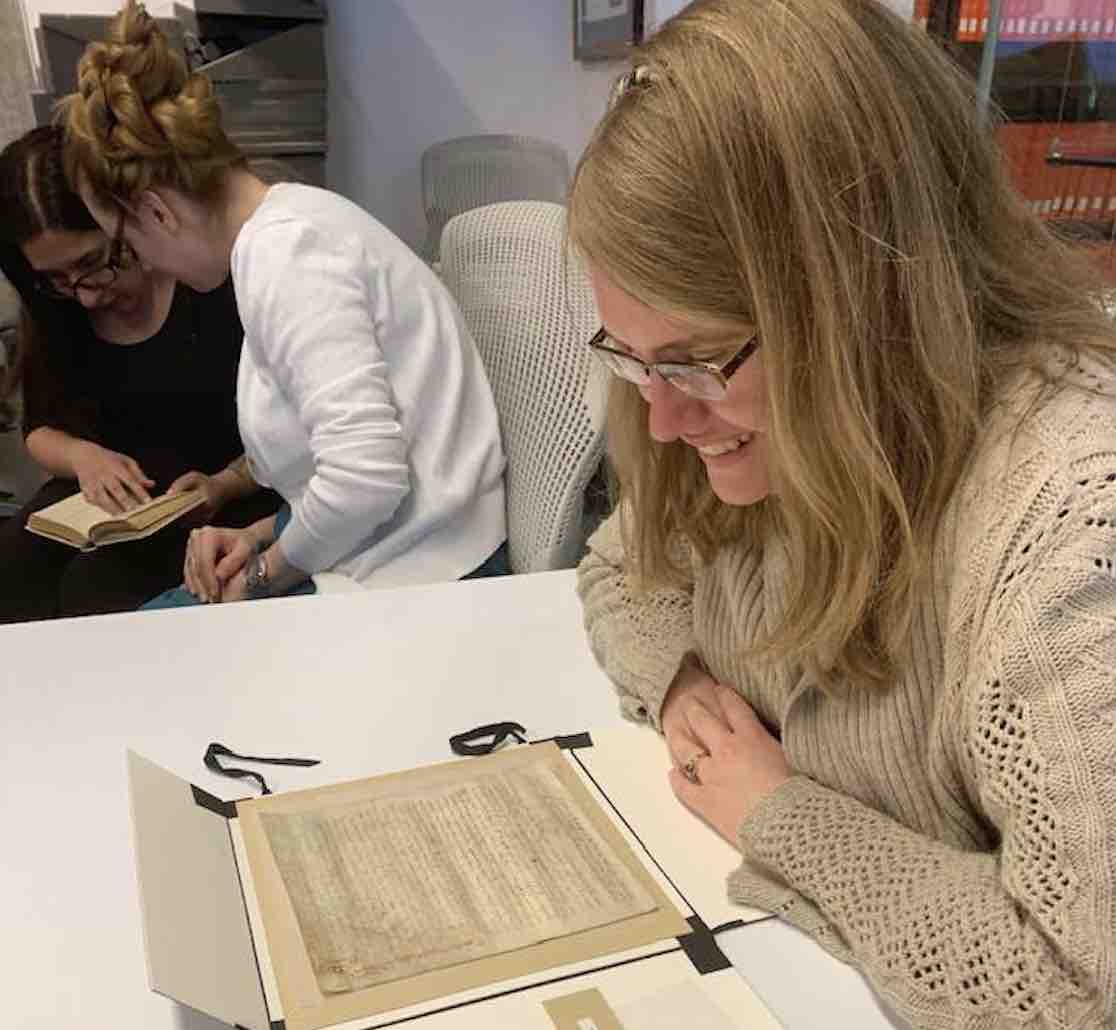
At the University of Minnesota, I also took paleography courses and joined reading groups, which improved my ability to read older scripts. My field of medieval German studies has a heavy emphasis on studying the transmission of texts, which is not my forte, but the repeated exposure later helped me navigate those questions when identifying texts in HMML’s microfilm collection. I applied some of these techniques to researching sections of my dissertation, which was a learning process in itself. Working on my dissertation also taught me how to find critical editions, which I now use to compare incipits of texts.
When I began working at HMML, I was amazed at how much I relied on my experiences at the MMRL and how working on my dissertation prepared me for what I do now.
Do you feel that your work at HMML has changed you? If so, how?
The process of earning a PhD means that you grow more and more specialized—in my case, medieval love songs and Arthurian romances. When I was first hired at HMML, I was a little daunted by the generalist knowledge required to catalog liturgical texts and compendiums of canon law that I had never encountered. But as I dove in, I leaned on skills that I developed while researching my dissertation: finding primary editions for comparing and identifying texts, and decoding highly technical and abbreviated descriptions in German. I realized I had more transferable skills than I had given myself credit for! Beyond expanding my knowledge base, working with a wide range of manuscripts has given me a better sense of what medieval and early modern intellectual and spiritual circles valued enough to copy down.
What excites you about your work?
My work entails converting detailed catalogs in German into a searchable overview in English for HMML Reading Room. Occasionally, I get to check that work against color facsimiles online. Seeing the handwriting and the wear and tear on the pages, I feel a stronger connection to the people who copied these books and to the people in subsequent generations who thought these books were worth passing down. In many ways, I see myself as belonging to this long tradition, carrying on the work that they started in preserving and sharing knowledge.
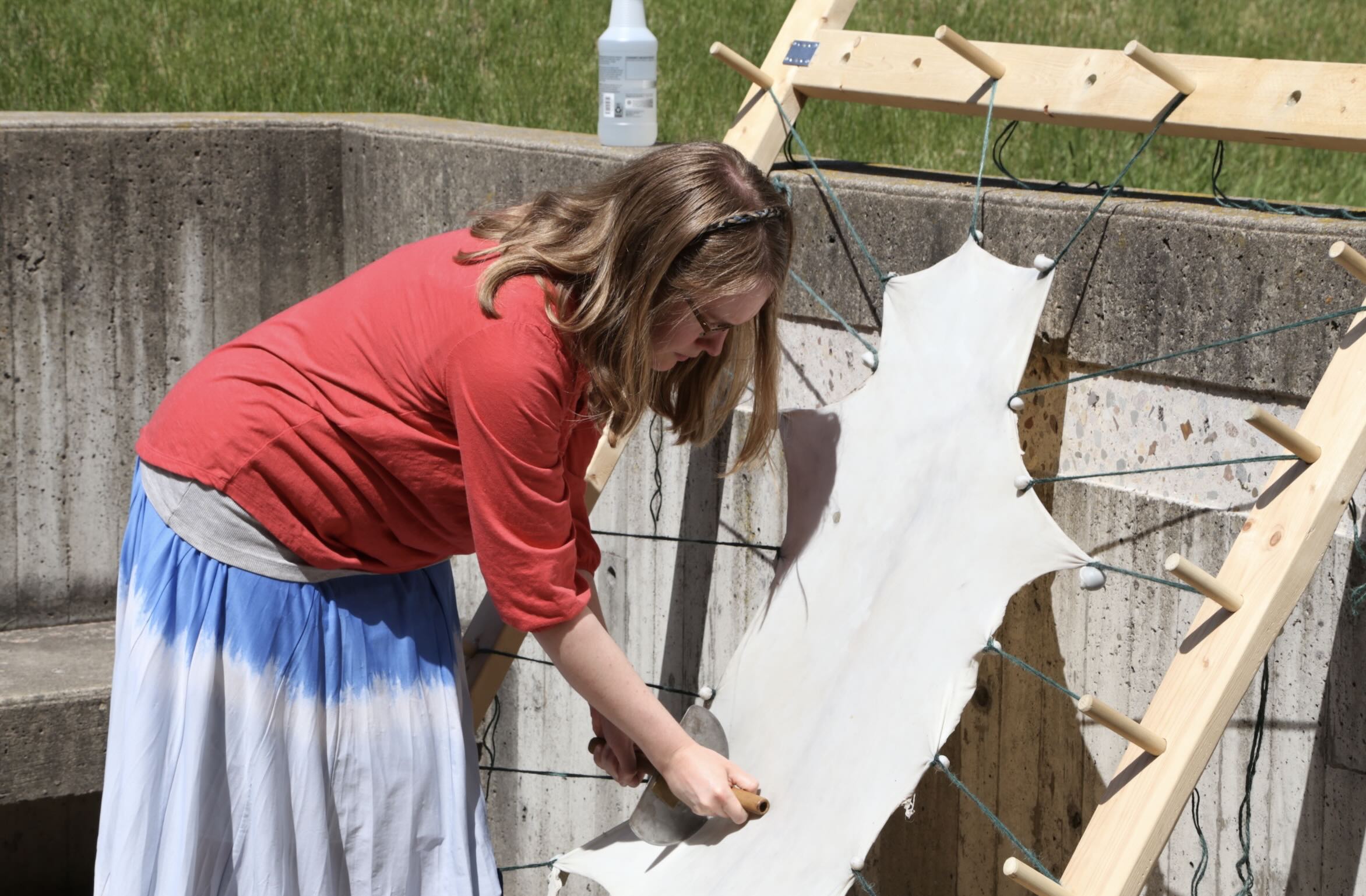
Because every manuscript was hand-copied, every manuscript is unique. That means that every day presents a new challenge, as I reconcile the information we have (in the manuscripts and in existing catalogs) with our standardized cataloging system. I often feel like a detective cracking a hard case when I need to track down the right author or text.
Tell us about a project you’ve worked on at HMML that you’re especially proud of, or that was meaningful to you.
It’s impossible to choose between cataloging the cartulary compiled by the scribe Anna Roede or cataloging the texts connected to Margarethe von Rodemachern and her mother Elisabeth of Lorraine.
In the case of Anna Roede, her cartulary came near the end of my cataloging the collection of manuscripts that HMML microfilmed at the Nordrhein-Westfälisches Staatsarchiv Münster in Germany. In the process of cataloging, I learned a lot about the history of the city of Münster—the many monasteries in the region that had extensive cartularies, the important nobles and bishops who ruled over the city, and the tumultuous years of the Anabaptist takeover of the city. All of these elements came together in Anna Roede’s life and work, which I wrote about for HMML’s series on women. It was a perfect snapshot of all I had learned from the collection, and it was a chance to share those findings with the greater HMML community. (See “Anna Roede and the Fight for Sovereignty”)
In the case of Margarethe and her mother, I cataloged Margarethe’s beautiful personal prayer book in the spring of 2024 and submitted a short biography of her for HMML’s metadata system. Because she had inherited part of her library from her mother Elisabeth of Lorraine, I also learned a little about Elisabeth. Almost exactly a year later, I cataloged an epic poem’s translation that was commissioned by Elisabeth and needed to submit her biography as well. I realized that now both mother and daughter were identified in HMML’s collection, as if I were facilitating a reunion of sorts.
The idea of authorship is a little tricky to define in the Middle Ages, and in trying to determine Elisabeth’s role in the translation, I started to notice a pattern in some of the dates. Ultimately, I figured out that Elisabeth, her mother, and her daughter all engaged with versions of this epic poem, right around the time each of their daughters were coming of age. You can read about it in “Postscript—A Legacy of Female Literacy.” I felt so much pride in finding this family connection and contributing some insight into why these women wanted this particular poem to be passed down to the next generation.
What documents/materials from our current moment in time would best tell our story in the future?
Our digital records will be useful to scholars only as long as these files remain accessible. If technology moves on past our current format, it could be our time period will be seen as a sort of “Digital Dark Ages,” where very few physical records—like diaries, letters, and account books—survive and a whole wealth of digital information is lost. The recently renewed interest in polaroid cameras, LP records, cassette tapes, and handwritten letters to pen pals may end up being invaluable to historians and archaeologists.
Of course, we can never predict the future completely: who knows what will be interesting in a hundred years? That’s why it is important that we preserve and catalog as much as we can, so that future scholars can find things we never thought to look for.