The Art Of Flowers In The Tale Of Genji
The Art of Flowers in the Tale of Genji
This story is part of an ongoing series of editorials in which HMML curators and catalogers examine how specific themes appear across HMML’s digital collections. From the Art & Photographs collection, Katherine Goertz has this story about Plants.
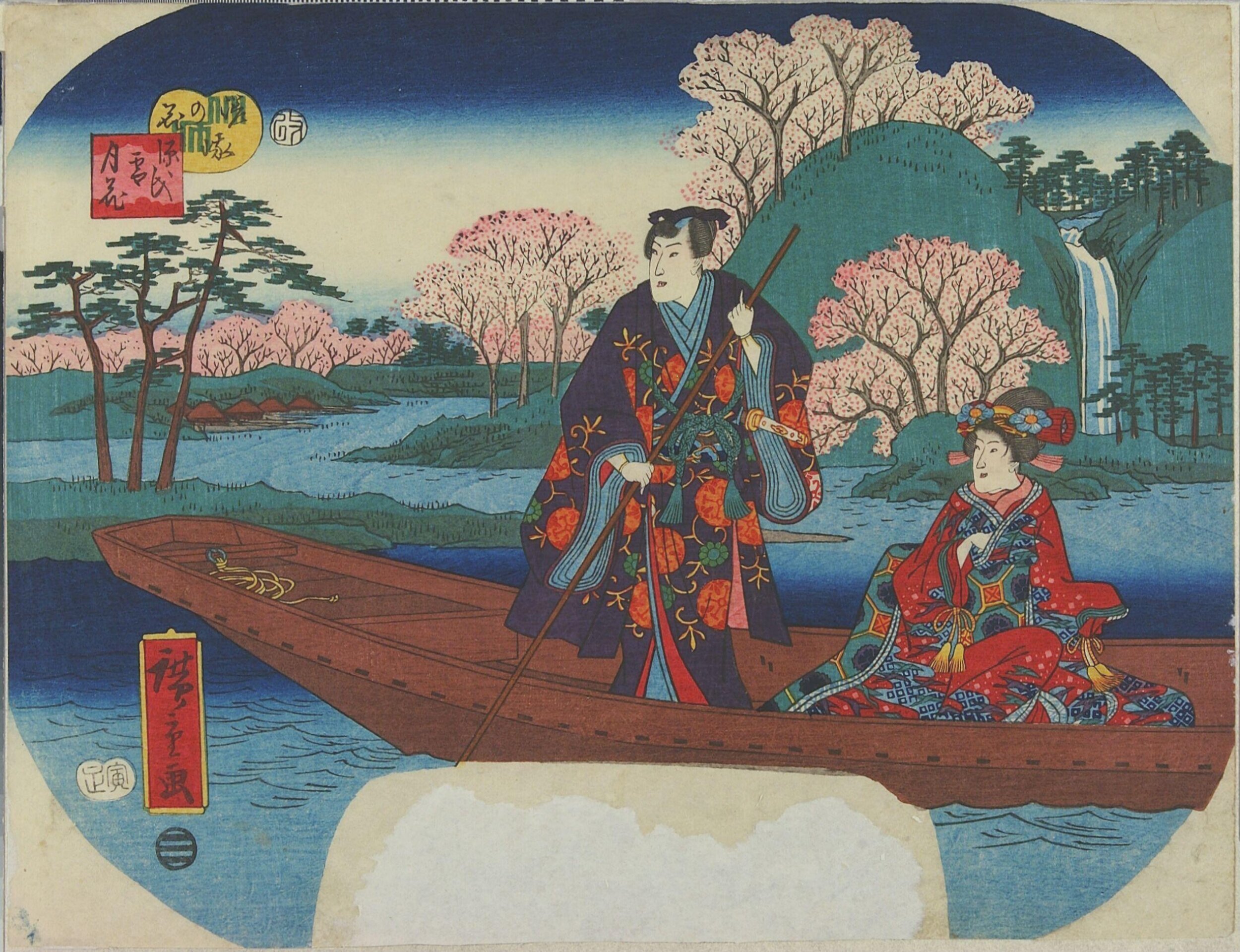
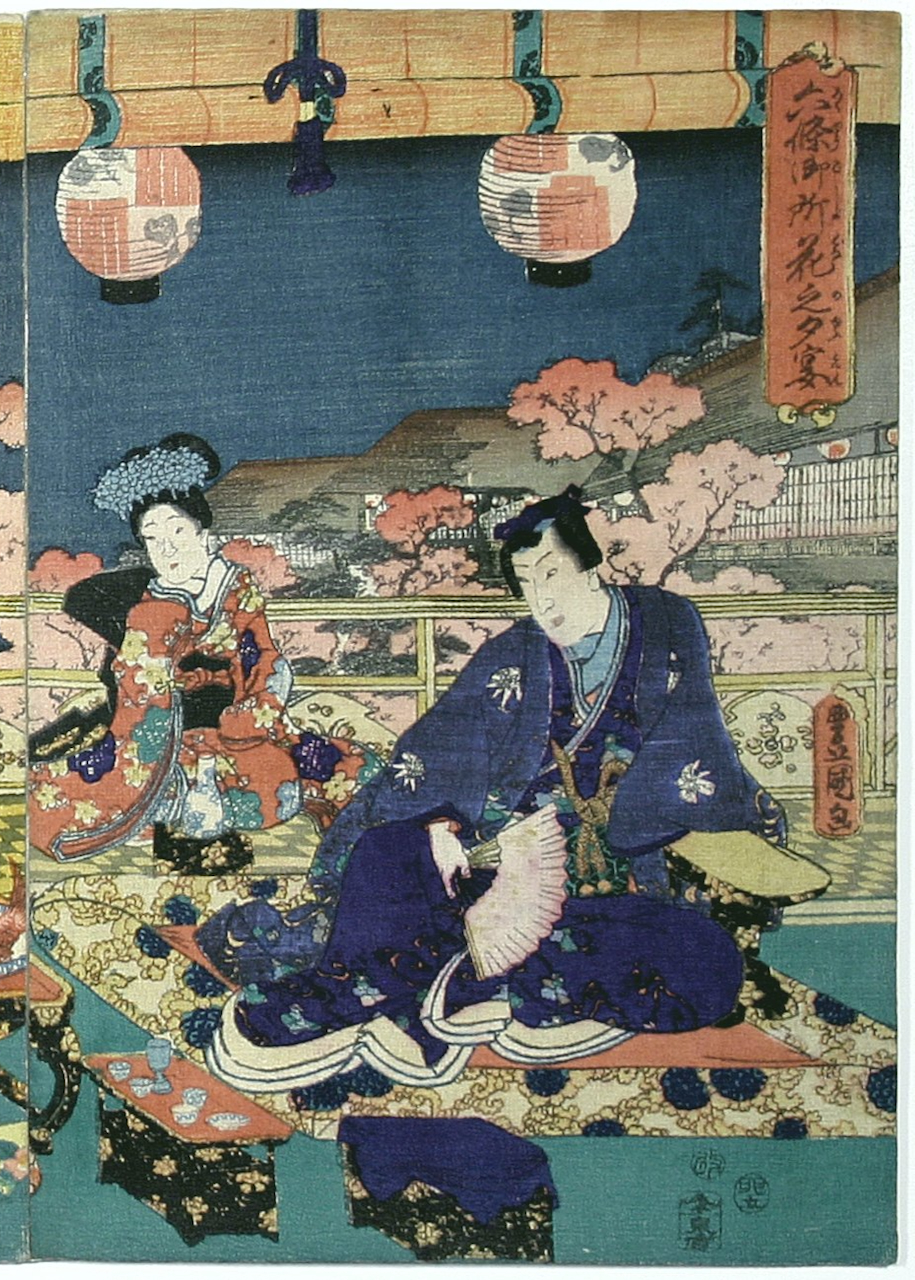
In the woodblock print Evening Banquet for Cherry-Blossom Viewing at the Rokujō Palace by Utagawa Kunisada, the Japanese literary hero Prince Genji smiles as two women play a game with battledores. Elsewhere in the scene, a woman plays a samisen while another watches. Through the open windows, cherry trees bloom in the cool blue light of evening.
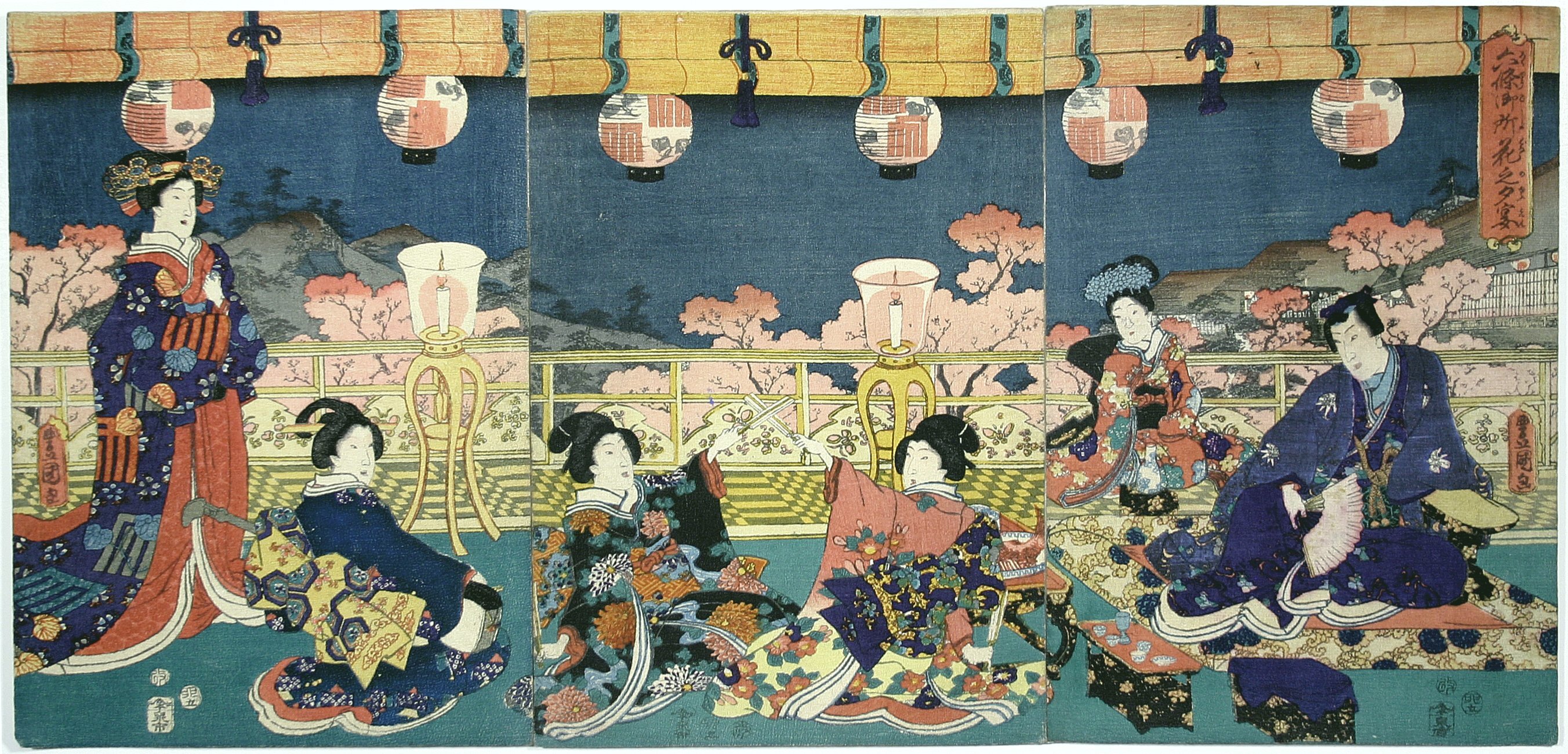
Like Prince Genji himself, the Rokujō Palace is fictional. Both originate from one of Japan’s most important cultural touchstones, Murasaki Shikibu’s 11th-century novel The Tale of Genji.
In the story, Rokujō Palace is an immense complex of palaces built as residences for four of Genji’s many romantic interests. Each palace has its own garden planted with flowers and trees associated with the four seasons: roses, oranges, and bamboo for the Summer Palace; maples for the Autumn Palace; and pines for the Winter Palace. The scene depicted in Evening Banquet takes place in the fourth residence, the Spring Palace. With its garden of peonies, plums, and cherries, this palace is home to Lady Murasaki, a woman for whom Genji pines for throughout much of the novel.
Flowers are central to the narrative of The Tale of Genji. Mentioned thousands of times across the novel’s 54 chapters, plants and blossoms serve as explicit literary symbols. Flowering orchards are the backdrop for emotional dramas, morning glories and moonflowers appear in scenes of love’s failure, and wisteria signifies the hopelessness of unattainable love.
Many of the characters—particularly Genji’s lovers and hoped-for-lovers—are identified by floral nicknames. These names function as metaphorical allusions, suggesting aspects of the women’s personalities, emotions, and roles within Genji’s journey through romance, courtly intrigue, and sexual conquest.
Artist Depictions
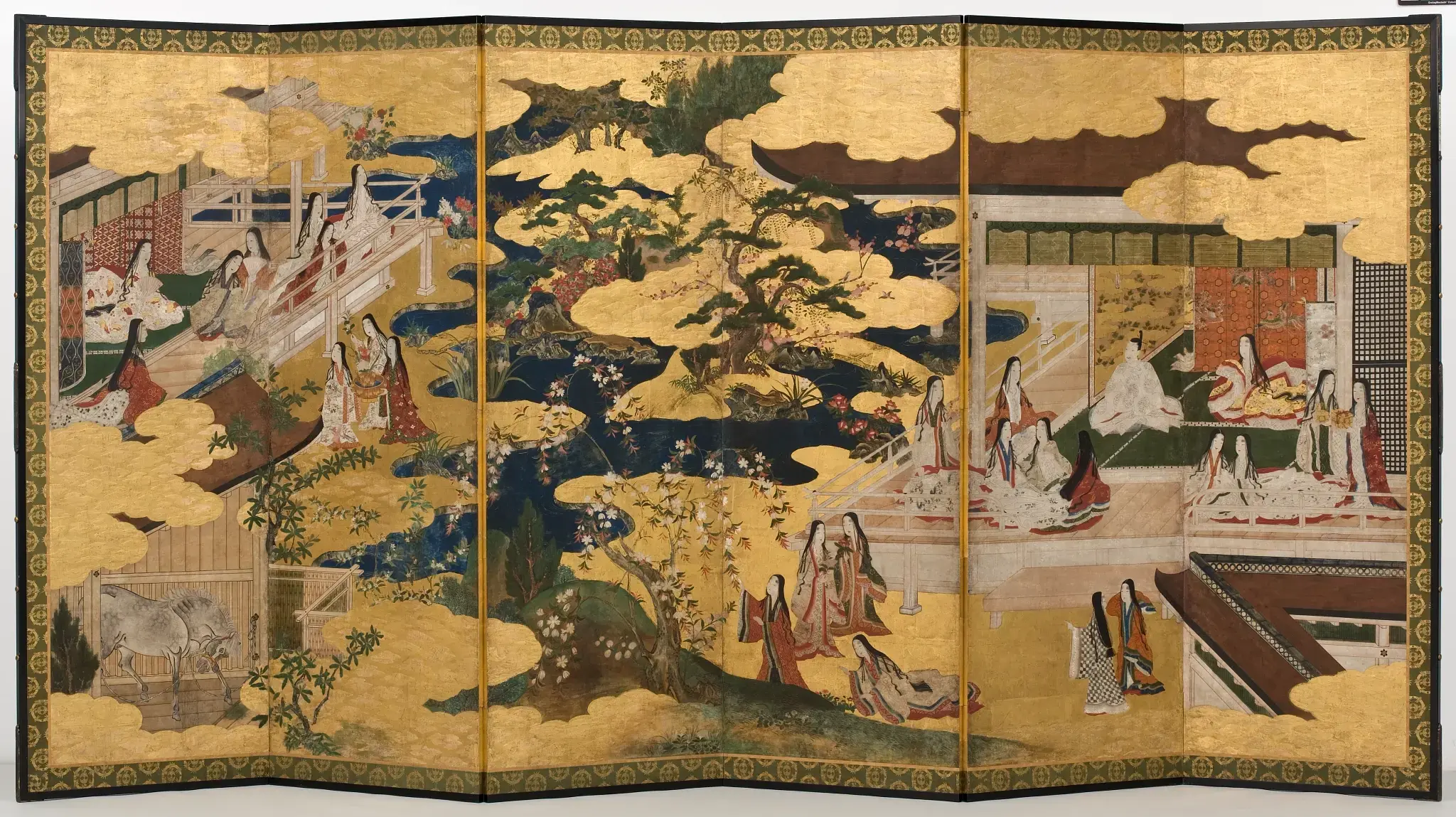
Shikibu’s novel has remained popular and influential in Japan for more than a thousand years, including in visual art. In the Edo period (1600–1868 CE), The Tale of Genji became even more prominent through the increased popularity of woodblock prints in Japanese visual culture. Artists like Utagawa Kunisada developed a genre of prints known as Genji-e, or “Genji pictures,” inspired by the novel. Since The Tale of Genji is filled with botanical imagery, so are the Genji-e.
Though the novel is set in the Heian period (794–1185 CE)—a period associated with an understated and subtle aesthetic—Genji-e prints typically transpose the story into the extravagant aesthetic world of the Edo period.
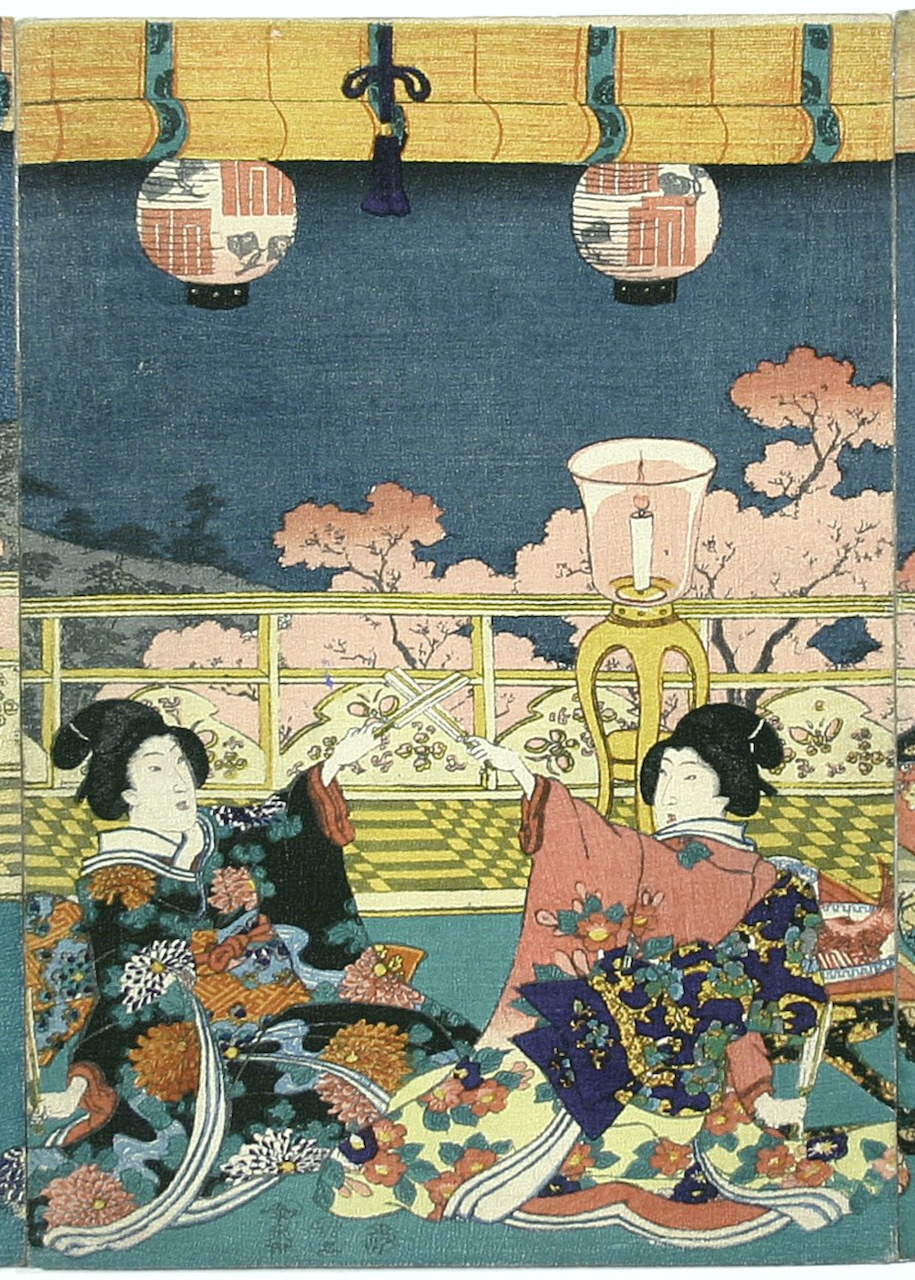
In Kunisada’s Evening Banquet, floral motifs appear throughout the environment of the print. Gold flowers decorate lacquer objects while carved butterflies and blossoms adorn the wooden railings. Dense patterns of chrysanthemums and summer blossoms cover the robes of the women engaged in the mock duel; these flowers suggest that the women are, respectively, Aki-konomu-chūgū (the lady of the Autumn Palace) and Hanachirusato (who resides in the Summer Palace). Nearby, the blue kimono worn by the samisen player suggests that she is Akashi no Kimi, the lady of the Winter Palace, who is often depicted in colors and motifs associated with the sea. Genji wears a robe decorated with paulownia, the flower associated not with a lover but with his mother.
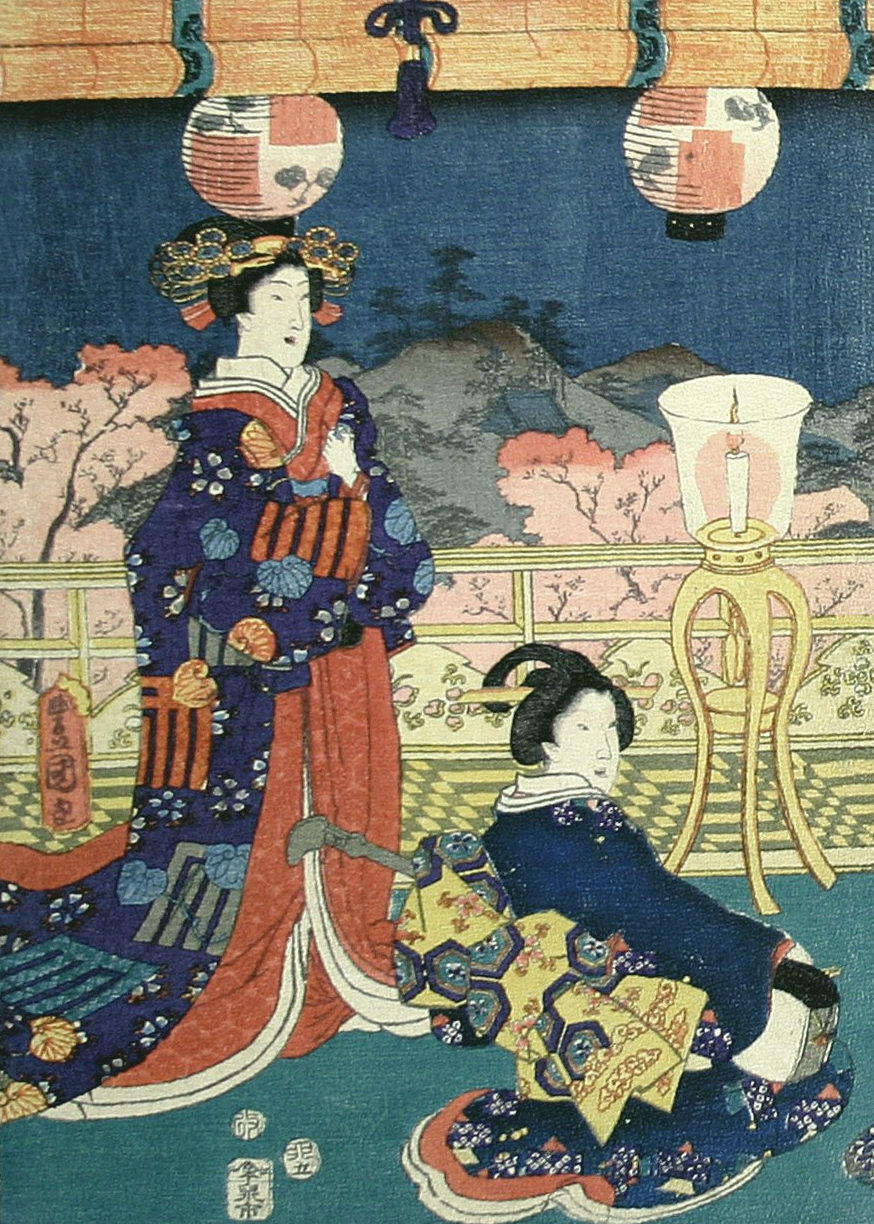
Lady Murasaki, the woman who lives among the cherry blossoms, stands to the far left. Her robe is decorated not with flowers but with the geometric motifs associated with Genji himself, emblems corresponding to the chapters of the novel.
Cherry Blossom Woman
Unlike many of the female characters in The Tale of Genji, Lady Murasaki of the Spring Palace is named not after a flower but after a color: purple. Purple is associated with wisteria (a fleeting flower of spring), and wisteria is the name given to another woman: Lady Fujitsubo, a pivotal character in the novel. Genji first sees Fujitsubo as a child, and he obsessively idealizes her as his perfect love throughout the decades. Their names emphasize that, for Genji, Murasaki (whose love he attains) is inextricably tied to Fujitsubo (whose love is unattainable).
Despite Lady Murasaki’s association with wisteria, the flower she is most closely linked with in the world of the novel is the cherry blossom. This flower appears everywhere she does. Like the cherry blossom, her beauty and grace is described by the author as near otherworldly, as something fragile and evanescent. Genji’s passion for Lady Murasaki is also depicted as otherworldly, as a particularly obsessive iteration of idealized courtly love. But, while Genji’s love for the lady survives most of the novel, in the end the beauty and life of Lady Murasaki, like the cherry blossom, does not last.
Cherry blossoms bloom brilliantly but briefly, falling within days of their emergence. In the Tale of Genji, this metaphor of fleeting beauty drives a narrative that embeds a sense of quiet and inevitable sadness among Genji’s biography of love and success.
Evening Banquet depicts the characters admiring cherry blossoms at the height of their beauty during a lively gathering. Guests laugh, drink (note the tiny sake cups near Genji) and play lighthearted games. Such hanami, or cherry-blossom viewing parties, appear frequently in the novel. Yet even these joyful moments carry an undercurrent of transience. In the text, signs that the petals will soon fall accompany scenes of celebration, reminding the reader that romance will eventually give way to loss.
Lady Murasaki is not the only character associated with cherry blossoms. Genji’s greatest happiness occurs during hanami and his romantic encounters blossom beneath the flowering trees. It is those cherry trees that he mourns in times of nostalgia and grief and, in the end, his death is described as the falling of the cherry blossom.
None of this wistful symbolism is overtly apparent in the woodblock print of Evening Banquet, but it would have been readily understood by Edo-period viewers. Evening Banquet captures Genji and Murasaki at a moment of happiness—one as beautiful and fleeting as the cherry blossoms themselves.