
Lost And Found In Translation
Lost and Found in Translation
The historical origins and ongoing study of translation
“When I had thus enquired into the origin of words, I resolved to show likewise my attention to things; to pierce deep into every science, . . . and exhibit every production of art or nature in an accurate description, that my book might be in place of all other dictionaries whether appellative or technical. But these were the dreams of a poet doomed at last to wake a lexicographer. I saw that one enquiry only gave occasion to another, that book referred to book, that to search was not always to find, and to find was not always to be informed.”
Samuel Johnson, “Preface,” A dictionary of the English language (1755)
At its core, language is communication between people. But like people, language is complex, carrying with it cultural perspectives, emotional subtexts, and implicit assumptions. Johnson had difficulty creating a comprehensive dictionary of a single language, but translators navigate multiple languages with different underlying cultural contexts or even different concepts of language itself. Translators may try to capture the hidden valences of words, only to find that new meanings are created at the expense of the intended ones.
And yet, translation also allows for discovery: it is a meeting point of minds across space, time, and cultures. Translation reveals surprising commonalities and beautiful differences. It reorients and contextualizes our own perspectives and realities, affirming and challenging our assumptions about the world and about ourselves.
This exhibition is a tribute to translation, examining its historical origins and its ongoing study. HMML’s catalogers and curators continue to grapple with the challenges of translation while making our microfilm and digital collections accessible. Many objects in this exhibition have been selected to represent the multilingual work of HMML’s catalogers, curators, and staff over the past 60 years. The many featured languages, scripts, and faith traditions reflect HMML’s intercultural vision.
The Rosetta Stone is a famous and dramatic example of a multilingual text allowing scholars to read a once-forgotten language. But multilingual texts continue to shape our understanding of words and their meanings. In this exhibition, we invite you not only to read about each object but to read the object itself. To this end, we have chosen passages that may be familiar to you or accompanied by a language you may know—hopefully inspiring “Rosetta Stone” moments of your own. We also invite you to contemplate these questions:
- How might translation impact religious, cultural, and political identities?
- Should a translator prioritize an exact word-for-word translation from the original text, or a paraphrased translation that reads more easily in the new language?
- How do the objects in the exhibit “talk” to each other?
The History of Dictionaries: A Case Study
Dictionaries may come in different sizes, depending on their intended use. Pocket-size dictionaries are perfect for travel, while large dictionaries are read at a desk or table alongside the original work. Specialized dictionaries may be for a specific purpose, such as the study of religion.
Mĕnaḥem ben Saruq composed the earliest known Hebrew dictionary in Spain in the middle of the 10th century. In subsequent centuries, Jewish scholars would build off each other’s work or fill in missing gaps. Around the same time, multilingual dictionaries also started appearing, allowing translation between Hebrew and Arabic, Aramaic, and eventually Latin.
Despite antisemitism’s deep roots in Europe, the study of Biblical Hebrew was considered the most prestigious language to learn at university, particularly beginning in the 16th century with the rise of Humanism. This led to an increase in bilingual dictionaries to aid in the reading of Hebrew, laying the foundation for modern dictionaries.
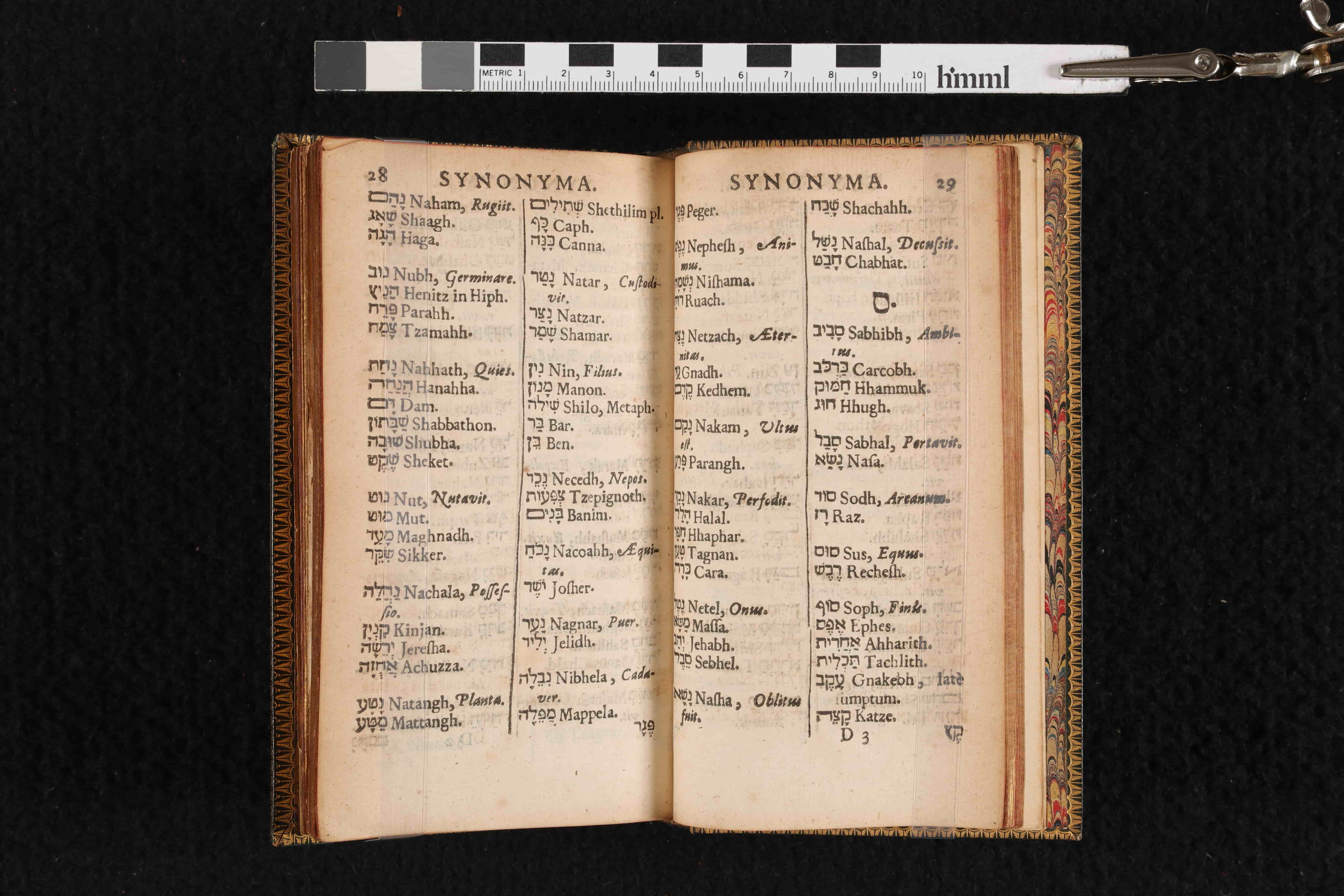
Christian Ravis. A generall grammer for the ready attaining of the Ebrew, Samaritan, Calde, Syriac, Arabic, and the Ethiopic languages.
London: W. Wilson, 1650.
This Hebrew grammar was published in 1650 and compiled by Christian Ravis (1613-1677). Ravis was an orientalist and theologian from Berlin, Germany. His book asserted that Hebrew, Samaritan, Chaldean (Calde), Syriac, Arabic, and Ethiopic were all the same language, something we know to be false today. Ravis was viewed as an authority on Semitic languages during his lifetime, and, despite his far-fetched claims, he is seen as an important figure in early modern scholarship.
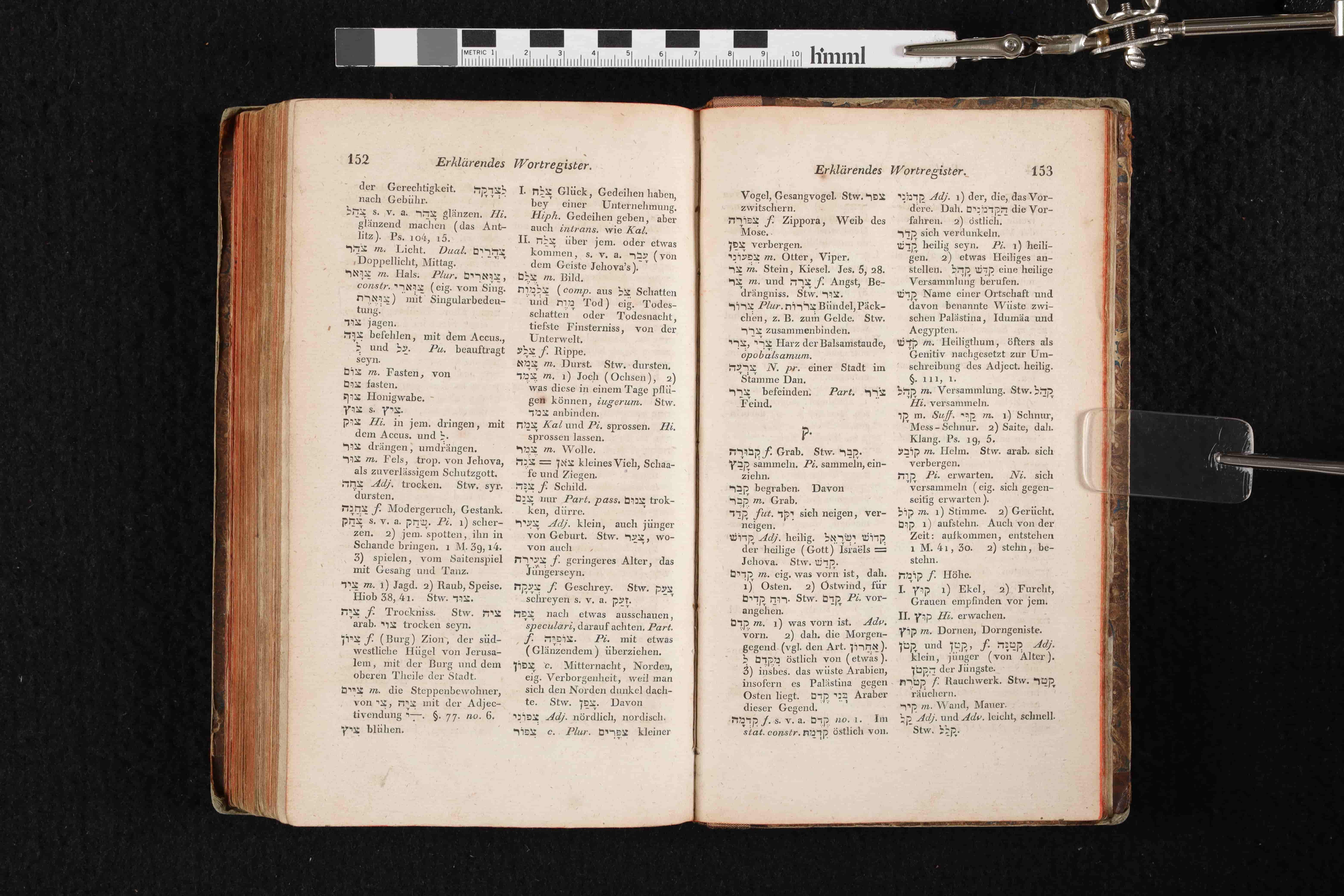
Wilhelm Gesenius, Hebräische Grammatik.
Halle: Regerschen Verlags-Buchhandlung, 1828.
Wilhelm Gesenius (1786-1842) was a prominent scholar and professor of Biblical studies and a pioneer of Hebrew lexicography and grammar. In 1806, he began compiling his first Hebrew lexicon in German, Hebräische Grammatik, which first went to print in 1813. It focused entirely on Biblical Hebrew. By 1828, when this edition was printed, Gesenius had revised his work nine times.
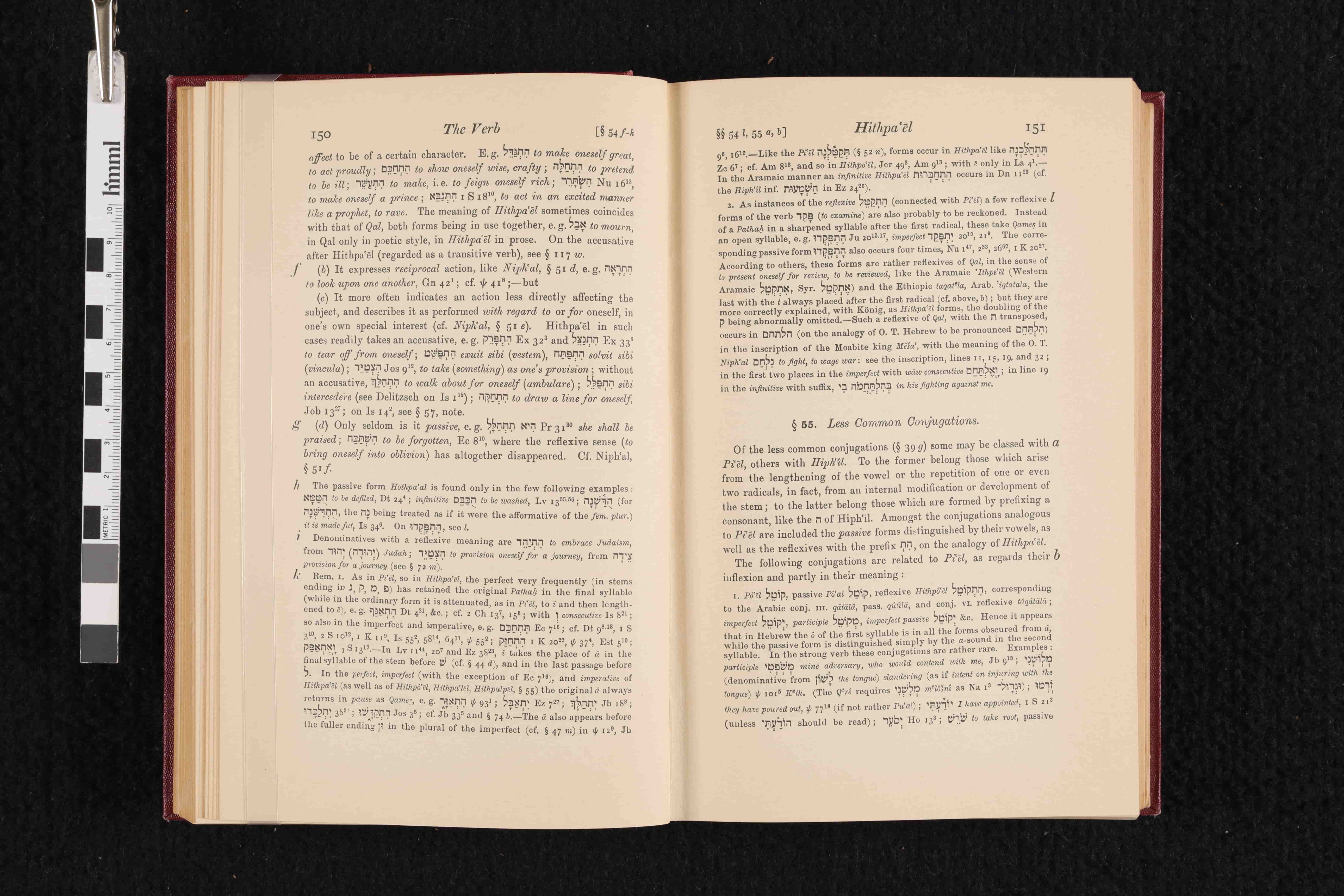
Gesenius' Hebrew grammar.
Oxford: Clarendon Press, 1910.
The influence of Wilhelm Gesenius’ Hebräische Grammatik was widespread and led to the Grammatik’s translation into English. Oxford University Press published the second English translation of the 28th German edition of Gesenius’ Hebräische Grammatik in 1910. Gesenius’ grammar continues to be used today in Hebrew classes and by scholars around the world.
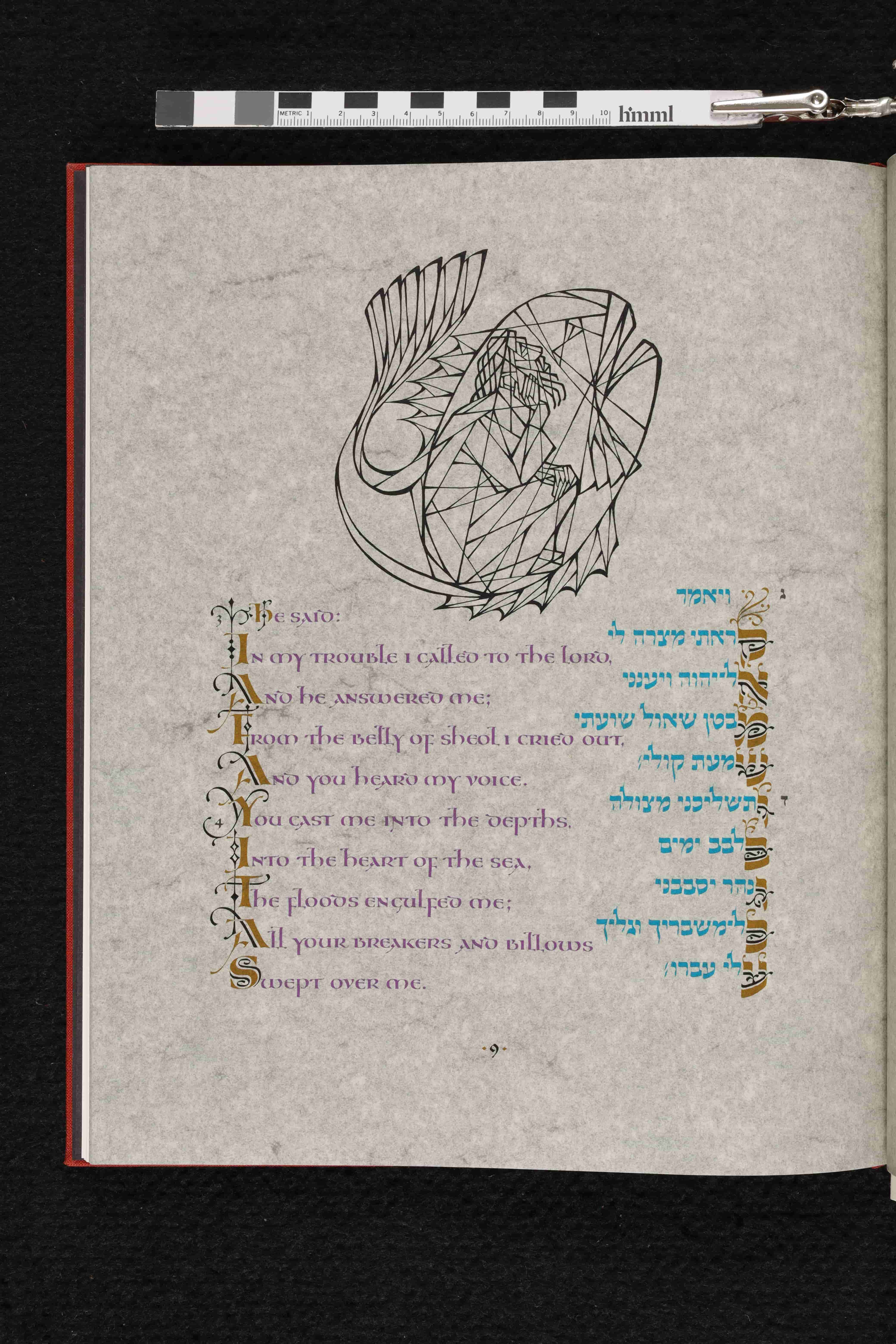
Ismar David, The Book of Jonah.
Southbury, Conn.: Chiswick Book Shop, 1991.
Ismar David (1910-1996) was an artist best known for his calligraphy. Born in Germany into a Jewish family, David moved to Jerusalem in Palestine in 1932, where he spent the duration of World War II. This piece comes from David’s 1991 portfolio, The Book of Jonah. It shows a delicate illustration of Jonah inside the great fish. Below this illustration is a quote from Jonah 2:2-3 in calligraphy and accompanied with the Hebrew text. The Hebrew calligraphy closely resembles David’s created typeface, David Hebrew, which he published in 1954.
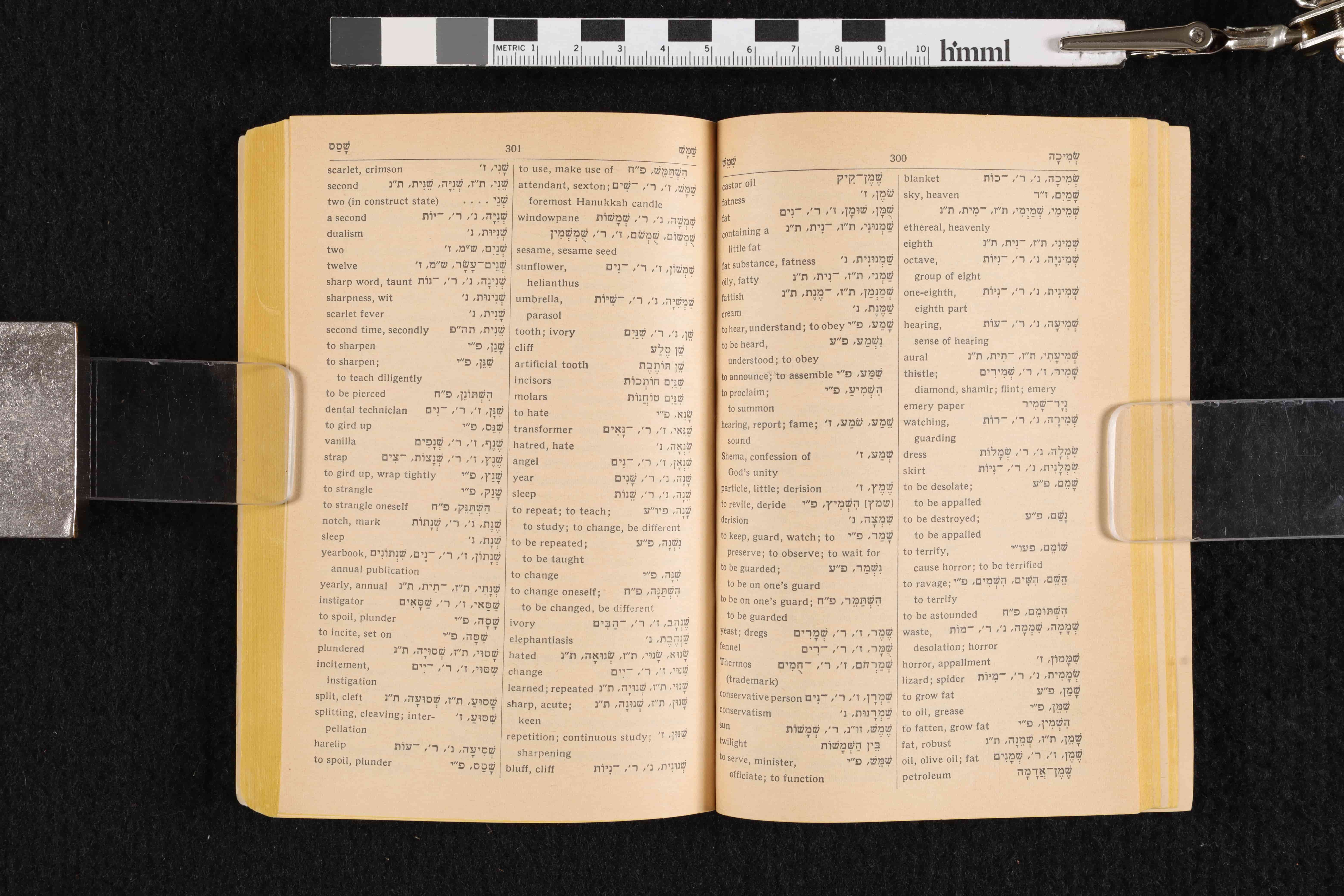
Ben-Yehuda's Pocket English-Hebrew Dictionary.
New York: Washington Square Press, 1964.
This pocket dictionary is based on the Ben-Yehuda Dictionary, the first modern Hebrew dictionary, originally comprised of seventeen volumes.
Eliezer Ben-Yehuda (1858-1922) is most known for his role in the revival of the Hebrew language as not just a sacred language but one spoken and used in daily life. At the time, standard dictionaries arranged Hebrew words by the root, but Ben-Yehuda arranged words alphabetically in his dictionary. Through his work, Hebrew was modernized.
Bridge Languages
Many languages represented in HMML’s microfilm and digital collections are considered bridge languages. A bridge language, also commonly known as a lingua franca, allows people in groups with different mother tongues to more easily communicate with one another, whether to meet economic, religious, political, or academic needs. In this way, a bridge language is a form of everyday translation, operating as a second or third language for its speakers.
Some of the historic bridge languages in HMML’s collections include Arabic, Church Slavonic, Fulfulde, Ge’ez, Greek, Latin, Low German, Polish, Sanskrit, and Songhai.
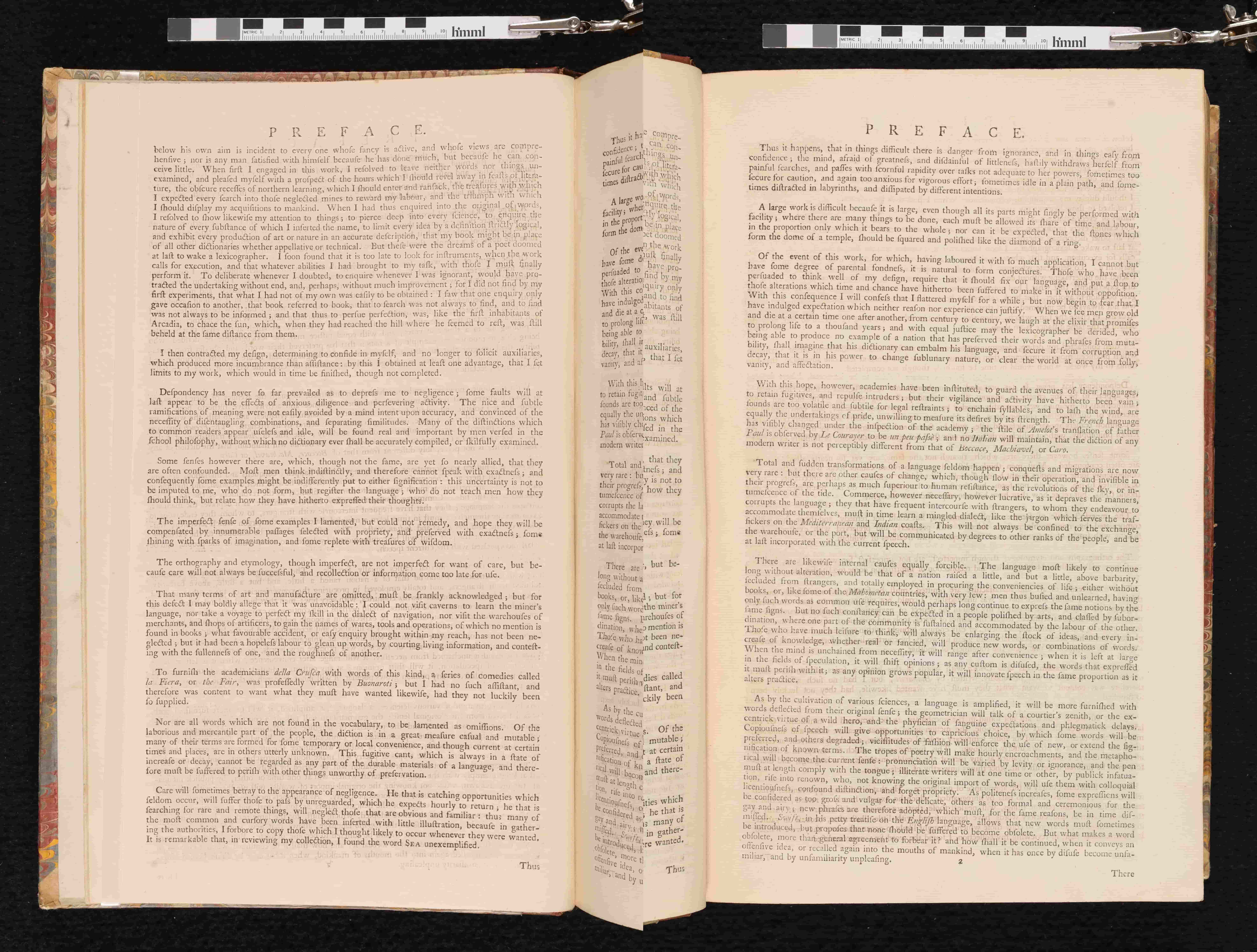
Samuel Johnson, A dictionary of the English language.
London: Printed by W. Strahan, 1755.
It took Samuel Johnson over seven years to single-handedly complete A dictionary of the English language. Upon its completion, it was received enthusiastically by the public and remained the standard until Noah Webster published his own dictionary in 1828. In fact, his dictionary even led to Johnson receiving a yearly state pension from King George III in 1762.
At the time of the dictionary’s publication, printing had been made more accessible and affordable for the middle and lower classes. This meant that Johnson’s Dictionary found itself inside homes across Britain, America, and Europe.
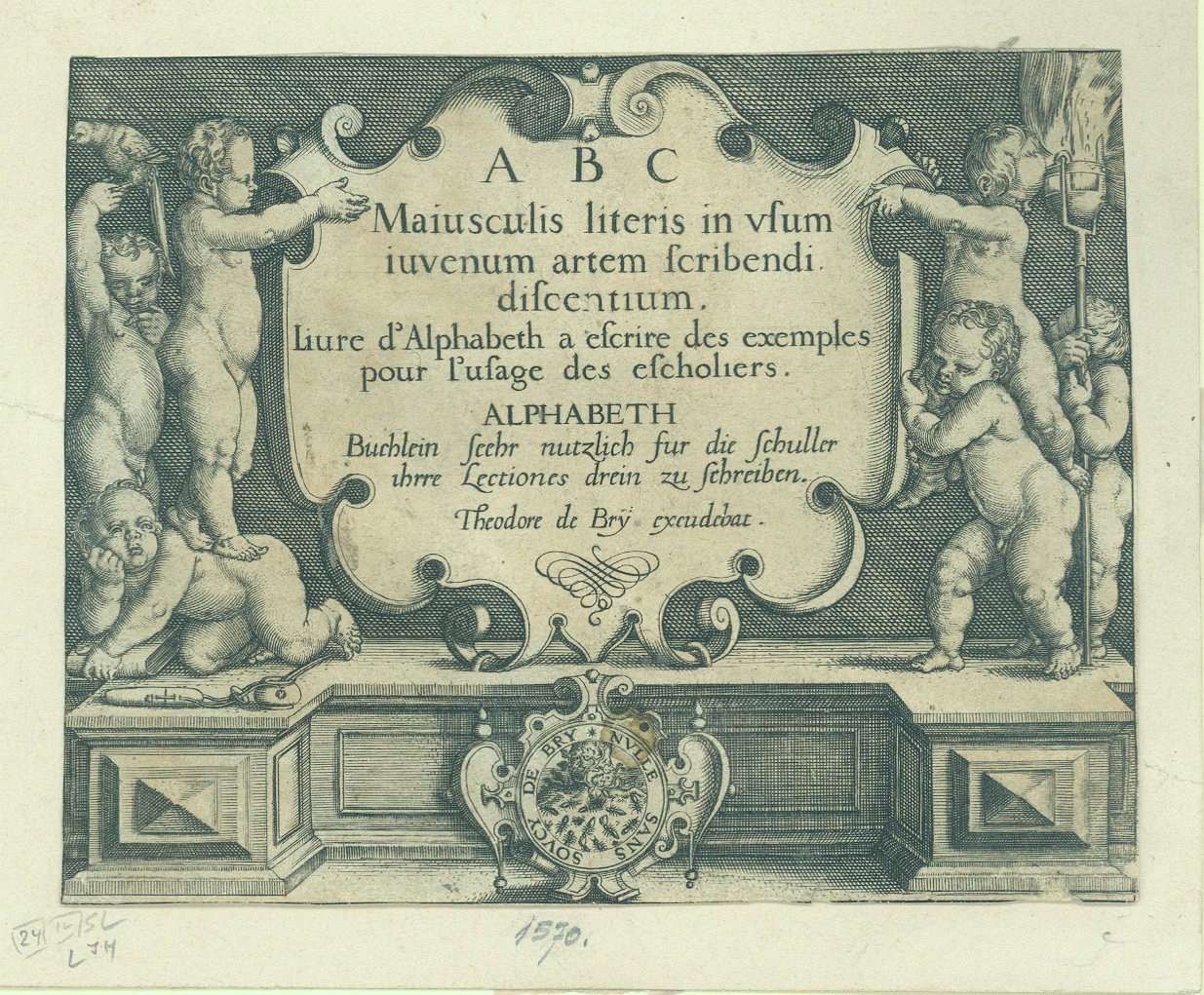
Theodor de Bry, Title page for ABC Maiusculis literis in usum juvenum.
1570.
This is a title page from an alphabet book published in 1570 that was used by schoolchildren to learn their letters. The center of the image shows the title of the book, ABC Maiusculis literis in usum iuvenum artem scribendi discentium (Latin for: “ABC In capital letters useful for youths learning the art of writing”), in three languages, each with a different typeface.
Theodor de Bry, whose name is featured below the translated titles, was a Dutch engraver from the 16th century. The majority of his works focused on landscapes and the recollections and observations from explorers of the Americas.
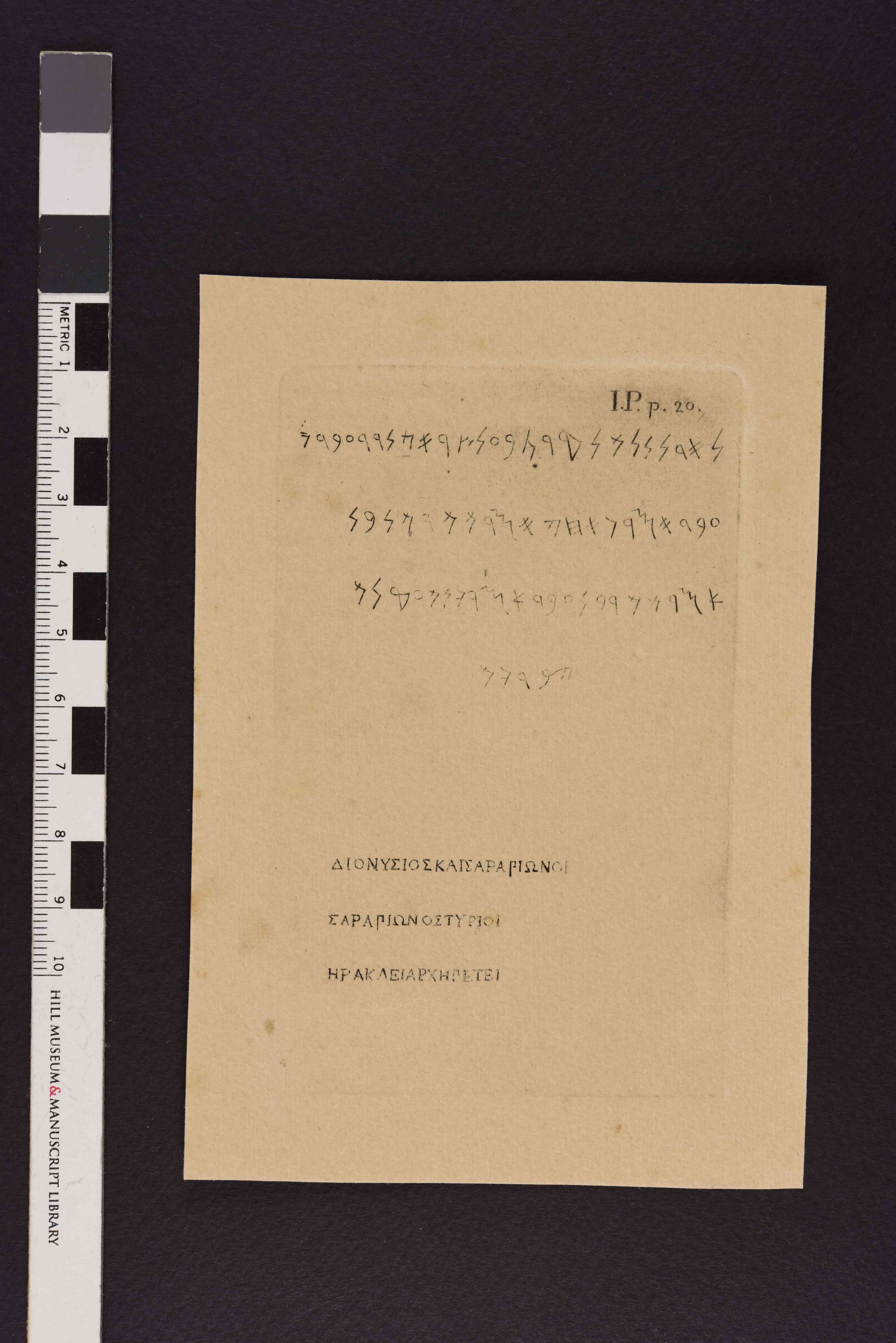
Phoenician inscription of Cippus of Melqart.
1791.
This inscription was copied from marble cippi (pedestals) found in Malta in the 17th century and dated to the 2nd century BCE. The inscriptions are done in both ancient Greek and Phoenician. The cippi offered one of the first bilingual inscriptions found in Malta and were important in the decipherment of the Phoenician language.
The Phoenician inscription (top) reads: “To our lord Melqart, Lord of Tyre, dedicated by Your servant Abd’ Osir and his brother ‘Osirshamar Both sons of ‘Osirshamar, son of Abd’ Osir, for he heard Their voice, may he bless them.” The Greek (bottom) reads, “Dionysios and Sarapion, the sons of Sarapion, Tyrians, to Heracles the founder.”
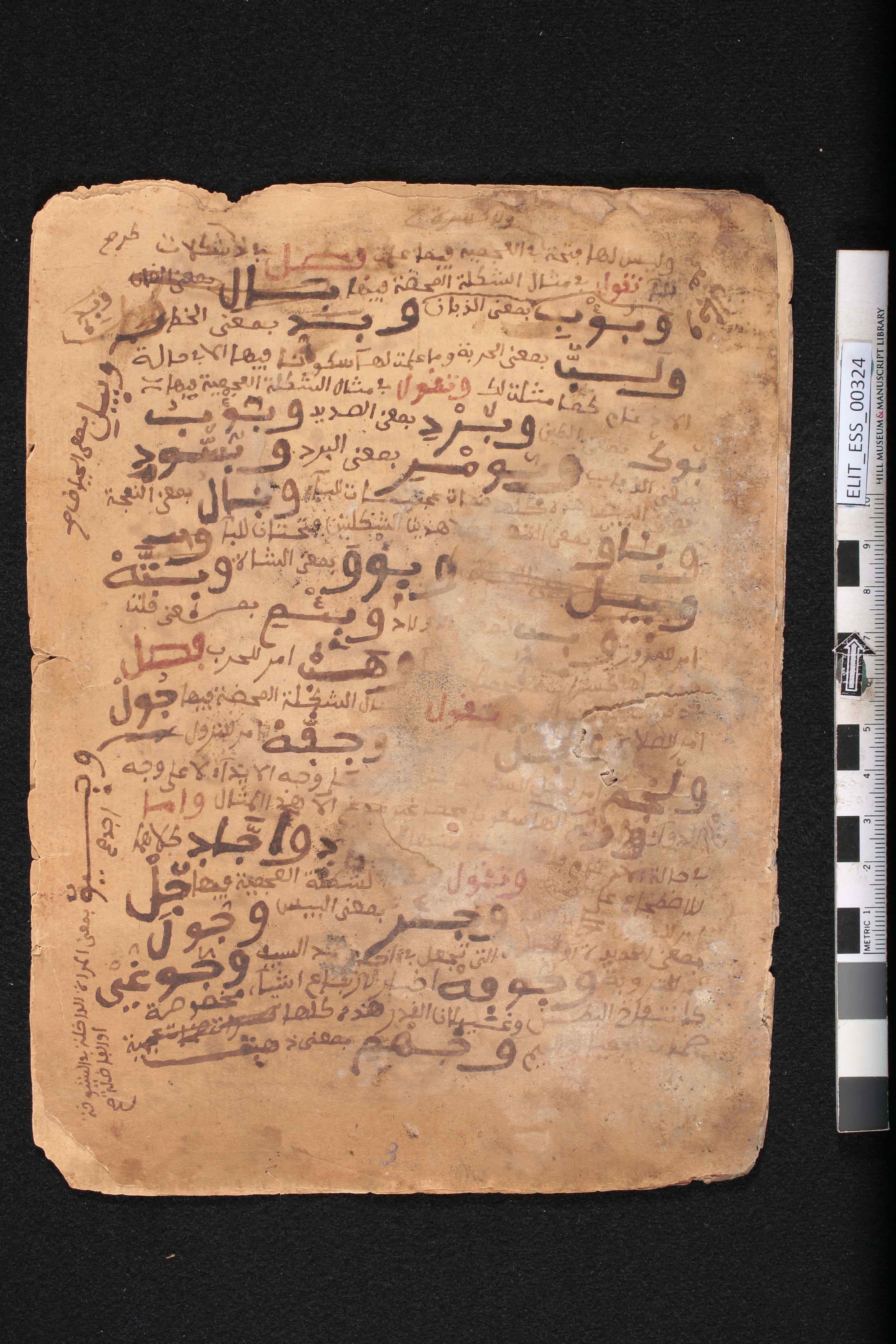
Aḥmad ibn al-Qāḍī Abī Bakr al-Fūtī, Arabic Guide to translating the Fulfulde language.
1829.
This 19th century manuscript offers a guide in Arabic to translating the Fulfulde language. Fulfulde is a major West African language spoken across the Sahel region by the Fulani people, who were early converts to Islam. Fulfulde has been written with Arabic script since the 17th century. This practice is known as ʻajamī.
Nothing is known of the author, Aḥmad ibn al-Qāḍī Abī Bakr al-Fūtī. His work methodically moves through different consonant and vowel combinations following the letters of the alphabet, providing a Fulfulde example with its Arabic translation. He describes it as an abridgement of two larger works on the same theme.
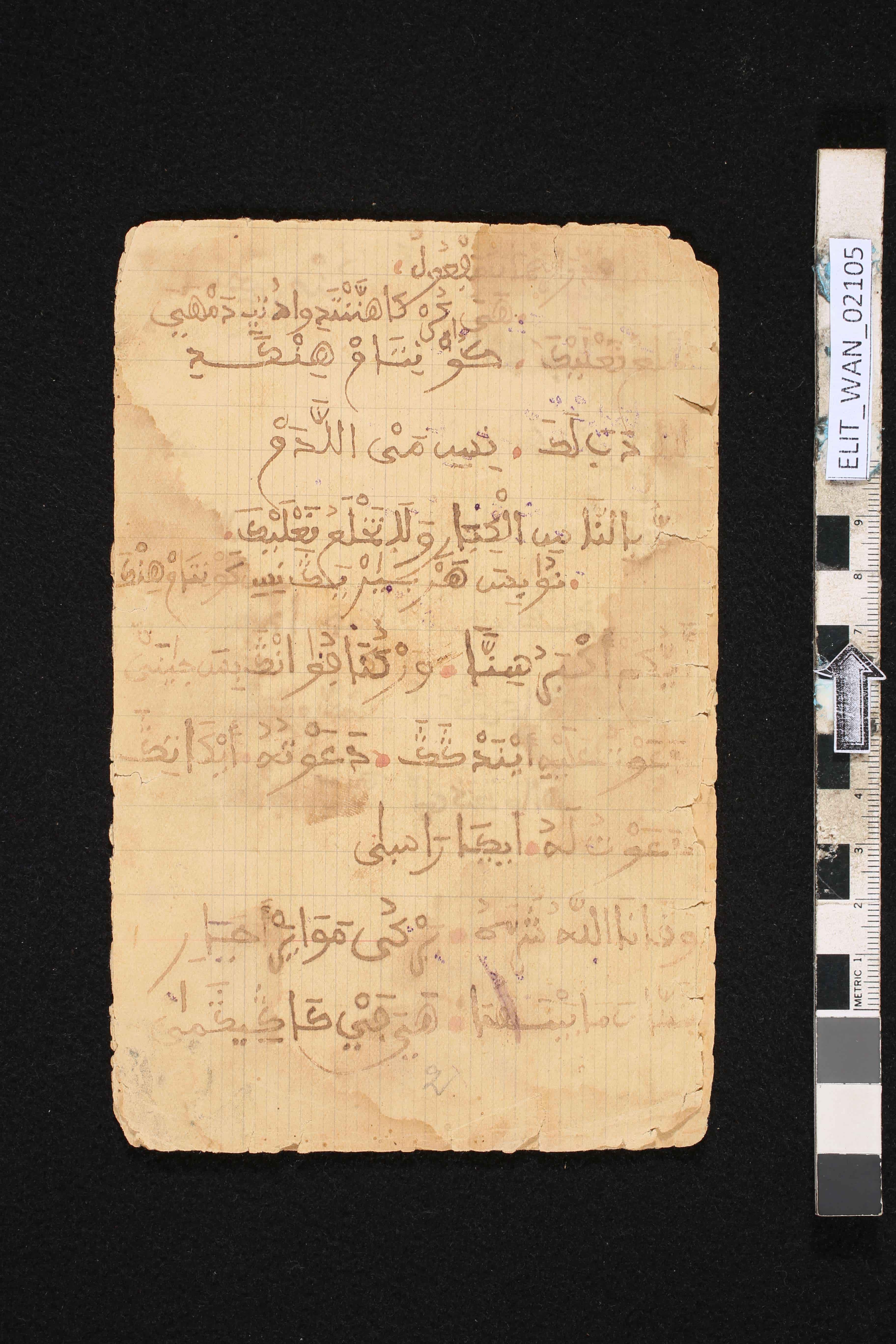
A conversation rendered in Arabic and Songhai for the purposes of language acquisition.
20th century.
This manuscript, written on paper, describes a fictional conversation in both Arabic and Songhai ʻajamī (Songhai in Arabic script). Songhai is a language family from West Africa, concentrated around the middle of the Niger River area.
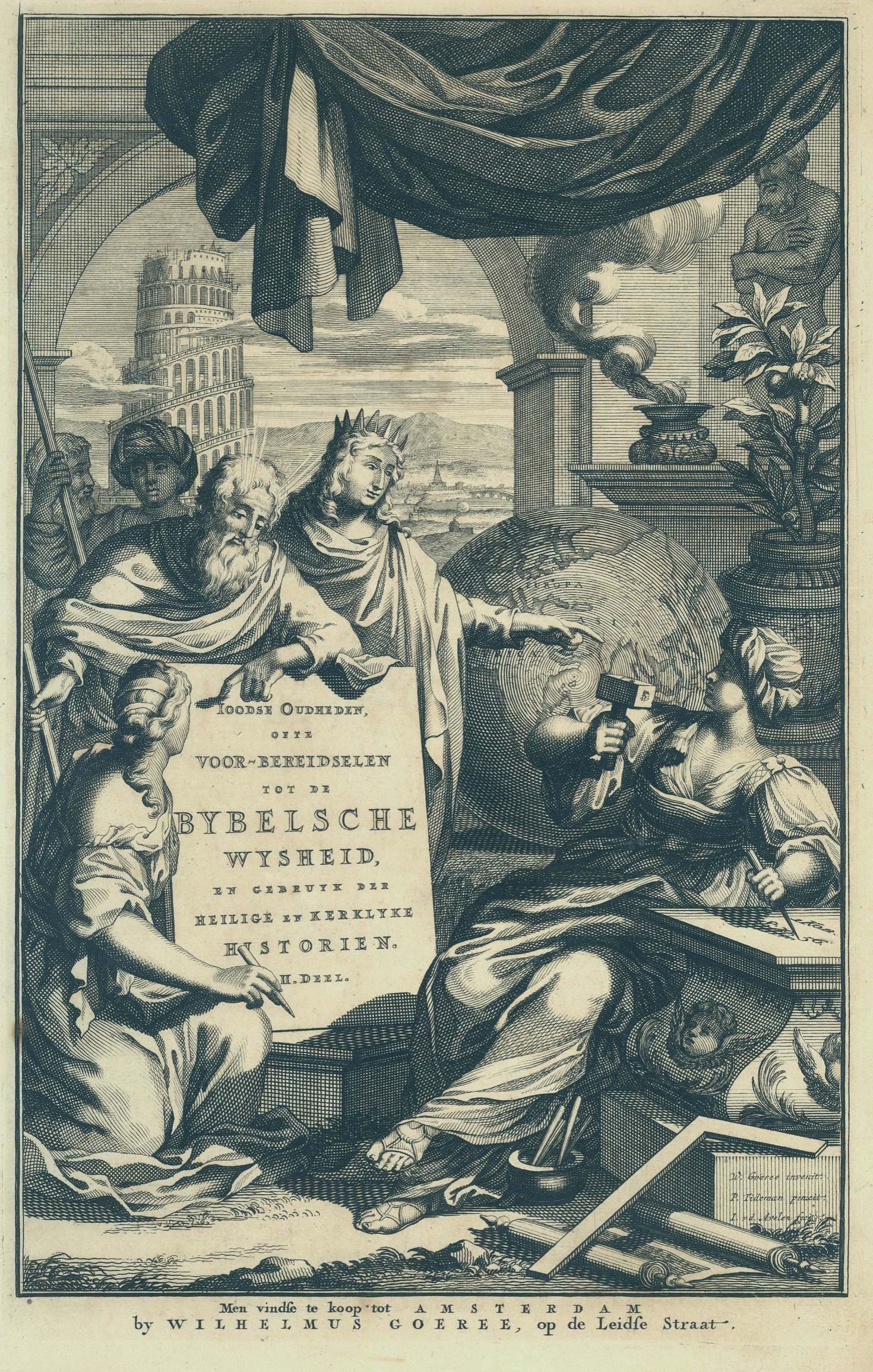
Johannes van den Aveele, Joodse Oudheden, ofte Voor-Bereidselen to de Bybelsche Wysheid.
1690.
This engraving served as the title page for Willem Goeree’s 1690 book on biblical and Jewish history. Written in Dutch, it was published only a few decades after the first authorized full Dutch translation of the Greek New Testament and Hebrew Bible. Other full translations existed, but none drew from the original sources.
Created by Johannes van den Aveele and Philipp Tidemann, both Dutch artists, it is rich with biblical references: Moses and David both stand behind the tablet engraved with the book’s title, while the Tower of Babel, the biblical origin of all the world’s languages, stands tall in the background.
Translation in the Christian Tradition
For practitioners of Christianity, having access to the Holy Scriptures is important, which has led to translation being prioritized. The 2nd century saw the translation of the New Testament into Coptic, and the 5th century, Syriac. Jerome famously translated the Old and New Testament into Latin, which became the standard text in Western Europe until Erasmus made the Greek more readily available through the printing press in 1516.
Gothic was the first Germanic language to be used for a Bible translation and is attributed to the missionary Ulfila. This 4th-century translation is one of the only surviving examples of the language, which has long since died out. This story is not unique to Gothic: many other languages (or their earlier forms) may have the Bible as their only substantial written record.
Translators of the Christian Scriptures often face the challenge of not only transferring meanings across languages, but also creating a written form of the language, since the language might otherwise be entirely oral. In the case of Gothic, Ulfila opted for a Roman alphabet, while Cyrillic is based on Greek uncial.
Translators of the Christian Bible often prioritize the translation of the Gospels, relating the central story of Christ’s ministry on Earth. From there, translators may turn to the Psalms for use in liturgy or Paul’s epistles for the development of church communities, before translating the rest of the Bible. As a result, scholars studying a now-dead language might only have the Gospels or Psalms available. The Gothic Bible may have never been fully completed–a large part of the New Testament and only a fraction of the Old Testament survive today.
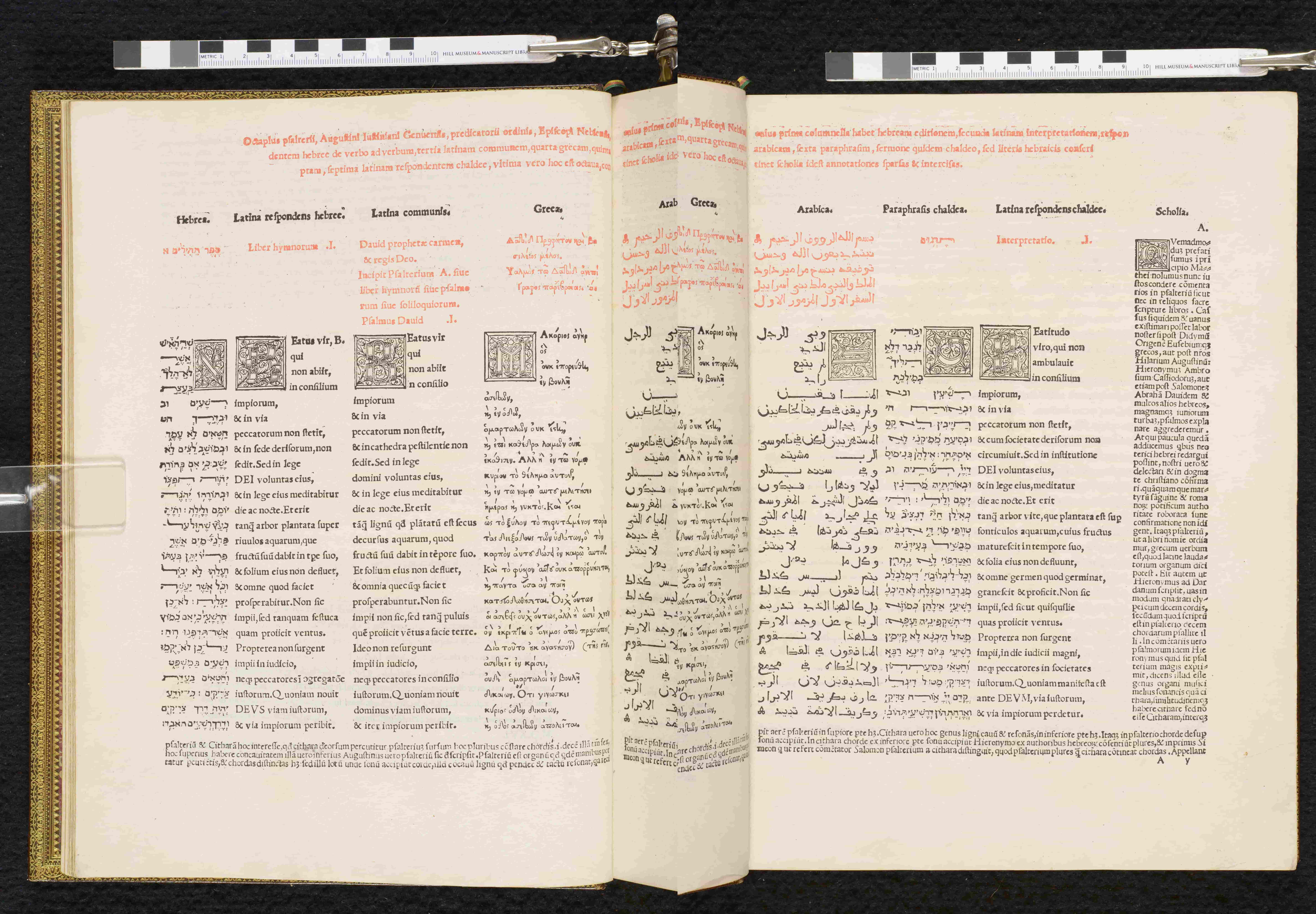
Agostino Giustiniani. Psalterium Hebraeum, Graecum, Arabicum, et Chaldaicum (Genoa Psalter).
Genoa: Petrus Paulus Porrus, 1516.
The Genoa Psalter was the first printed polyglot psalter, published in 1516 in Genoa. The psalms are printed, side-by-side, in Arabic, Aramaic, Greek, Hebrew, and Latin. Both the Hebrew and Aramaic psalms have corresponding Latin translations, which differ slightly from the Latin Vulgate.
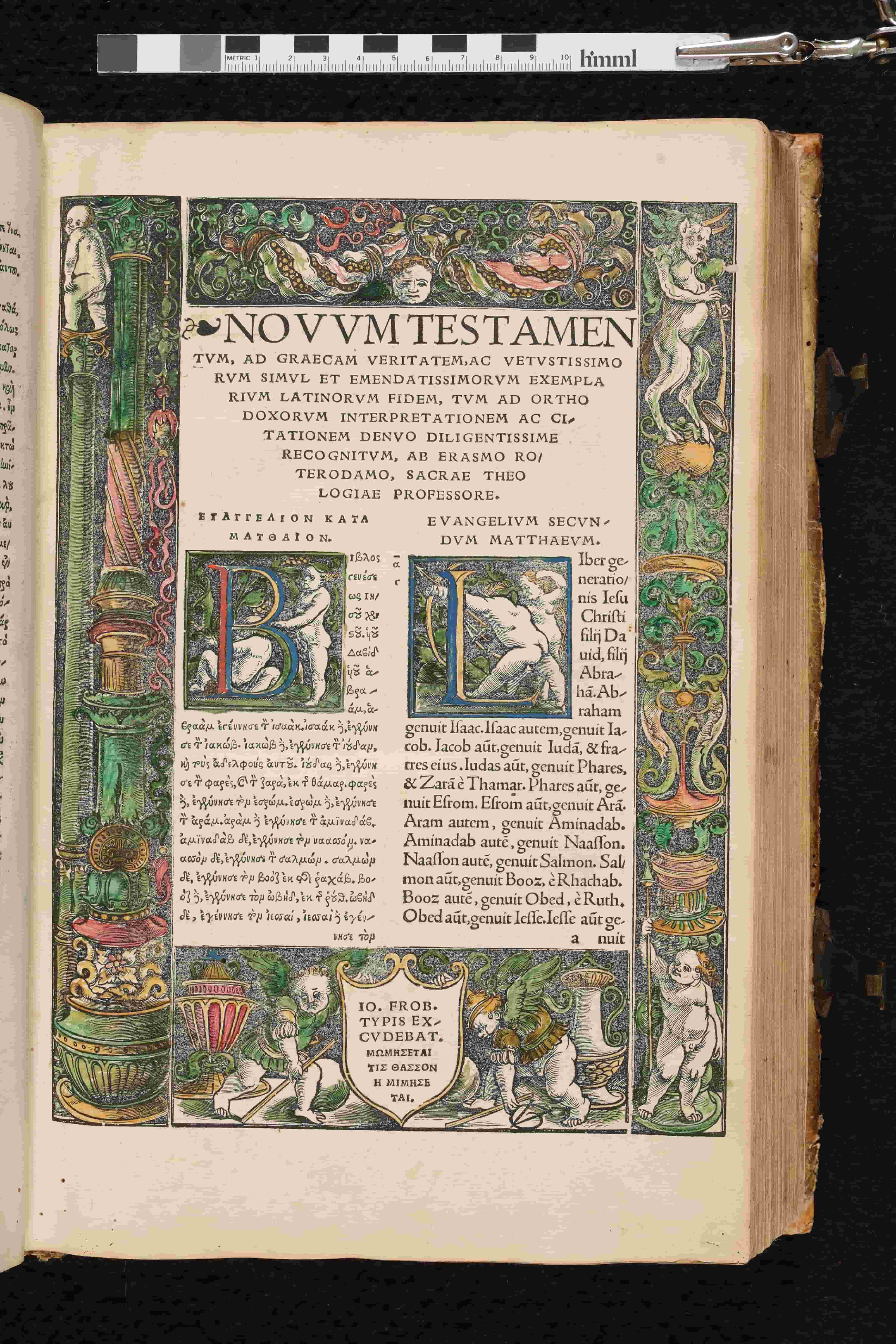
Disiderius Erasmus. Nouum Testamentum omne multo quàm antehac diligentius.
Basileae: Johann Froben, 1519.
The Nouum Testamentum omne was Desiderius Erasmus of Rotterdam’s second edition of his complete bilingual Latin-Greek Bible. The first edition (Novum Instrumentum omne), published in 1516, was the first publication of the Greek New Testament. The 1519 edition served as the basis for Martin Luther’s German translation of the New Testament in 1522.
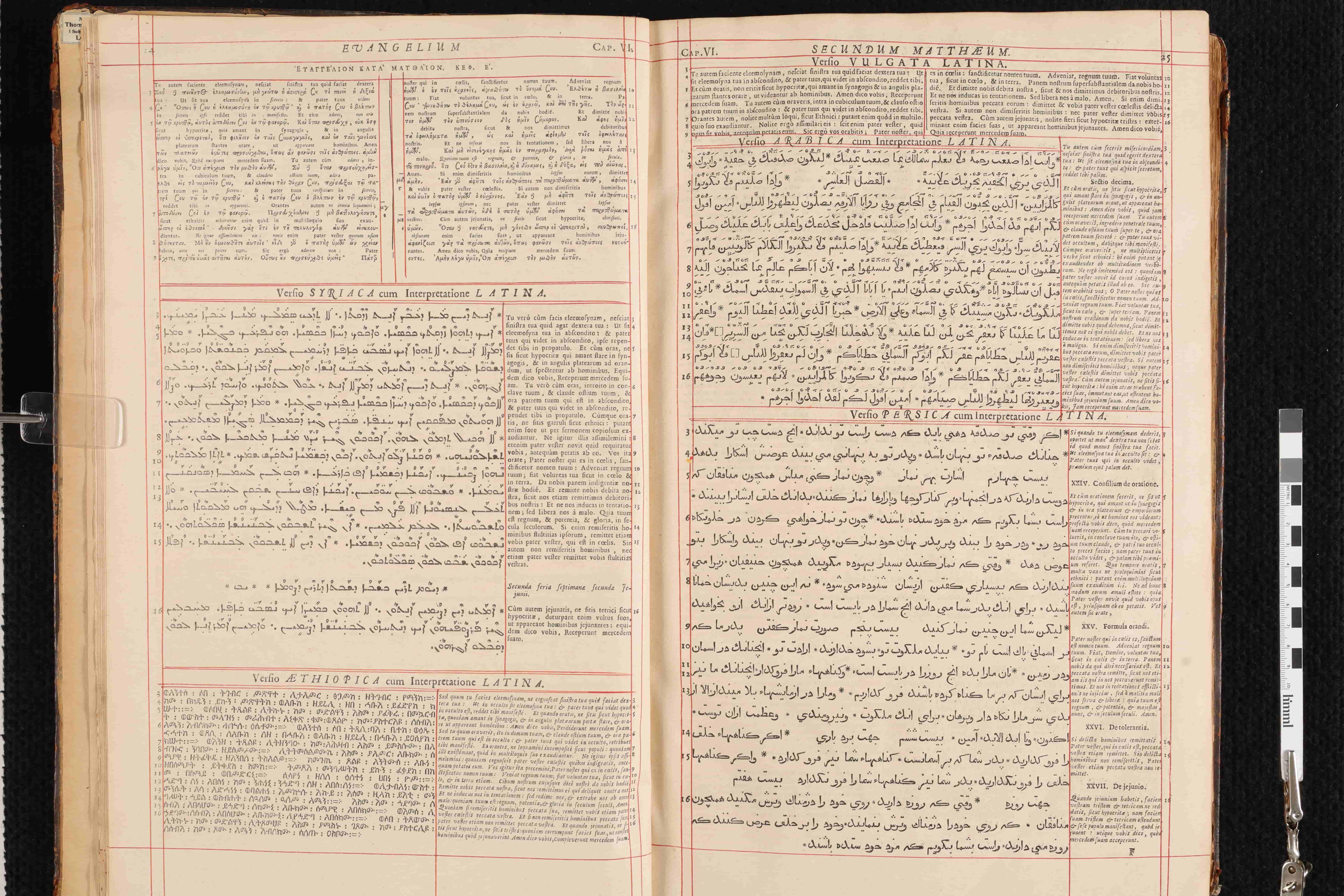
Brian Walton. Biblia sacra polyglotta.
London: Thomas Roycroft, 1657.
Edited by Anglican priest Brian Walton (1600-1661), the Biblia sacra polyglotta (also known as the London Polyglot) was published in six volumes from 1654-1657. The polyglot was a monumental undertaking, involving the work of multiple scholars to produce a Bible that placed different translations side-by-side. Nine languages were used in total (Arabic, Aramaic, Ge’ez, Greek, Hebrew, Latin, Persian, Samaritan, and Syriac), though each volume featured different combinations. This volume uses Arabic, Ge’ez, Greek, Latin, Persian, and Syriac.
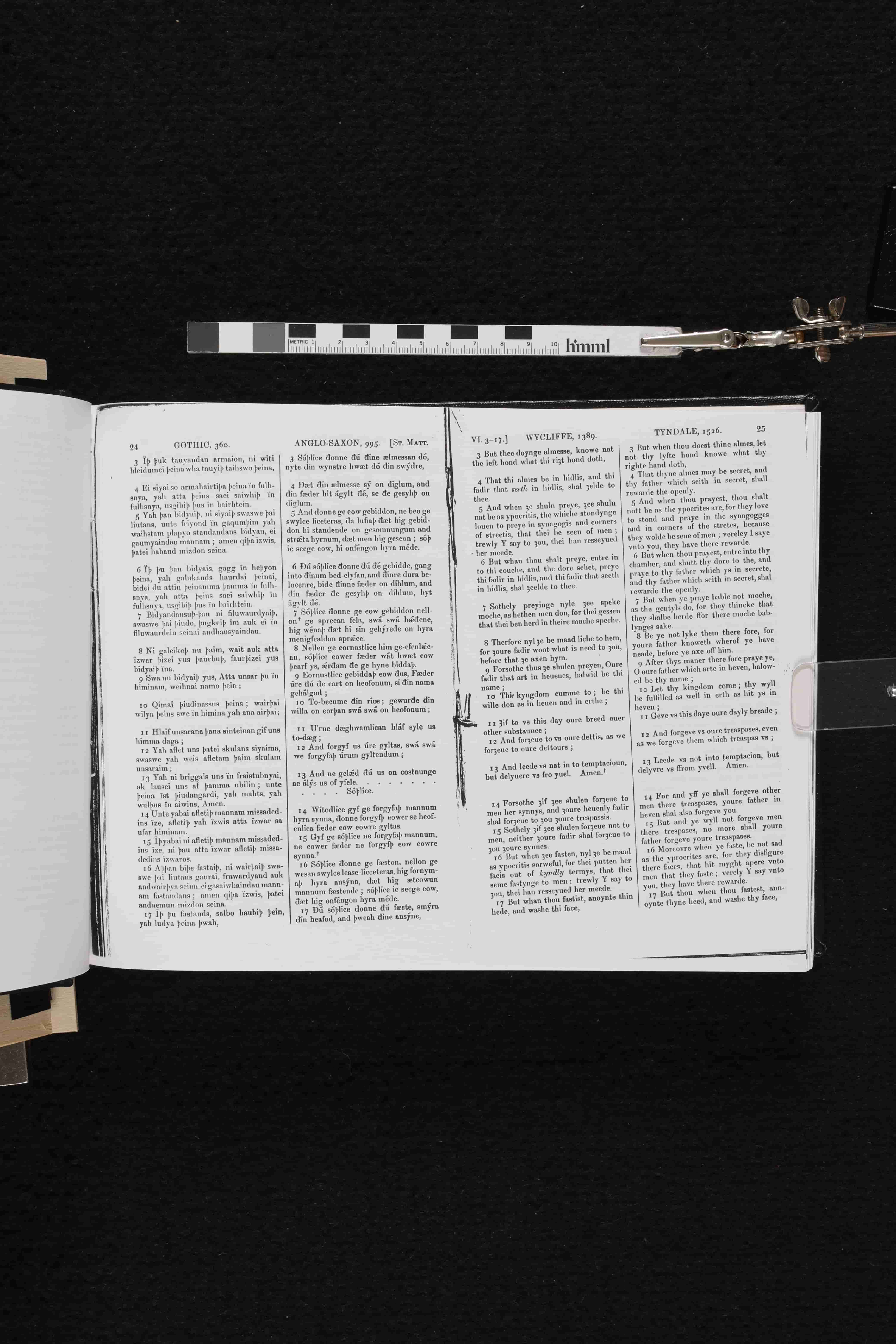
Joseph Bosworth. The Gospels : Gothic, Anglo-Saxon, Wycliffe and Tyndale.
London: Gibbings, 1907.
The Gospels was published nearly thirty years after Joseph Bosworth’s (1788-1876) death. Bosworth was a scholar of the Anglo-Saxon language and wrote the book’s preface in 1865. The book contains four translations of the Gospels, printed side-by-side: the Gothic translation of Ulfila (c. 311-383 CE), the 10th century Anglo-Saxon translation, John Wycliffe’s 14th century English translation, and William Tyndale’s 16th century English version.
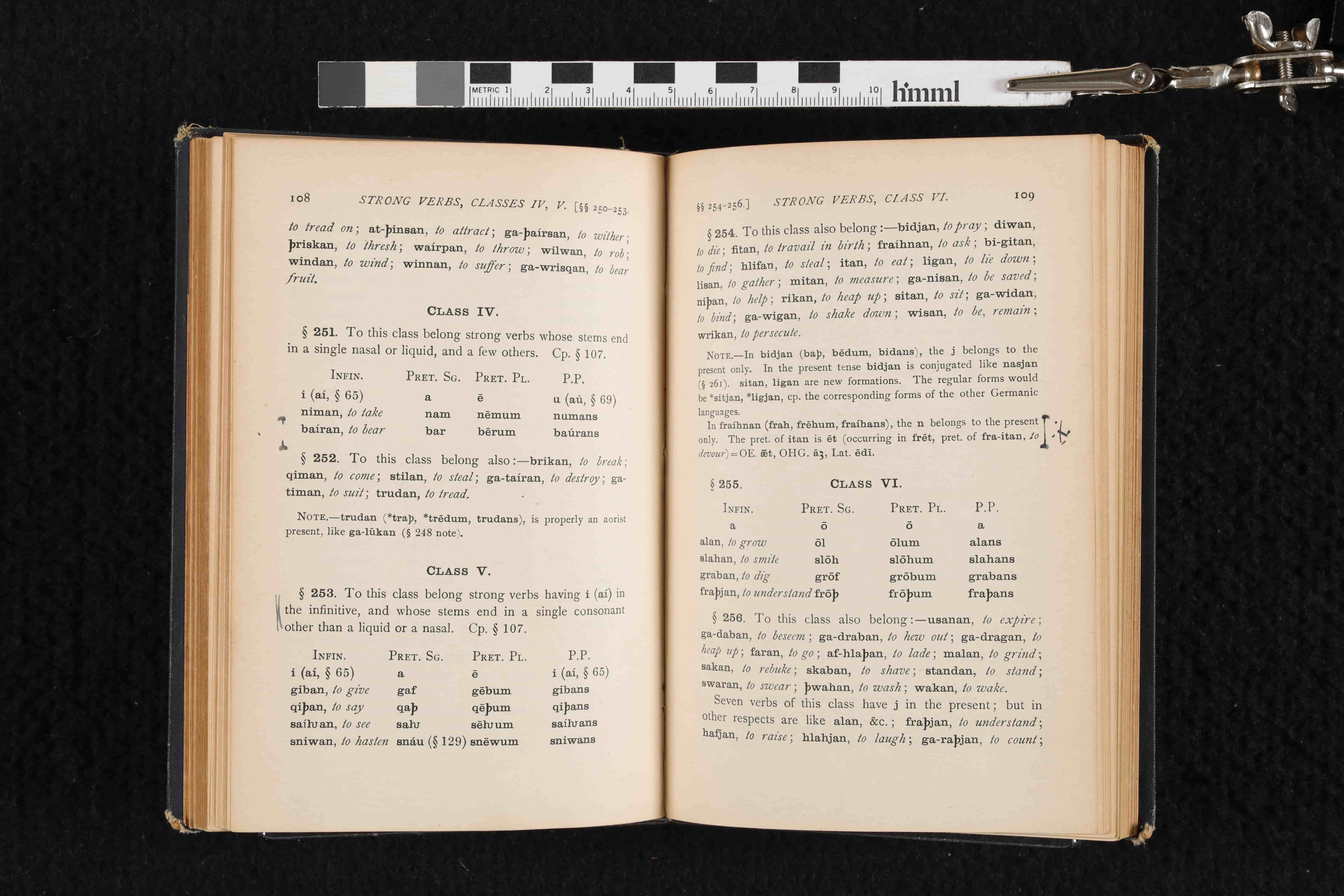
Joseph Wright. A primer of the Gothic language.
Oxford: Clarendon Press, 1899, 2nd edition.
While teaching at Oxford in 1892, Joseph Wright developed a primer on the Gothic language to aid students in studying German philology and linguistics. After a positive response from other instructors, he expanded his work to this second edition in 1899. When a third edition was requested, he developed a longer Grammar of the Gothic Language.
In addition to introductory grammars in historical Germanic languages, Wright is most well-known for his six-volume English Dialect Dictionary.
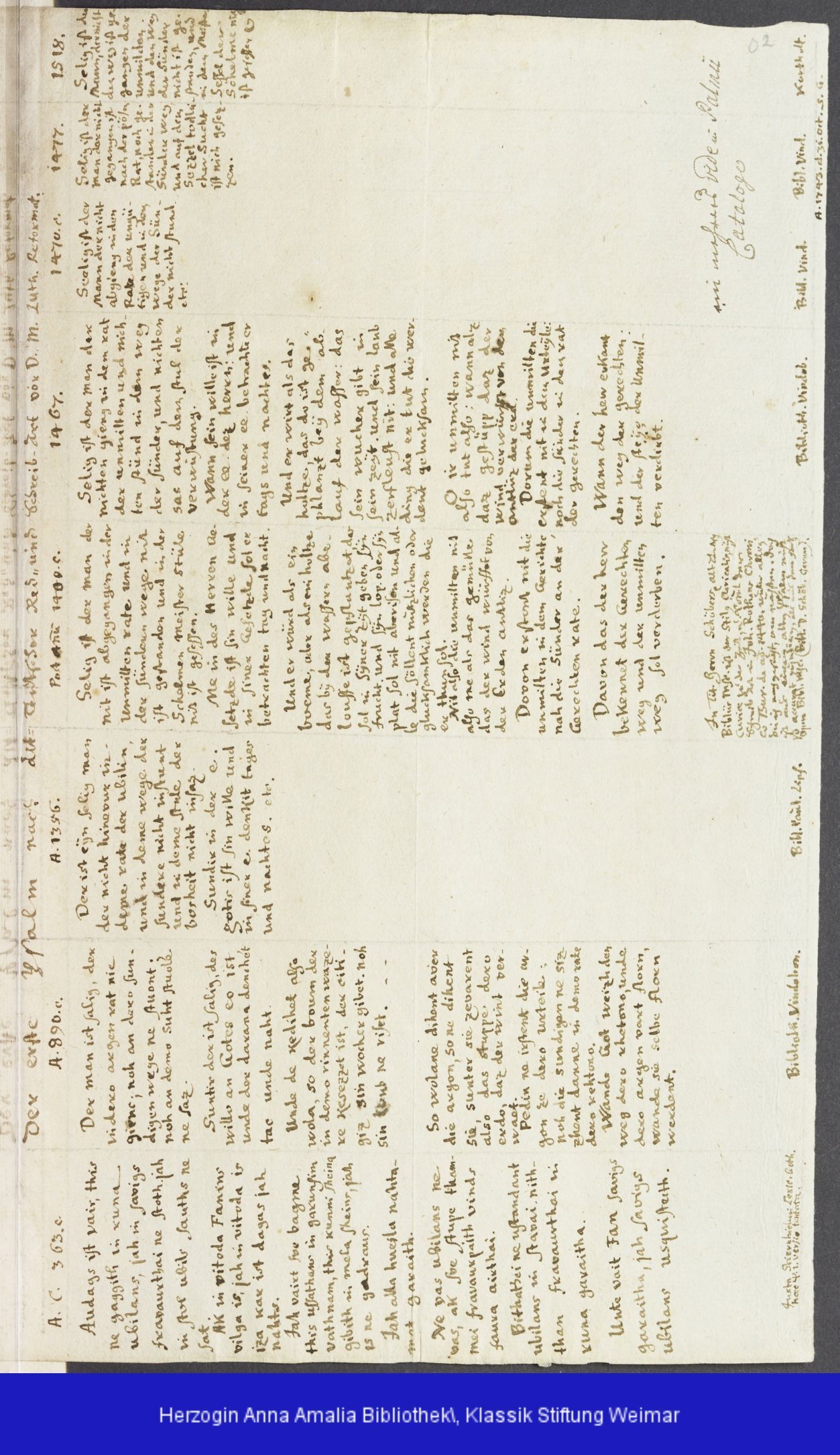
Der erste Psalm nach der Alt-Teutscher Rede und Schreib-Art von D. M. Luth. Reformat.
Southwest Germany, 15th century.
Before Martin Luther’s translation into German from the Greek and Hebrew, German translations of the Bible were based on the Latin Vulgate. This one was copied in the late 15th century in southwest Germany.
On the front flyleaf, a later owner created a synoptic table comparing 8 different German translations of Psalm 1. The table was made in 1743 and shows a shift in the language over time, with the earliest translation dating to 363 CE—likely Ulfila’s Gothic translation—while the latest is Martin Luther’s 1518 translation.
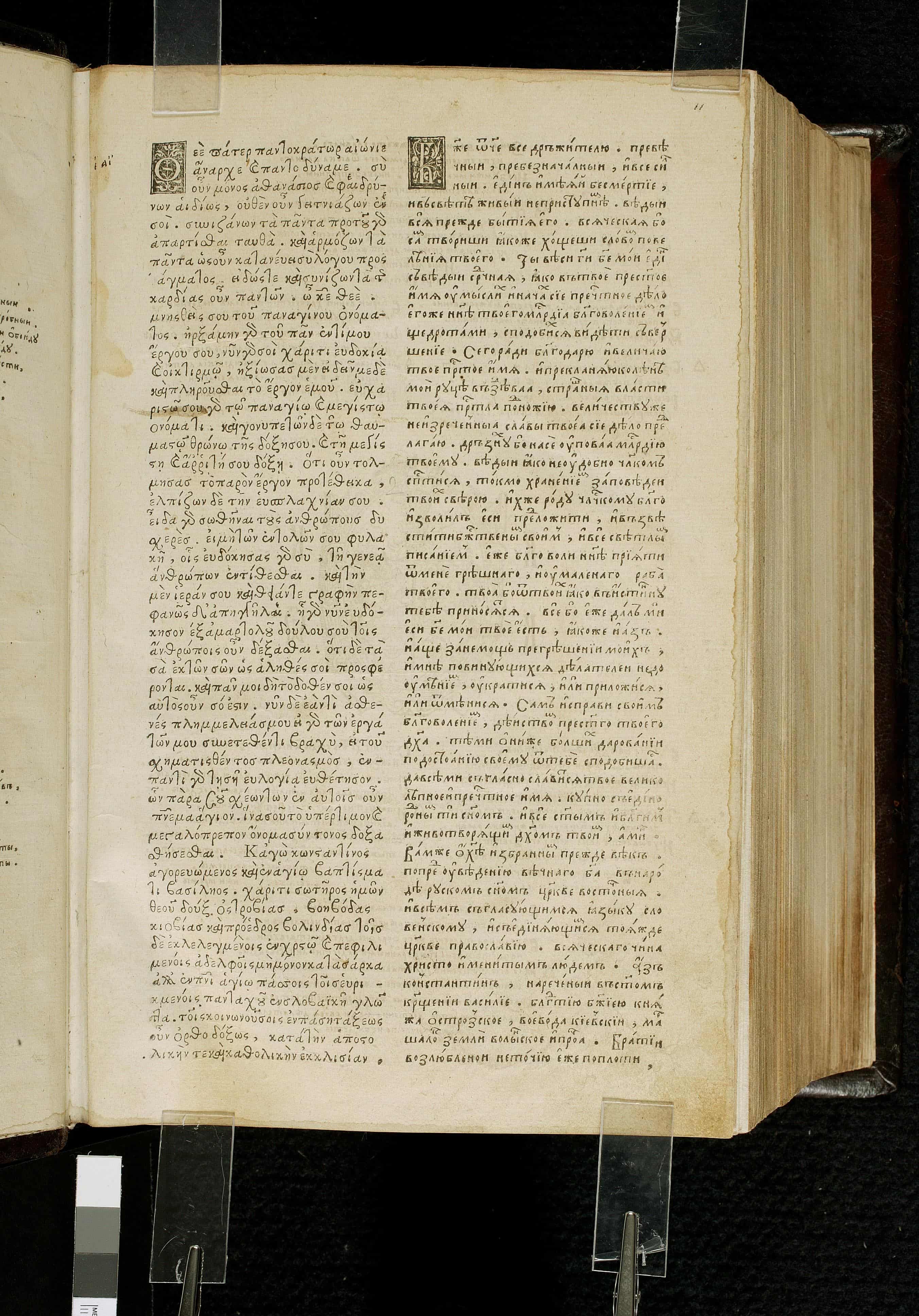
Ostrog Bible.
Ostroh, Ukraine: Ivan Fedorov, 1581.
The Ostrog Bible was the first complete Bible printed in Church Slavonic, the official language of many Eastern and Orthodox Christian denominations. Only two editions were printed, the first in 1580 and the second a year later. The introduction pictured here is provided in Greek and Church Slavonic in side-by-side columns.
The Ostrog Bible served as a unifying text for many Eastern and Russian Orthodox Christians and was commissioned by Prince Konstiantyn Ostrozkyi of Lithuania during a time of intense competition between Catholicism, Protestantism, and Orthodox Christianity in the region.
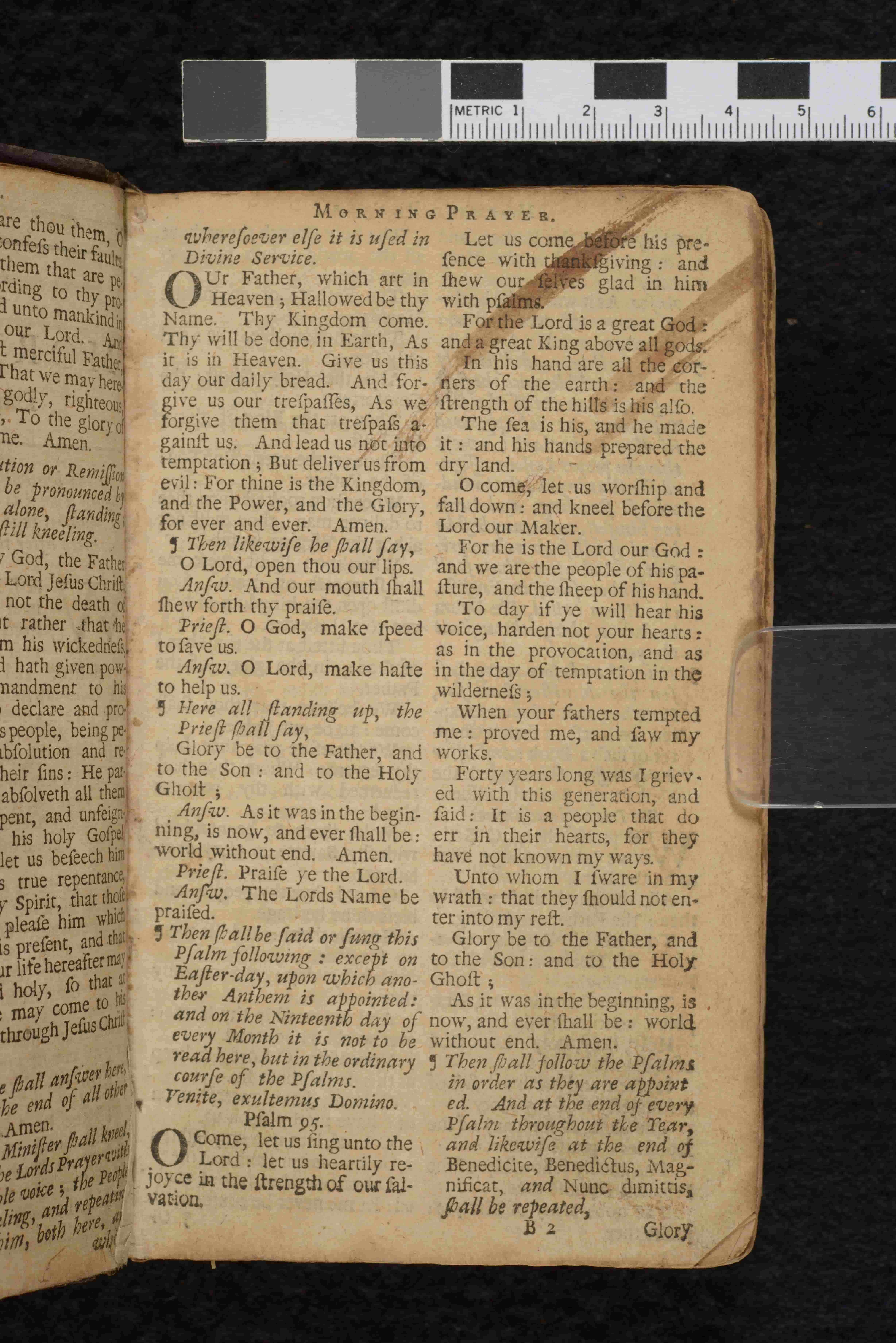
The Book of Common Prayer.
London: Printed by John Baskett, 1727.
This Book of Common Prayer was sold unbound for one shilling (about $12.09 today) and was printed by John Baskett, the same printer of the so-called “Vinegar Bible.” The purpose of the Book of Common Prayer was to standardize the prayers, liturgies, and sacraments in the Church of England. First published in 1549 by Archbishop Thomas Cranmer, the Book of Common Prayer remains in use today for the Church of England and many other Anglican churches.
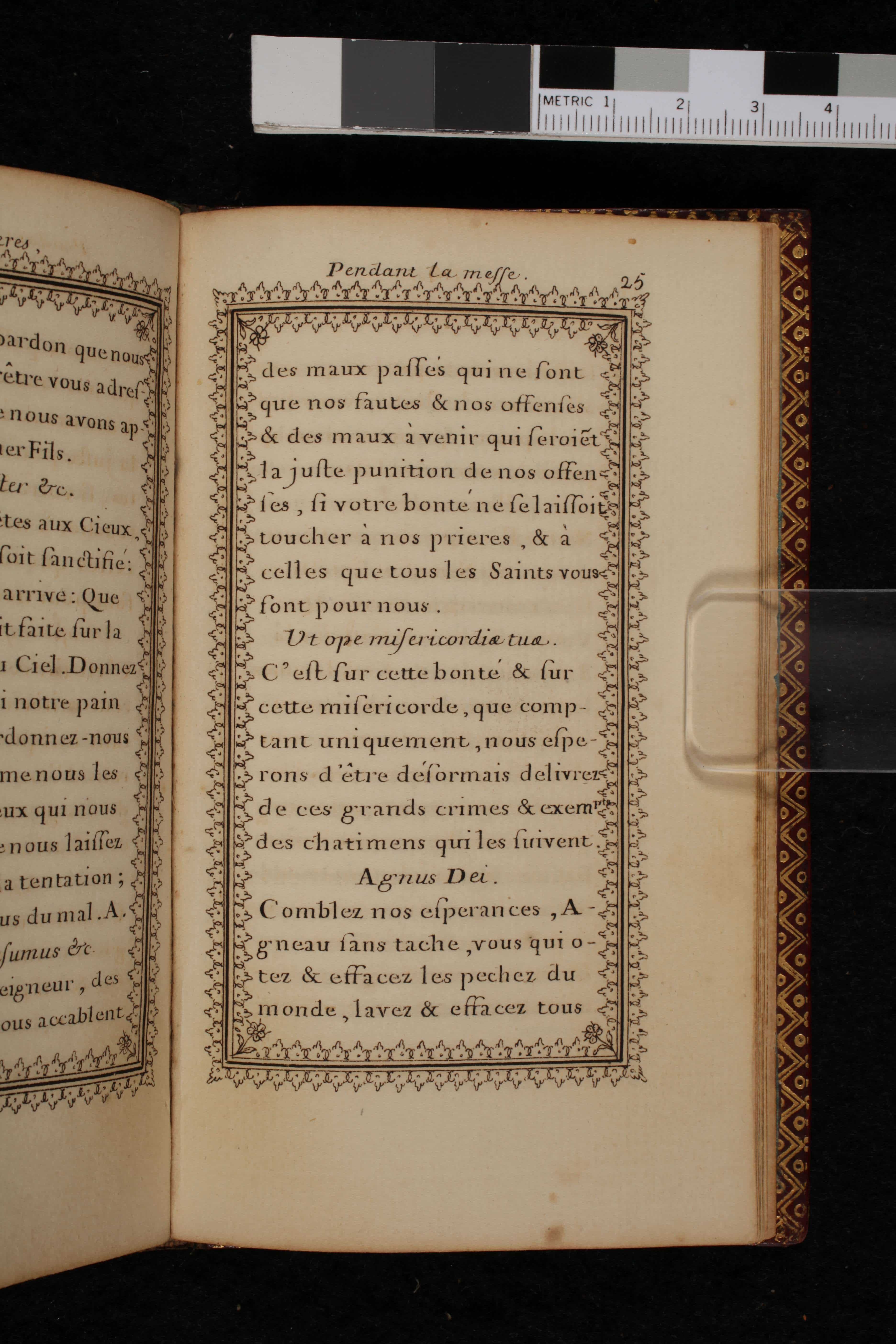
Philippe Charles Gallonde. French Prayer Book.
Paris, France, 1753.
This prayer book, written in French, was copied by Philippe Charles Gallonde (1710-1787) for Madame de Montmartel. Gallonde was a canon at the Abbey of Saint Genevieve in Paris.
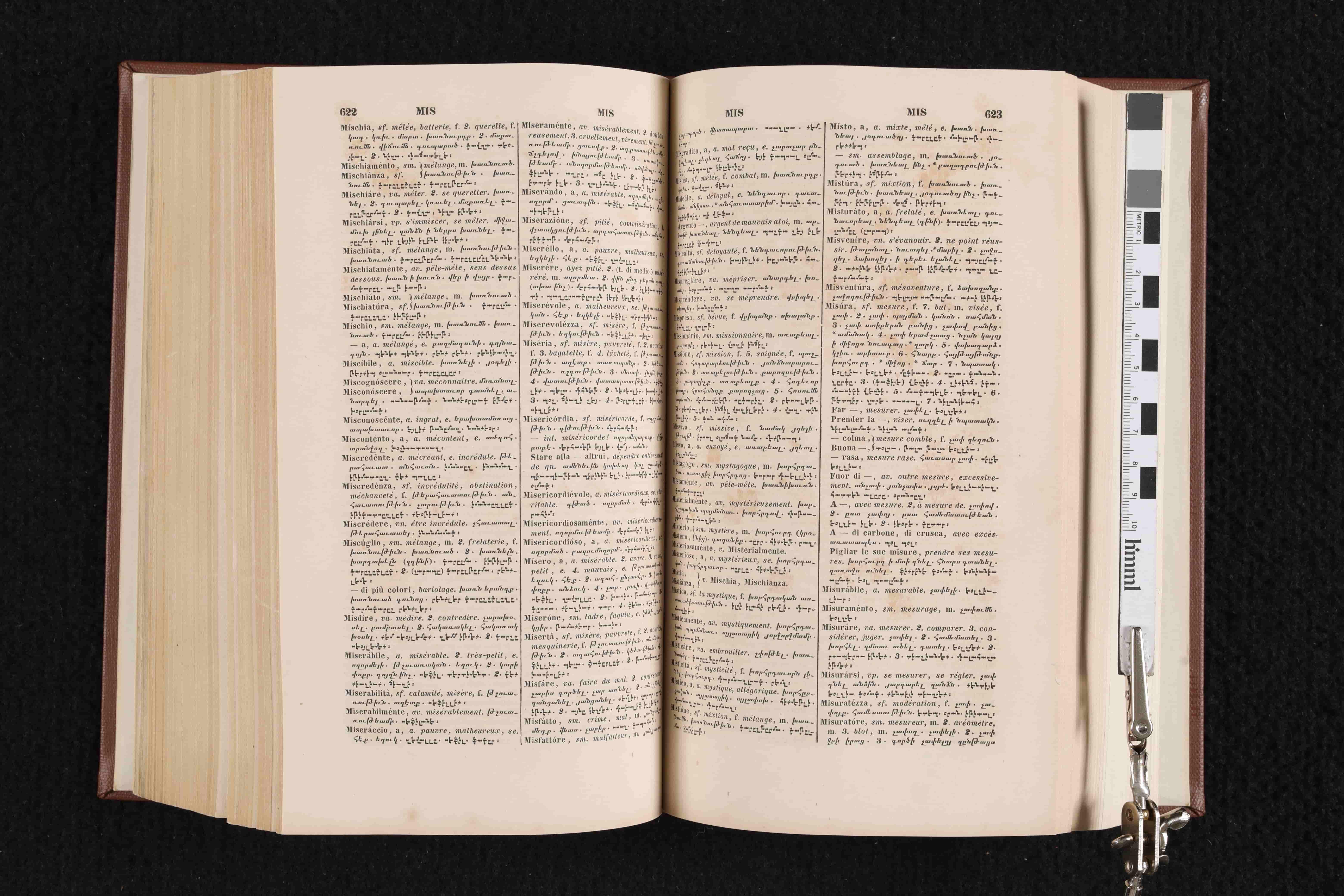
Mechitarists. Nuovo dizionario italiano-francese-armeno-turco.
Vienna: Tipografia dei PP. Mechitaristi, 1846.
The Mechitarists, a Benedictine congregation based in Venice and known for their contributions to the study of Armenian, published this dictionary in 1846. The dictionary is written in four languages: Italian, French, Armenian, and Turkish. The purpose, according to the preface, was to help Armenians in Italy learn to pronounce Italian better and facilitate language acquisition. It also served as an international resource for the Mediterranean region, likely to aid in trade, which was bolstered by the newly developed steamship.
The Divine Word
Judaism, Christianity, and Islam are all based on sacred texts, so that the practice of copying is extremely important. Perhaps the most important is writing the name of God.
Practitioners of Judaism often consider the name of God to be too holy to be spoken aloud, that is, ineffable. Thus the written representation, the Tetragrammaton (YHWH), offers a point of contact with and contemplation of the divine.
For Christians, the Word is a representative aspect of the incarnation of God, because one of the names for Christ is “the Word of God,” a translation of the Greek Λόγος (Logos).
In Islam, Allah is too perfect to be depicted in a picture, so calligraphy provides a way to visualize Allah’s presence and to meditate on his glory and sanctity.
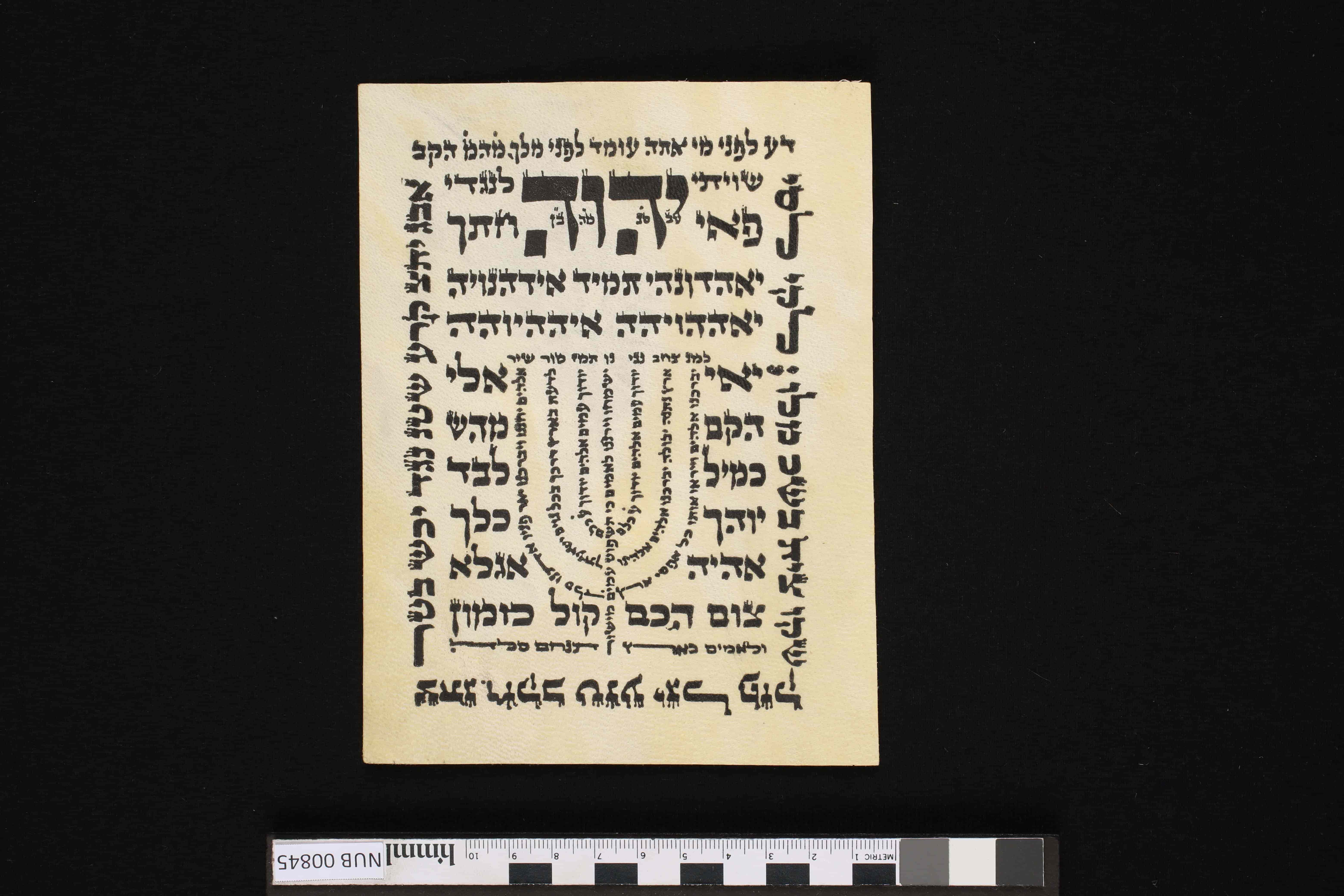
שויתי (Shiṿiti)
c. 19th century (?)
In the Hebrew Bible, God is named using the Tetragrammaton (יהוה or YHWH), a set of four letters that were not meant to be pronounced. The prayer shown here is a shiṿiti, a meditation aid, with the Tetragrammaton in large calligraphy near the top.
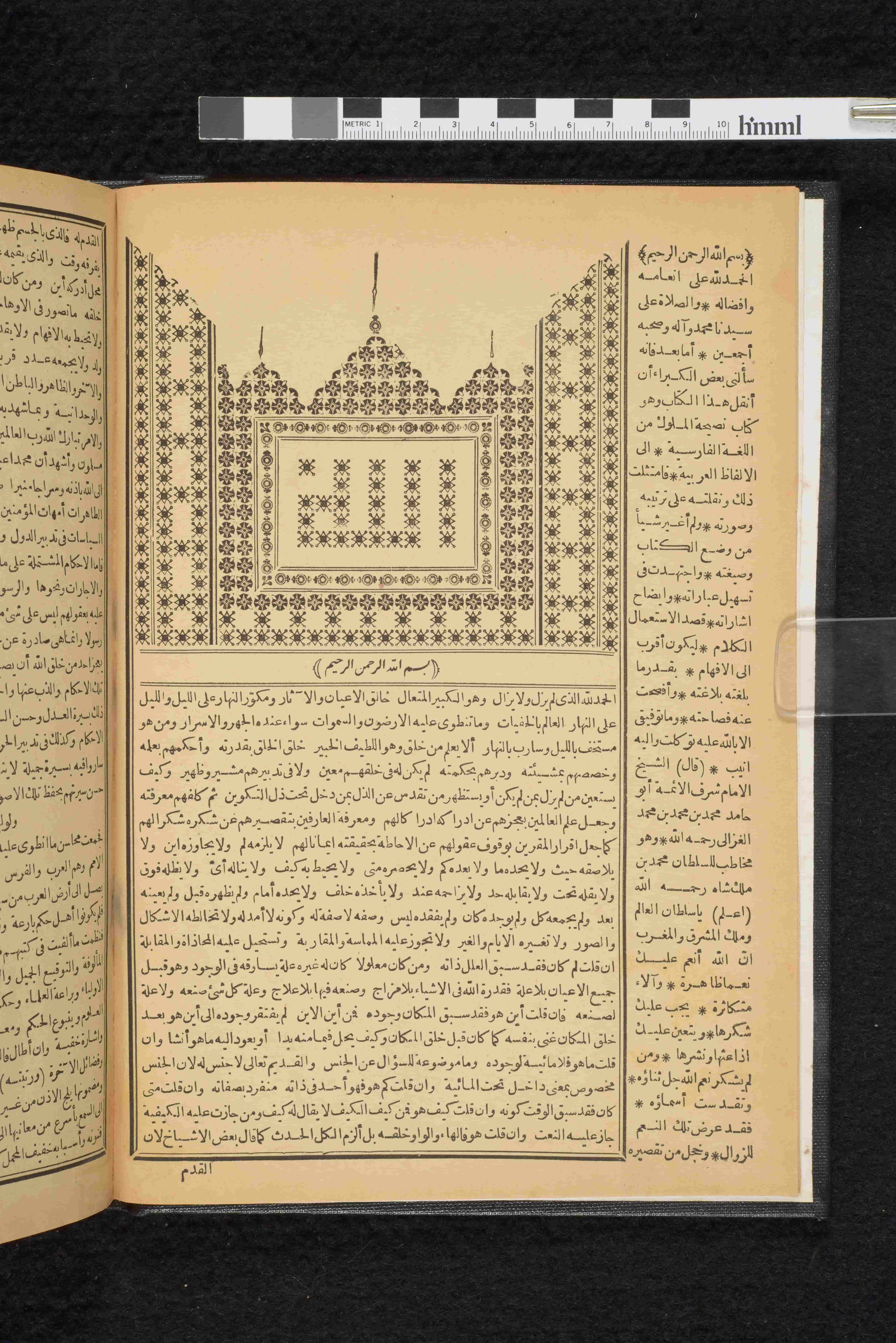
Muḥammad ibn al-Walīd Ṭurṭūshī. Sirāj al-mulūk.
Cairo: Al-Maṭbaʻah al-Khayrīyah, 1889.
The word Allāh (الله), Arabic for God, is printed in the center of a decorative headpiece atop the right page. Decorative headpieces were common in many manuscript traditions. With the invention of printing, early printers sought to replicate them in print, such as the one shown here.
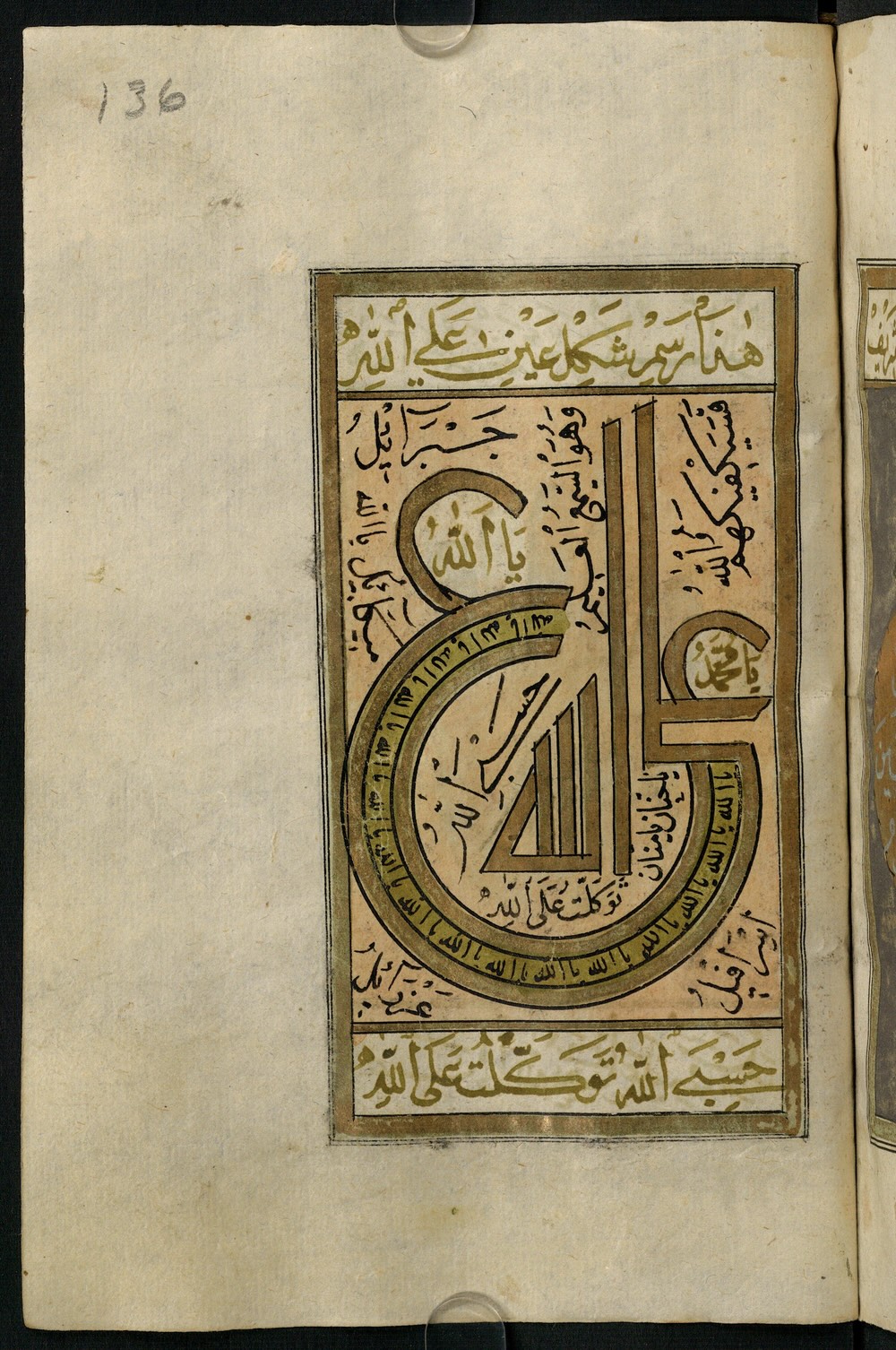
انعام شريف مع دلائل شريف (Prayer Book).
1794.
This prayer book is known as an Enʿām-ı Şerīf. Enʿām-ı Şerīf are Ottoman prayer books, which contained selections from the Qur’an and other prayers. This page shows a traditional magical calligraphic symbol known as ʻayn ʻalá Allāh, or “an eye upon God.” ʻAyn in Arabic means both the letter ع and the word “eye.” The initial ع is laid out to look like a giant eye, with Allāh in the middle. It exhorts the viewer to see God while simultaneously placing the word for God within the word for eye.
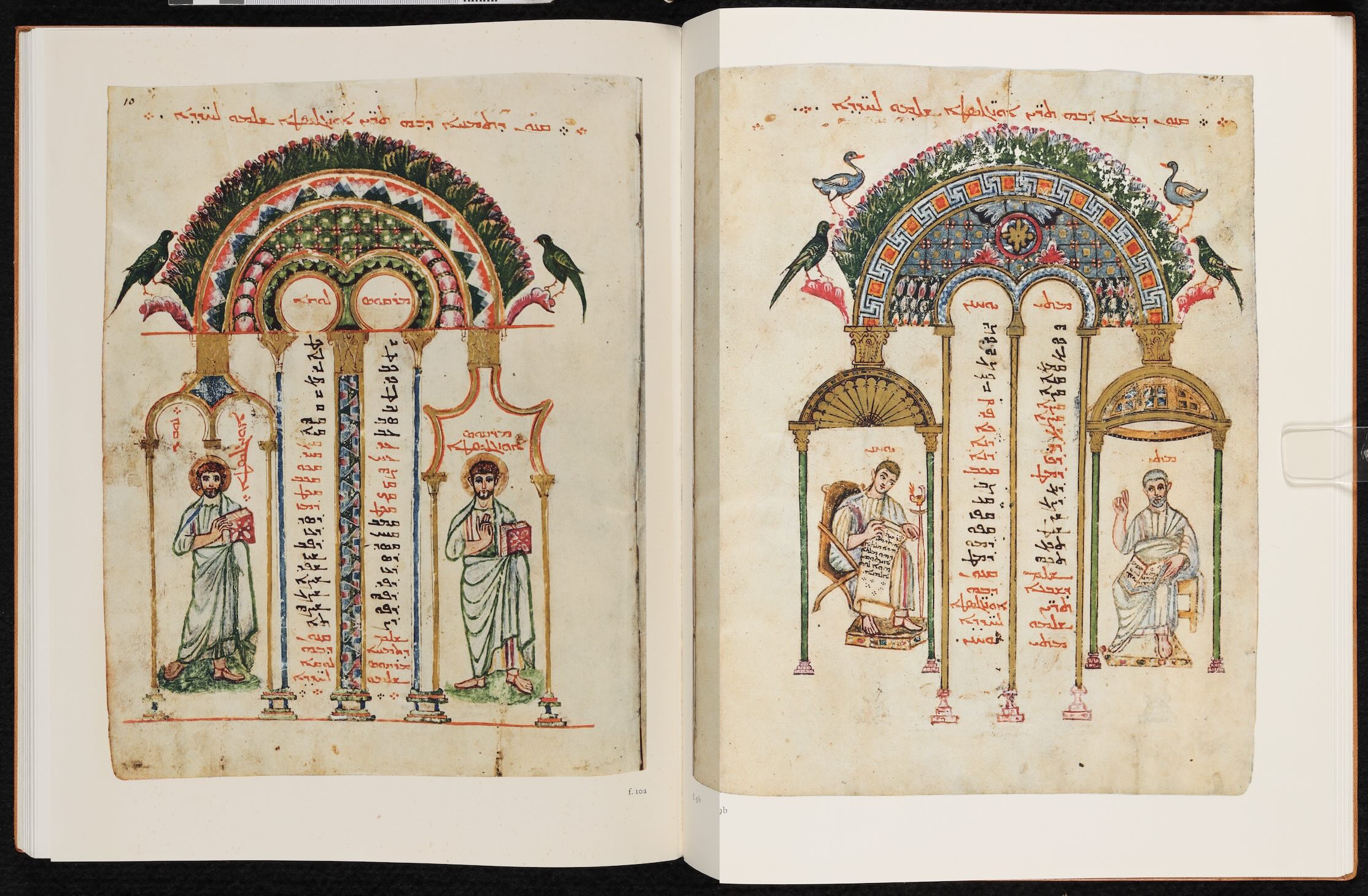
Facsimile of Rabbula Gospels.
Basel: Urs Graf-Verlag, 1959.
This illuminated Syriac Gospel book was originally created at the Monastery of St. John of Zagba, the modern location of which is unknown, by a scribe known as Rabbula around 586 CE.
On display is a facsimile (copy), open to the portraits of the Four Evangelists (left-to-right: Luke, Mark, John, and Matthew). The portrait of John holds a scroll with the Syriac version of John 1:1. Matthew holds a small book with two sets of three lines of writing from Matthew 1:18 (“The birth of Jesus the Messiah has been this”).
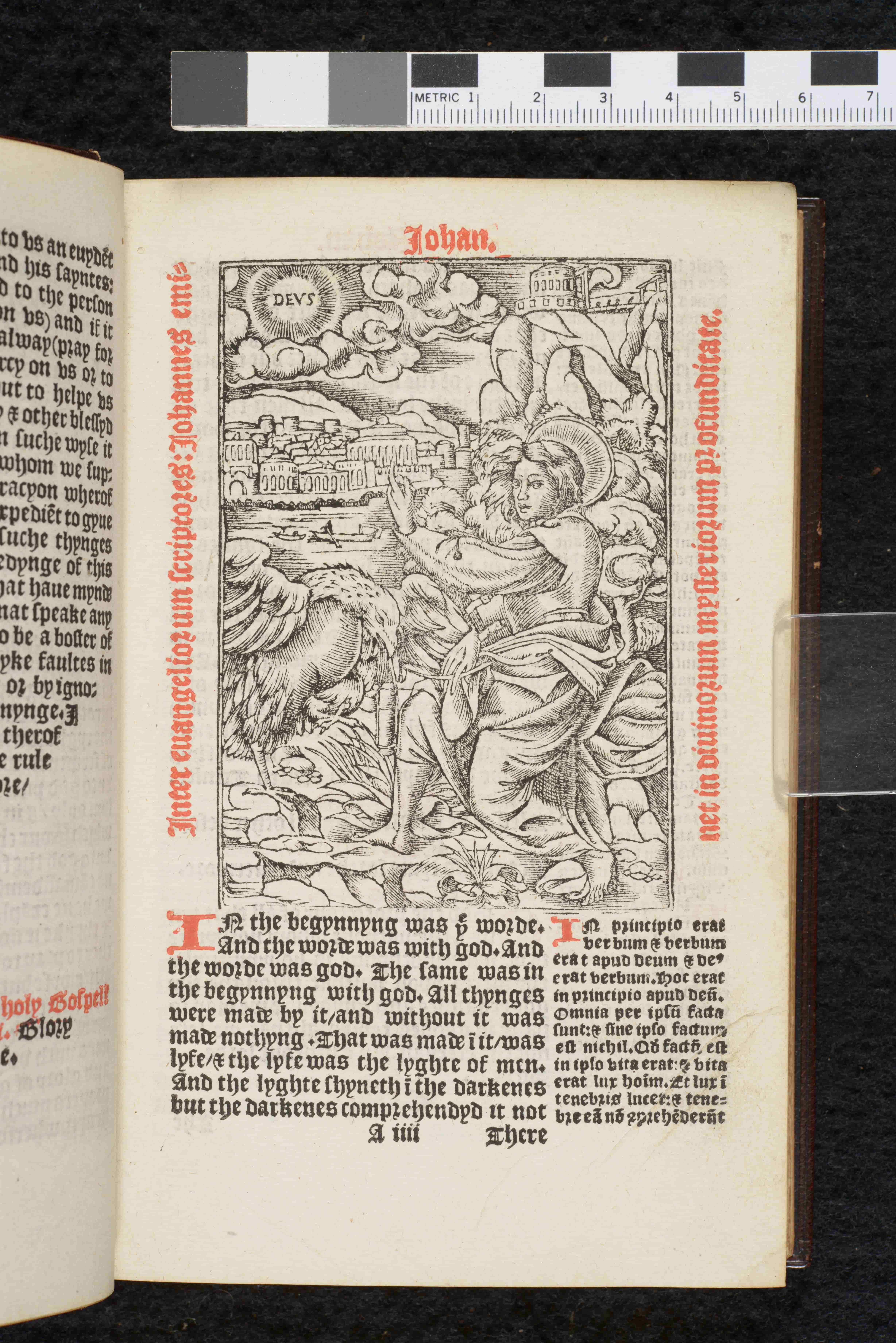
Girolamo Savonarola and William Marshall. An exposycyon after the maner of a contemplacyon.
Rouen: Nicolas le Roux, 1538.
In the New Testament, the Gospel of John refers to Jesus as “the Word,” as is shown here in both English and Latin (verbum).
The book is William Marshall’s translation of Girolamo Savonarola’s commentary on Psalm 51, in which the Dominican author calls for a reform of the church.
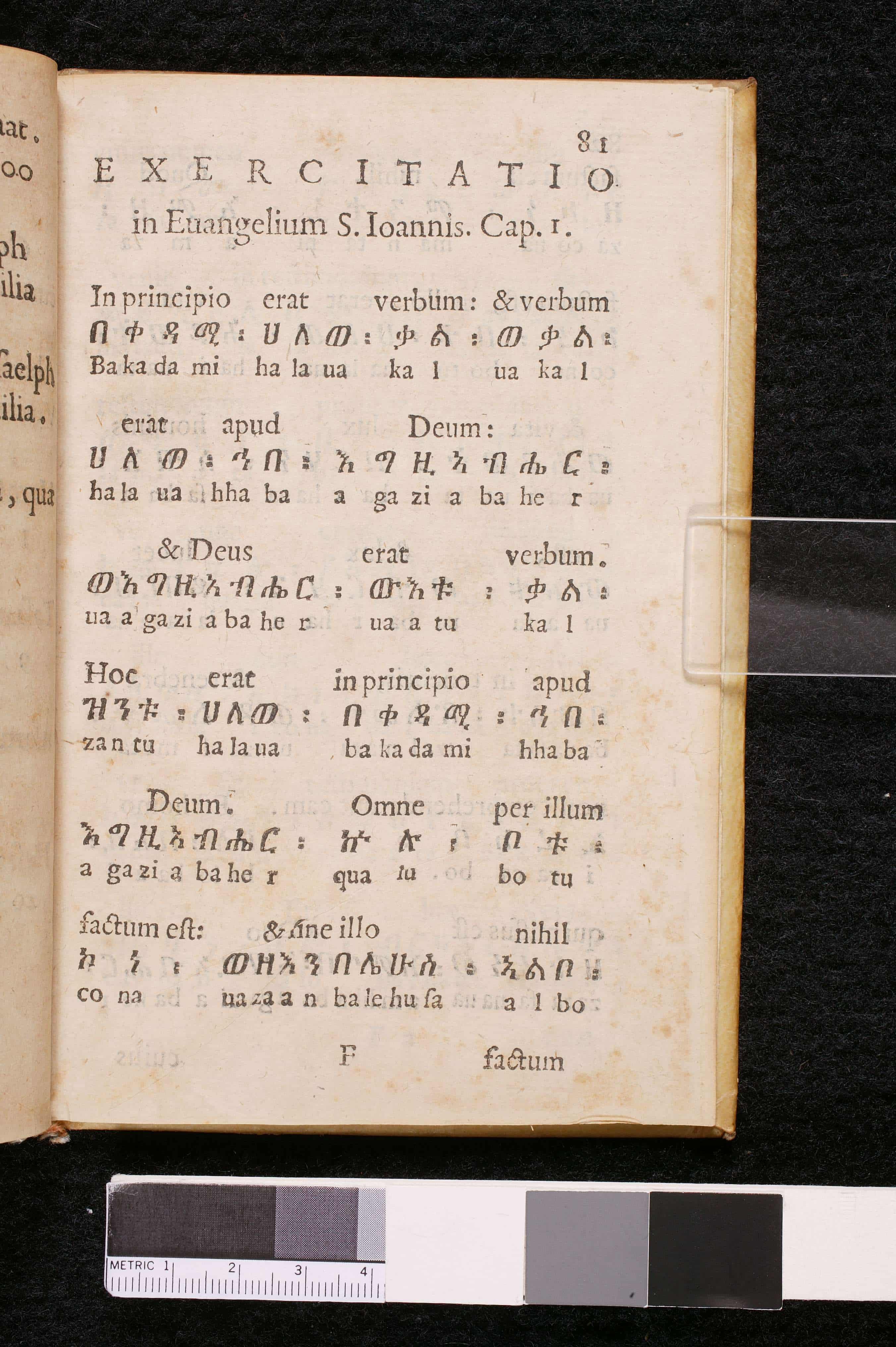
Marianus Victorius. Chaldeae seu Aethiopicae linguae institutiones.
Rome: Typis Sac. Congregationis de Propaganda Fide, 1630.
Marianus Victorius was a 16th century Italian theologian and linguist who participated in the 1570 Council of Trent. At the time, European scholars mistakenly used the term “Chaldean” to refer to Ge’ez, the liturgical language of the Ethiopian Orthodox Church. Victorius wrote the grammar in Latin, and it was published in 1552. This edition dates to 1630, demonstrating the continued academic interest in the language.
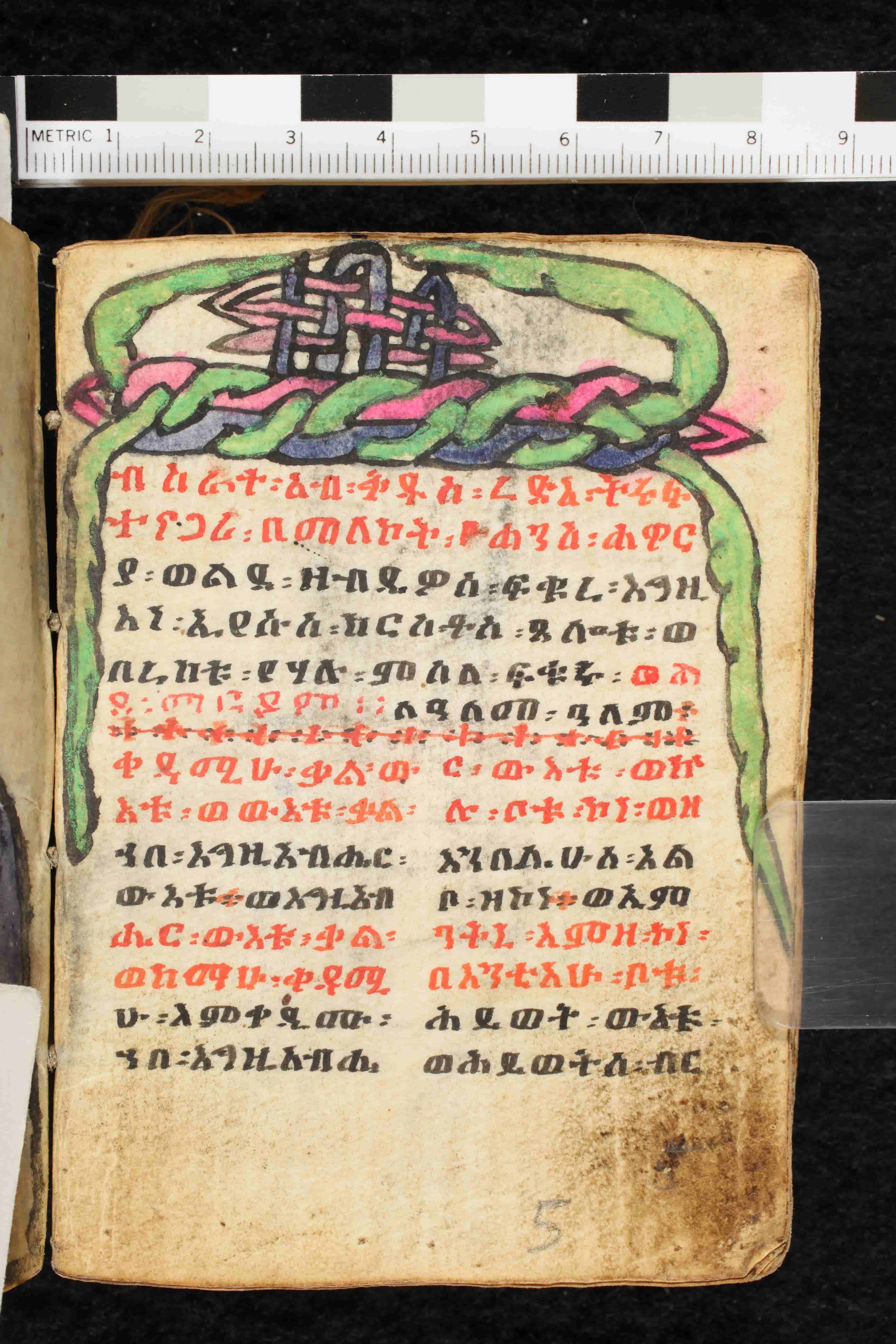
Gospel of John.
Ethiopia, 1918-1919.
This Gospel of John was copied by Walda Maryam for personal use and was carried in a leather pouch.
Biblical translations into Ge’ez are some of the oldest Bible translations, owing to the early spread of Christianity to the region in the 4th century. The oldest known Ge’ez translations of the Bible, the Garima Gospels, are thought to date to the 6th century.
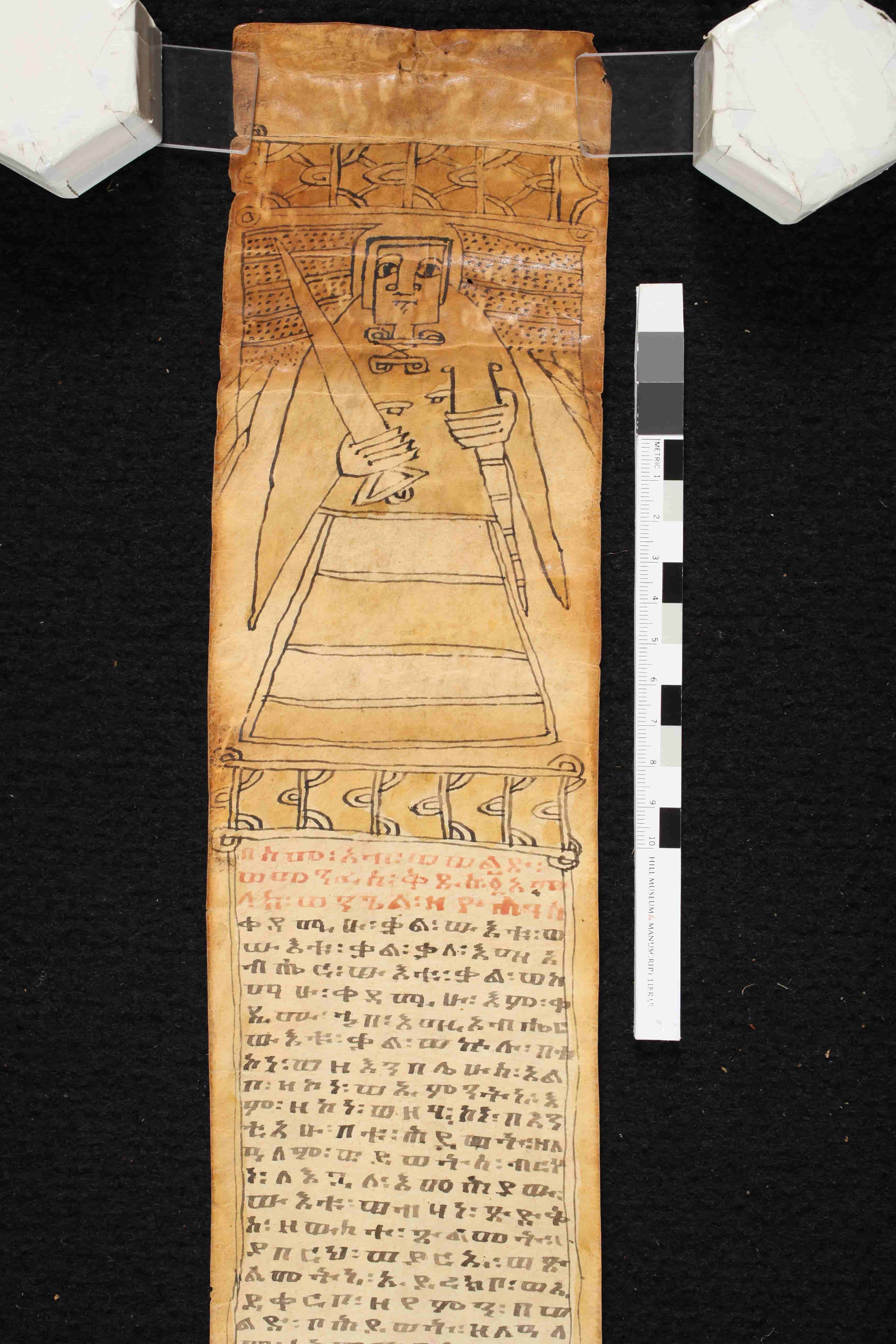
Magic Scroll.
Ethiopia, 19th century.
Prayer scrolls acted as protective and healing talismans in Ethiopia. Although not condoned by the Ethiopian Orthodox Church, they were popular among the laity and incorporated Christian texts. This prayer scroll, written in Ge’ez (the liturgical language of the Church), features the opening of the Gospel of John and applies it against the evil eye.
Letter of the Law
Law and language are closely intertwined. Laws are some of the oldest instances of writing and are often the earliest surviving examples of languages outside of religious and ritualistic texts.
Religious and secular laws rely heavily on the correct definitions of words and understanding the laws’ intent. Some scholars believe that the Latin word for law, lex, may come from a Proto-Indo-European root meaning “to gather,” that is, “gather words carefully.” If so, lex may be related to the Greek λέγω (“to speak”), which in turn is the ancestor of the English word “lexicon”.
The interpretation of religious and secular laws must consider the precise wording—the letter of the law—and the original intent of the law. In the same way, translators of any kind of text try to capture the flow of the prose or poetry without sacrificing the original meanings. Unfortunately, it’s not always possible to do both, and a translator may choose to prioritize one over the other.
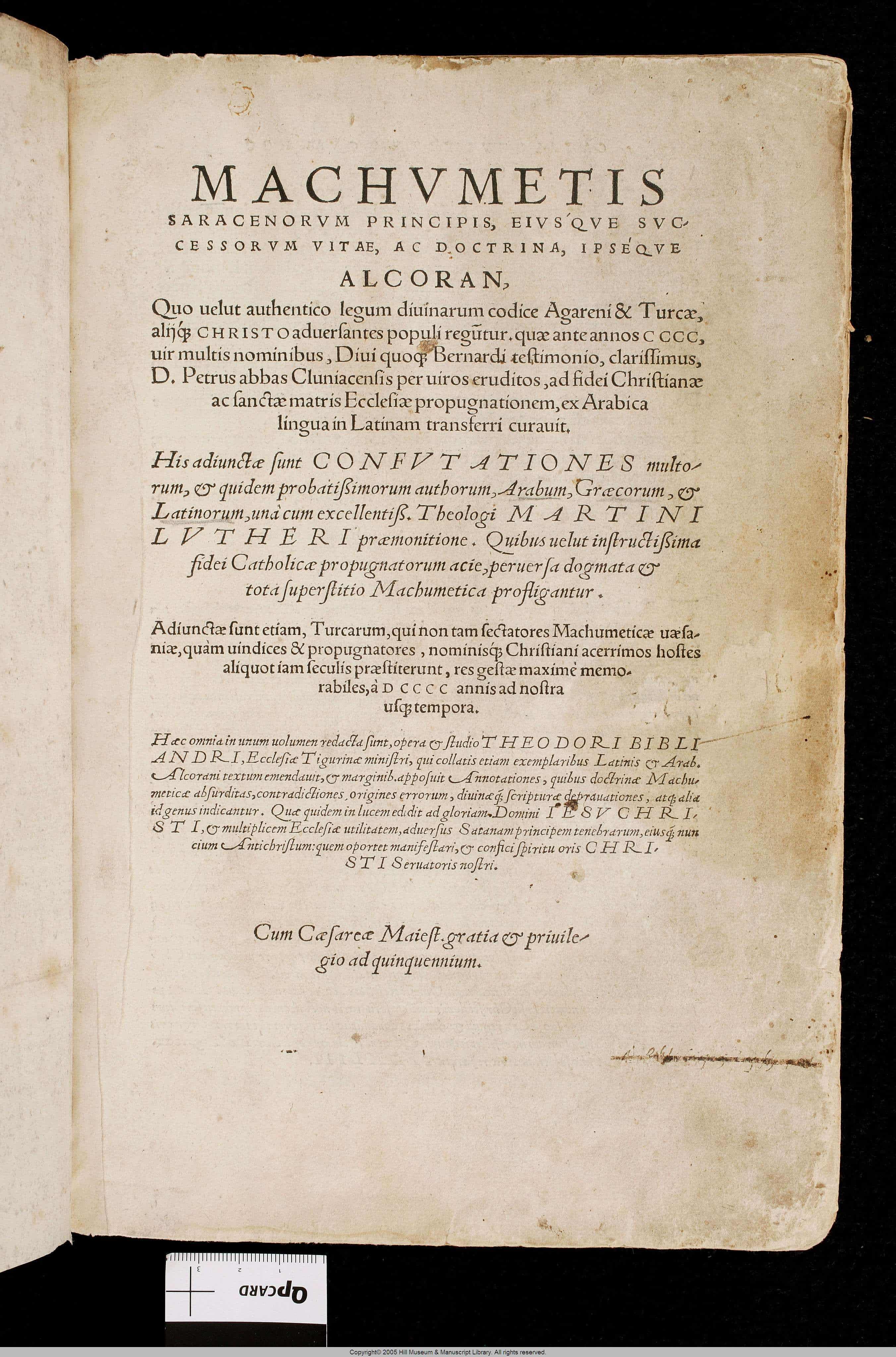
Theodorus Bibliander. Machumetis Saracenorum principis.
Basel: Joannes Oporinus, 1543.
This Latin translation of the Qur’an was edited by Theodore Bibliander and published in 1543, with a preface by Martin Luther. It is the first printed version of the Qur’an. Translations like Bibliander’s were intended to inform Western audiences on Islam and provide them with information needed to refute Islam and convert Muslims to Christianity.
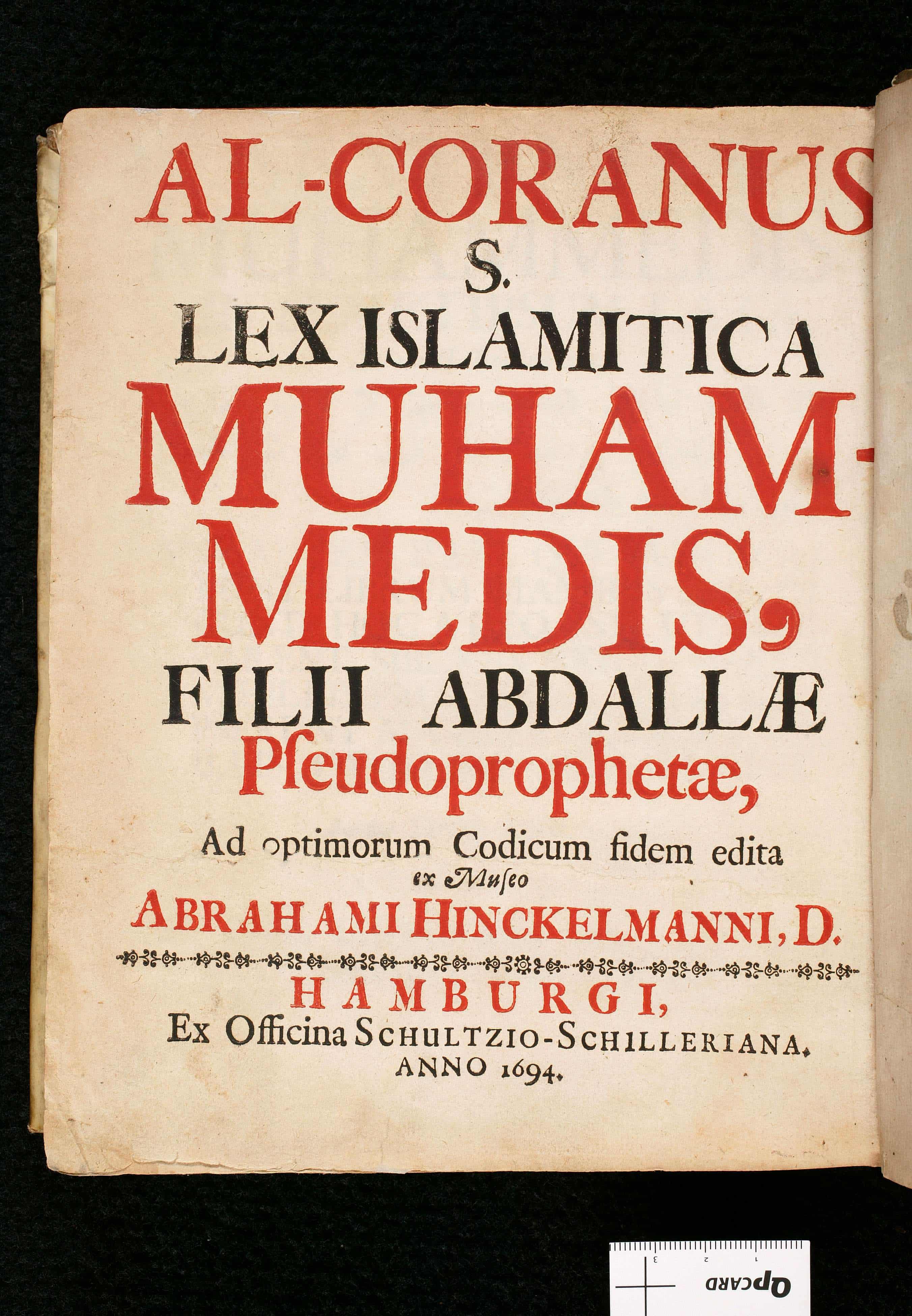
Abraham Hinckelmann. Al-Coranus S. Lex islamistica Muhammedis, filii Abdallae pseudoprophetae.
Hamburg: Officina Schultzio-Schilleriana, 1694.
Abraham Hinckelmann (1652-1695) published and printed one of the first complete editions of the Qur’an in Arabic in 1694. Certain sections of the Qur’an have been used to construct collections of laws (known as sharia) by Islamic scholars over the centuries.
Although prefaced with a refutation of Islam, this publication helped inspire European interest in the Qu’ran and the study of Islam.
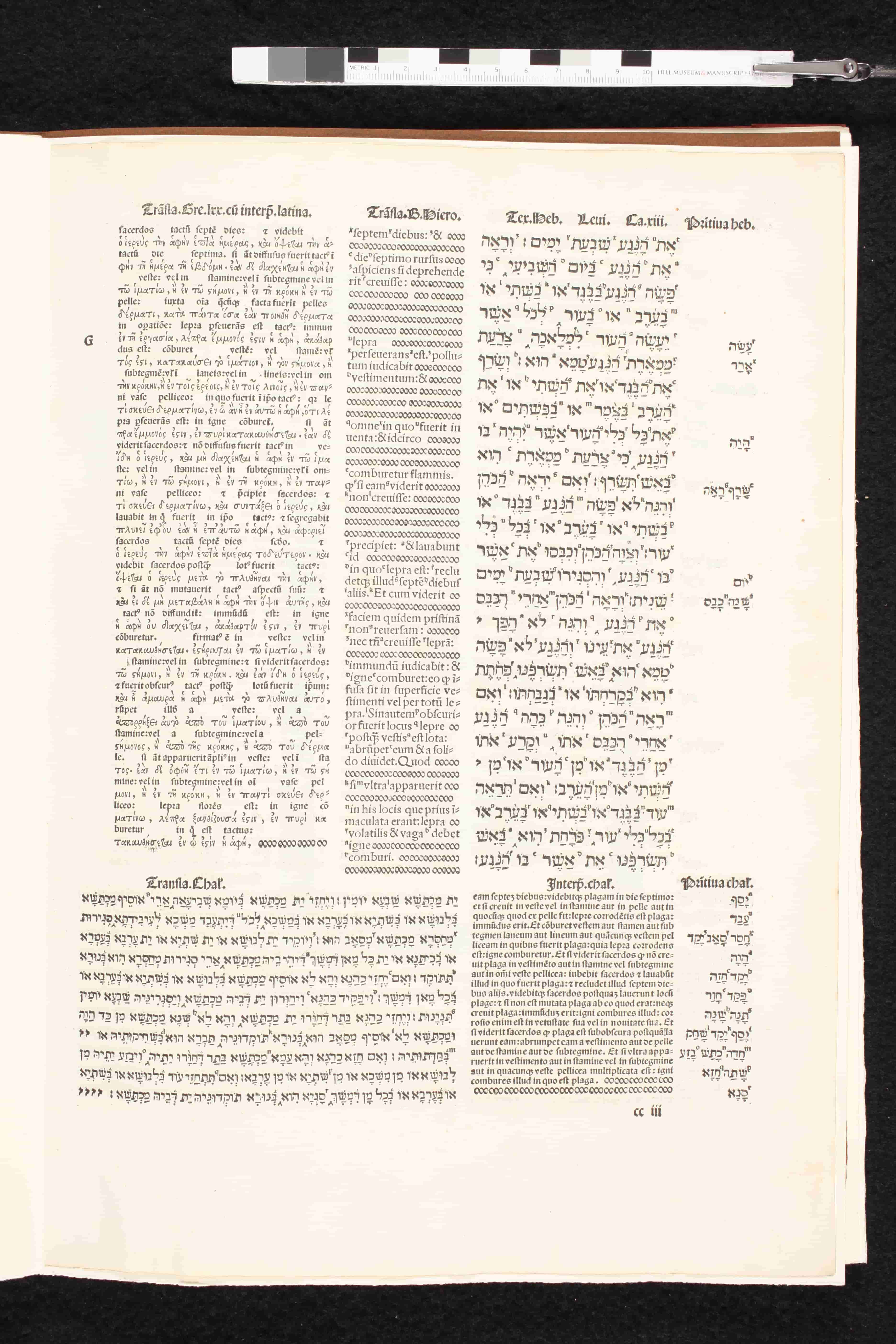
Leaf from The Complutensian Polyglot Bible.
Acalá: Complutense University, 1514-1517.
The Complutensian Bible of Acalá (also known as The Complutensian Polyglot Bible) was the first printed multilingual Bible. The idea for the project was conceived of by Cardinal Francisco Jiménez de Cisneros (1436-1517). The project took over ten years to complete and special print characters had to be designed to accommodate the different languages.
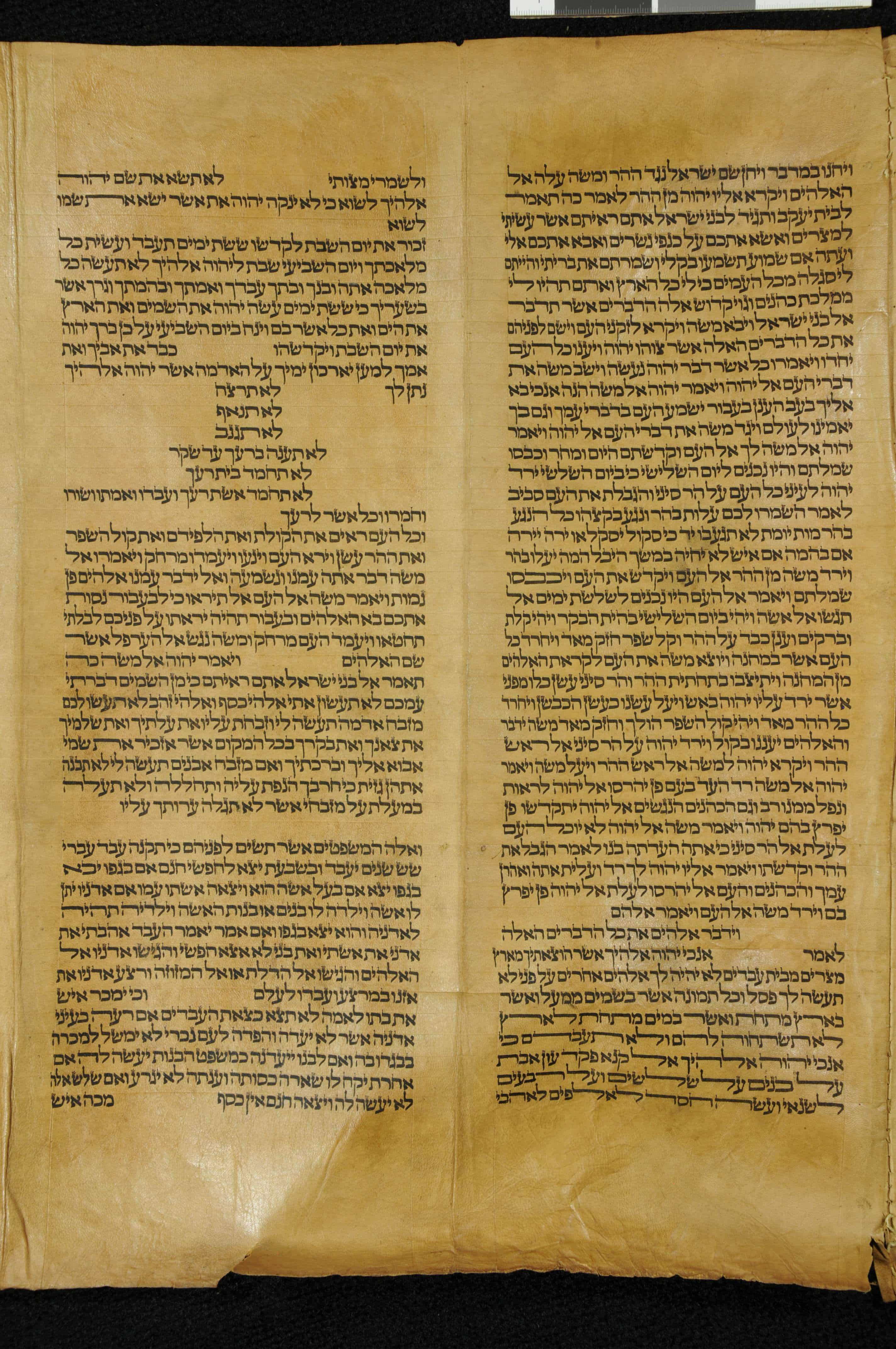
George Fox University Torah Scroll.
In Judaism, a Torah scroll is a handwritten copy of the Torah on a long, continuous piece of parchment. The Torah, the first five books of the Hebrew Bible, serves as a source of instruction for the faith’s adherents.
On display here are the Ten Commandments. This scroll was copied in North Africa, likely Morocco, between 1750 and 1850.
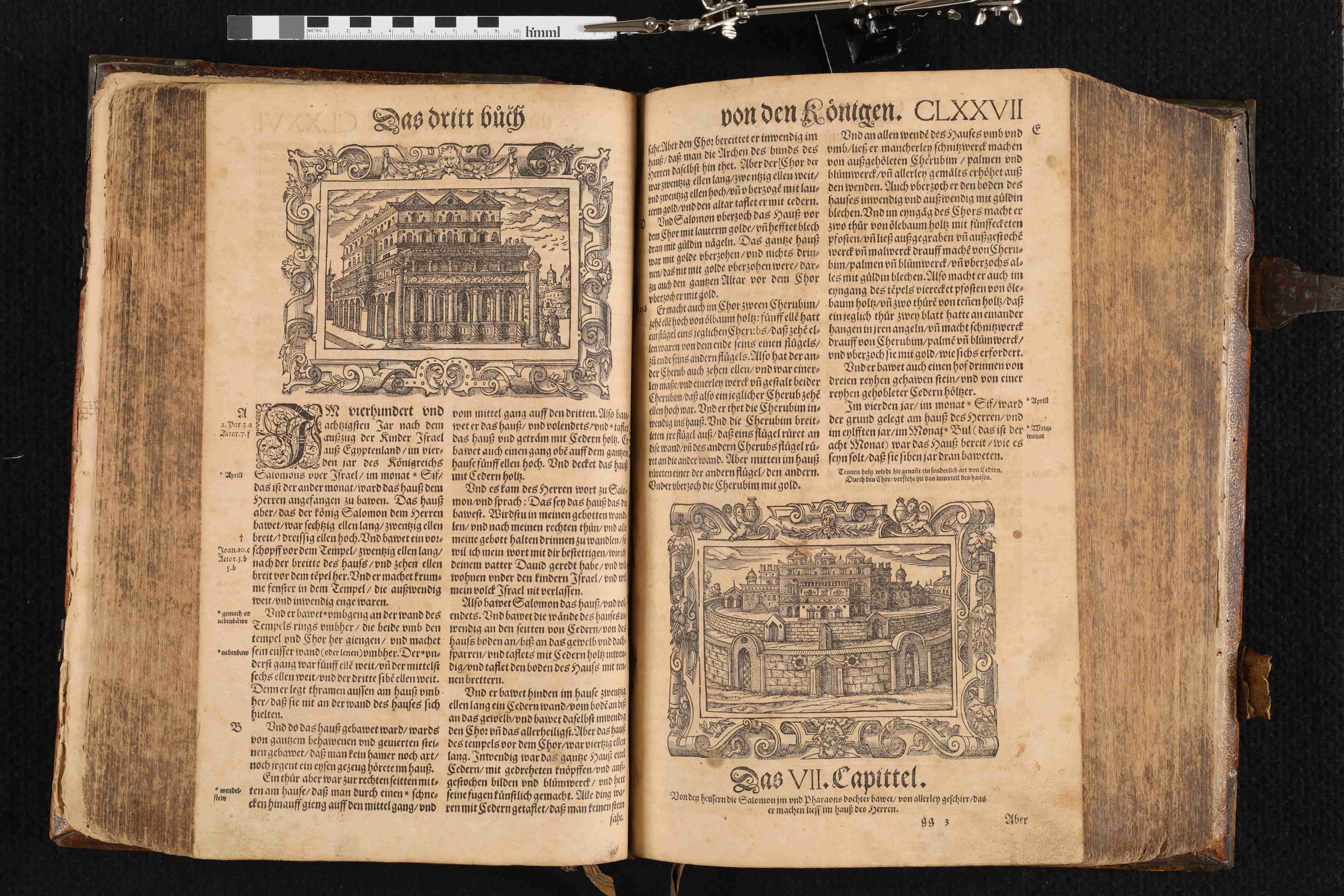
Johann Dietenberger. Catholische Bibell: Das ist alle Bücher der H. Schrift.
Cologne: Durch Gerwinum Calenium vnd die Erben Johan Quentels, 1584.
Johann Dietenberger, a Catholic theologian, published his German translation of the Bible in response to Martin Luther’s. His translation also drew from Greek and Hebrew texts but gave preference to the Latin Vulgate and Catholic teachings, whereas Luther’s leaned towards Protestant beliefs.
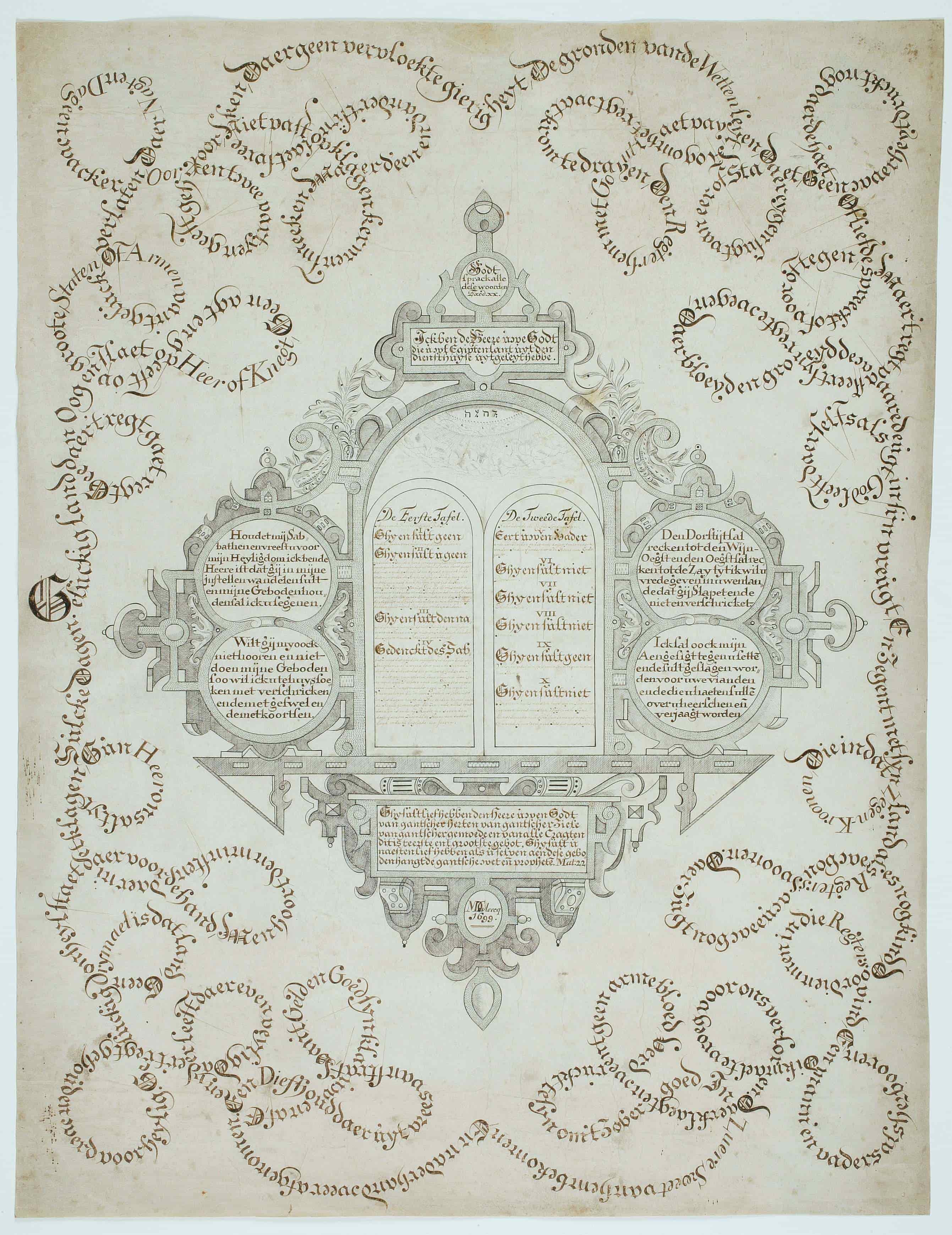
M.D. Clercq. Godt sprack atte dese woorden...
1699.
The Ten Commandments, seen here in Dutch the center tablets, provide a moral and ethical framework for followers of Judaism and Christianity, though interpretation differs among the different religious traditions.
The calligrapher, M. D. Clercq, is known only through this work and one other calligraphic piece that has survived from 1691.
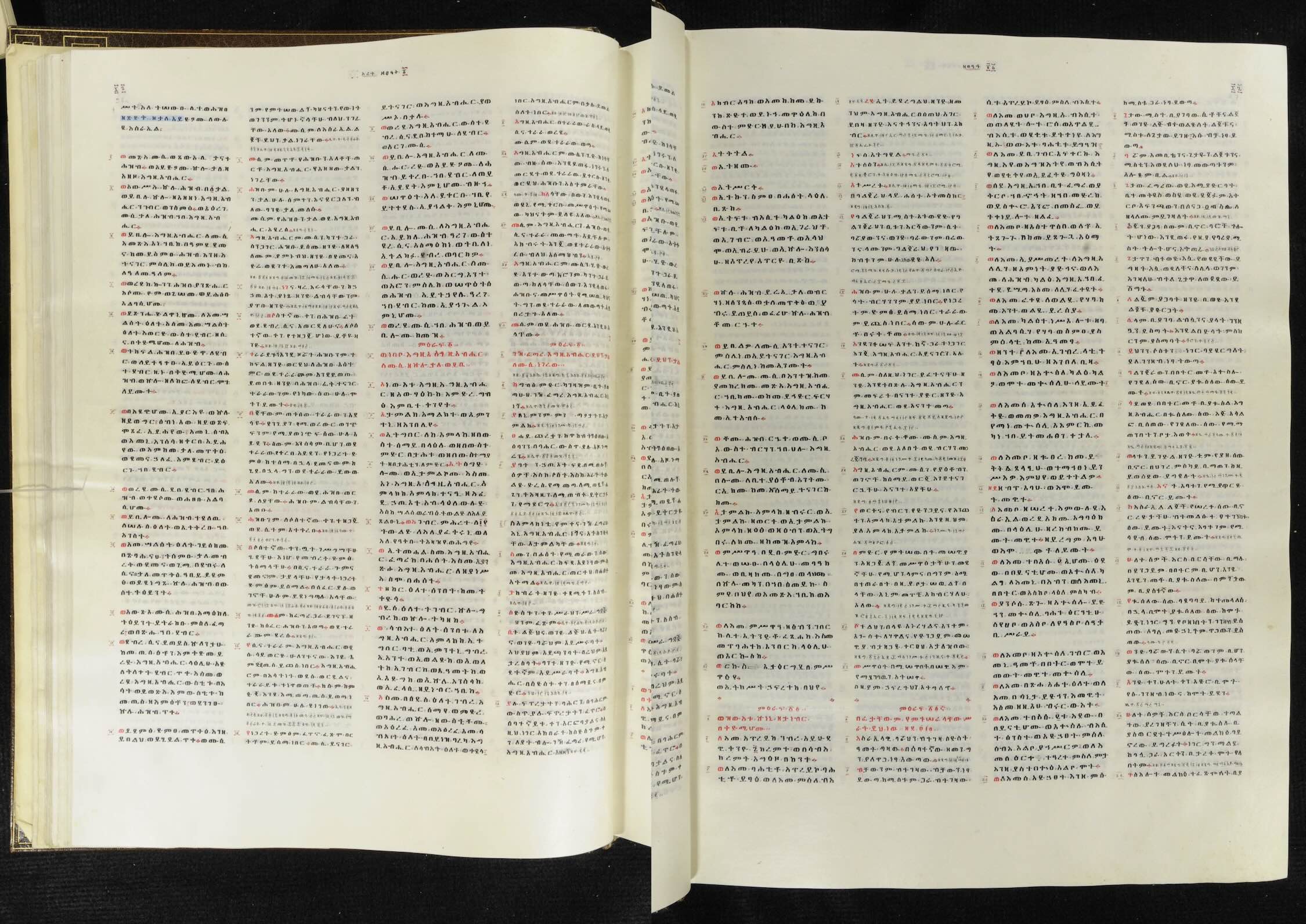
Bible.
20th Century, copied for Ḫāyla Śellāsē, Emperor of Ethiopia.
The pages shown here contain the Ten Commandments in both Ge’ez and Amharic. Ge’ez and Amharic are two Semitic languages that are used throughout Ethiopia, though they serve different purposes. Whereas Ge’ez is the primary liturgical language of the Ethiopian Orthodox Church, Amharic is the official language of the Ethiopian government, with over 33.7 million native speakers in the country as of 2020.
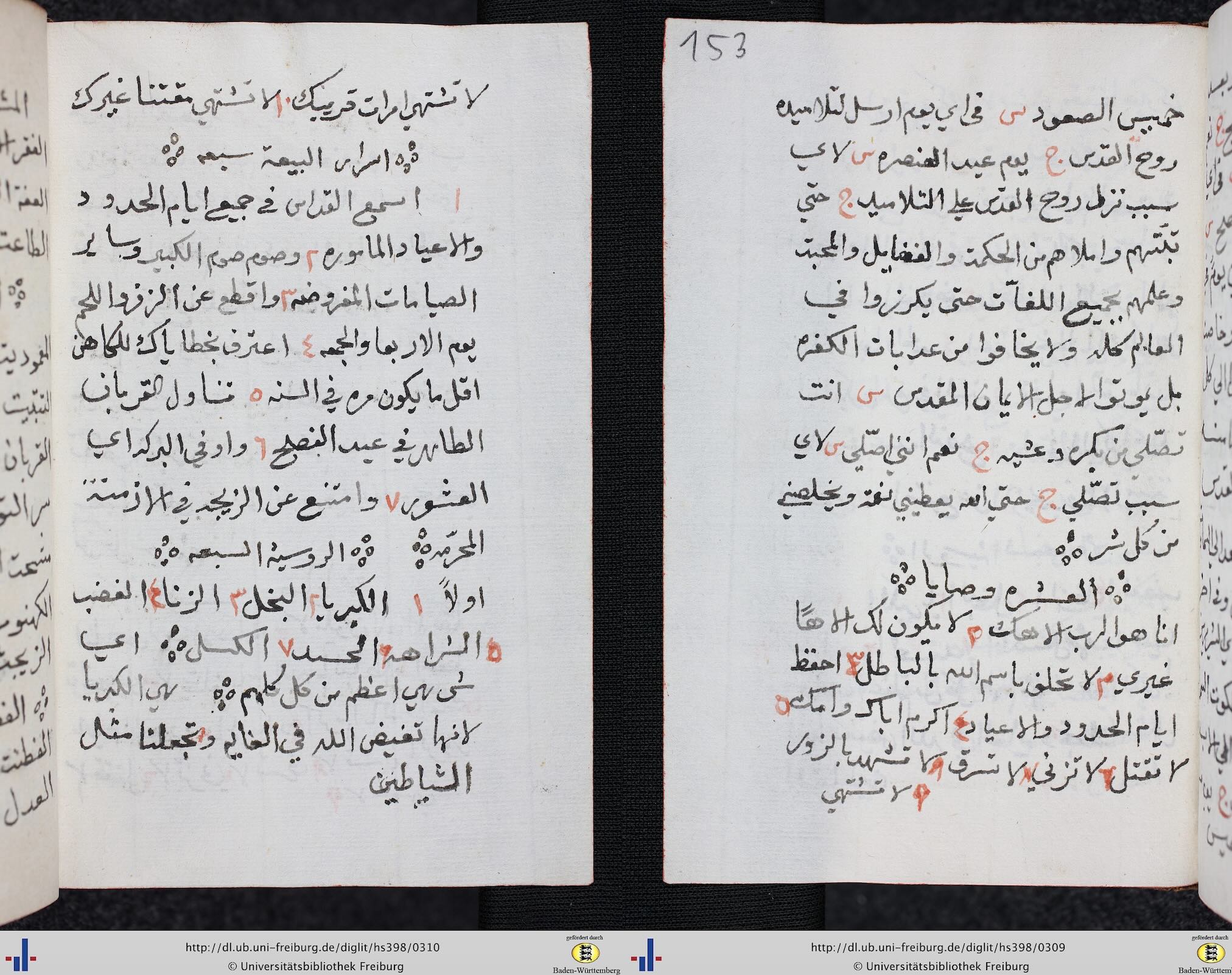
Psalter.
Vienna, Austria, 1778.
This page shows the Ten Commandments written in Arabic. It comes from a Psalter, a Book of Psalms, that also includes the Catechism and lists of important Christian terms.
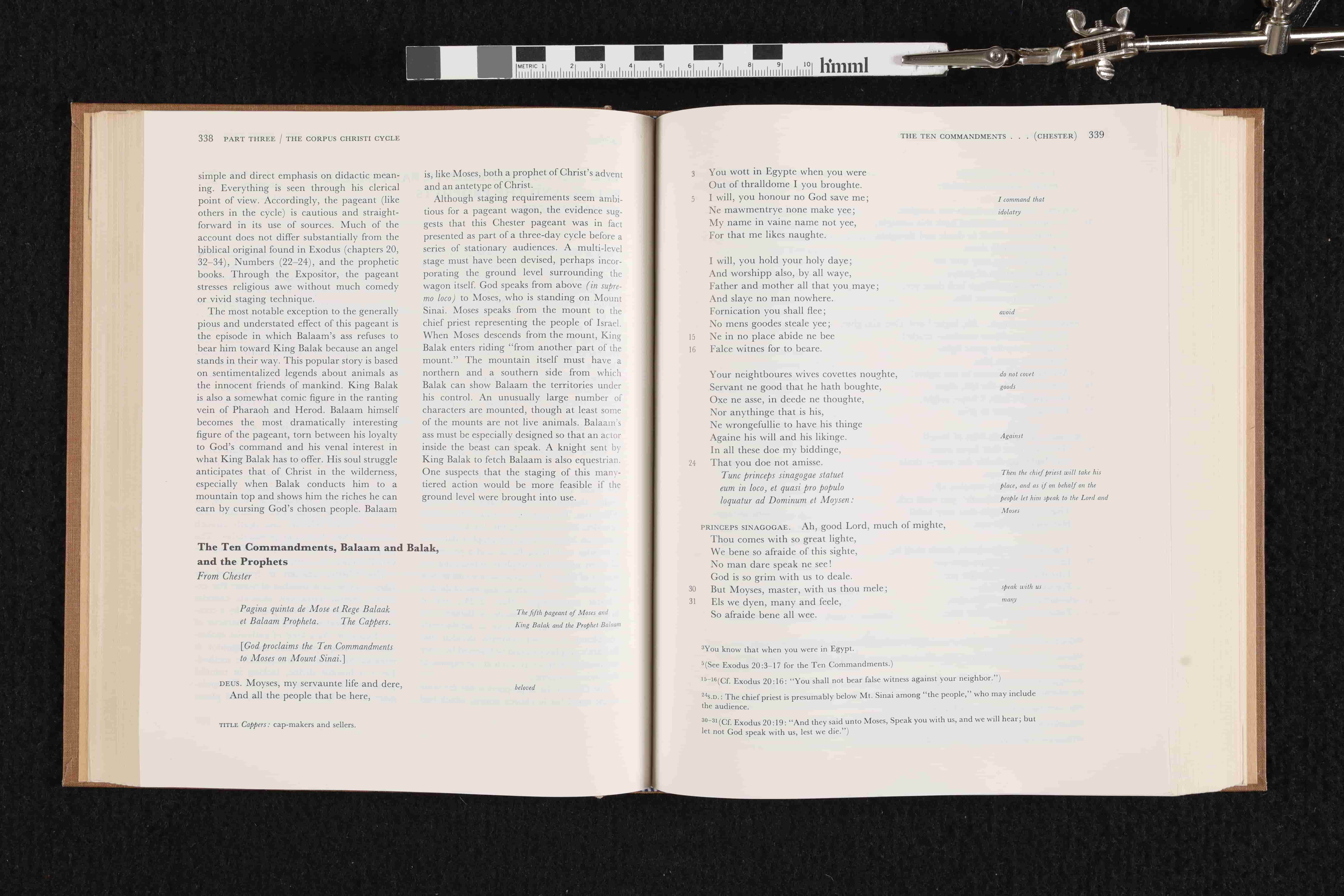
David Bevington. Medieval Drama.
Boston: Houghton Mifflin, 1975.
The Ten Commandments are featured here in a play from the Chester Mystery Cycle, believed to have been composed in the 14th century and performed by monks. In a time where literacy was low, plays such as this one were an excellent way to convey Biblical stories and morals.
David Bevington’s edition of medieval plays presents their text in the original Middle English alongside glosses and footnotes to aid modern English readers.
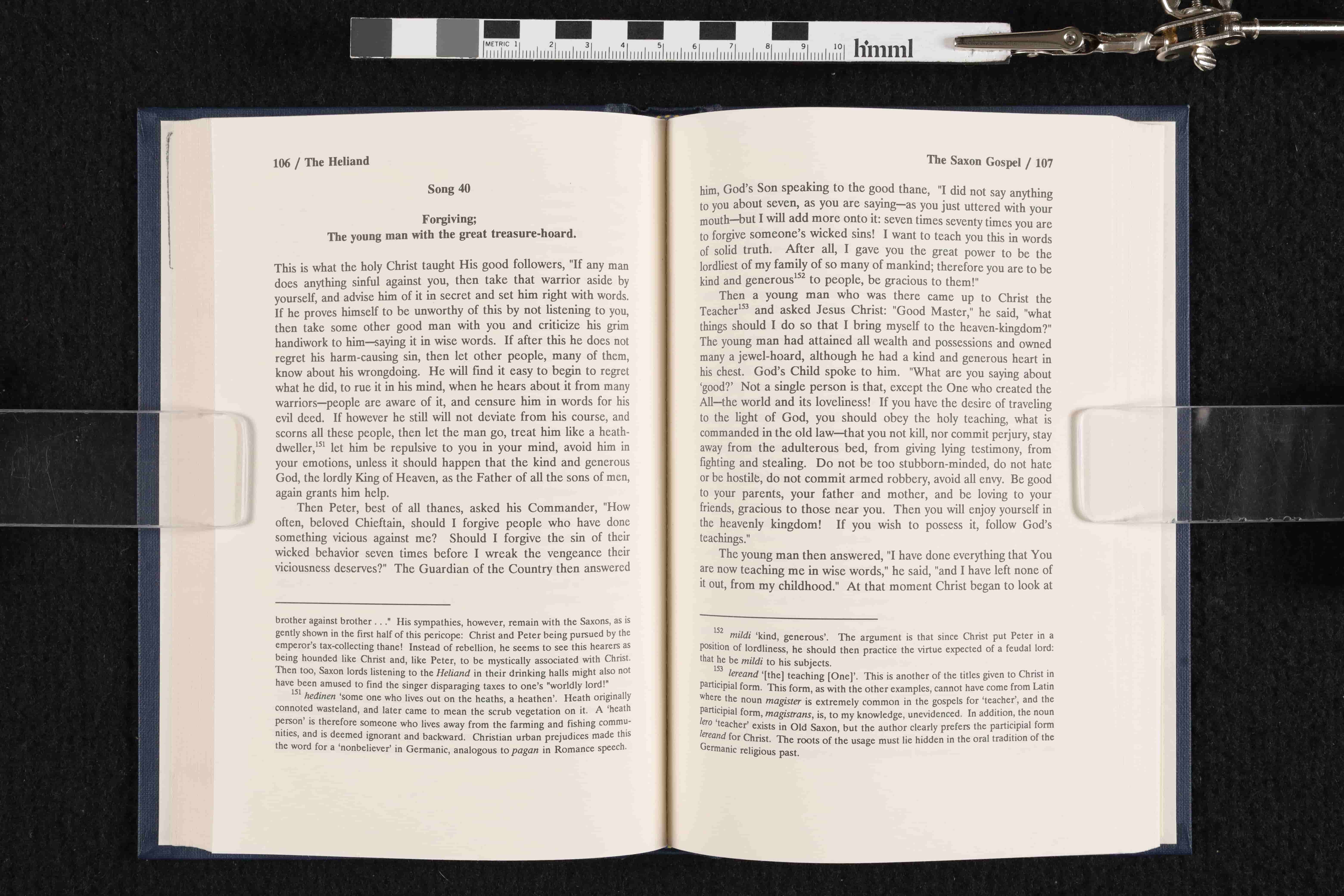
G. Ronald Murphy. The Heliand: The Saxon Gospel.
New York: Oxford University Press, 1992.
The Heliand is an epic poem written in Old Saxon, paraphrasing the Bible and the life of Jesus. The poem was created in the 9th century to facilitate Saxon conversion to Christianity and shows a blend of values and perspectives from Christian and Germanic warrior societies.
Ronald Murphy translated this paraphrase into modern English to help bring these cultural interactions to the fore. Some of the items of the Ten Commandments can be read in Jesus’s instructions to the young ruler.
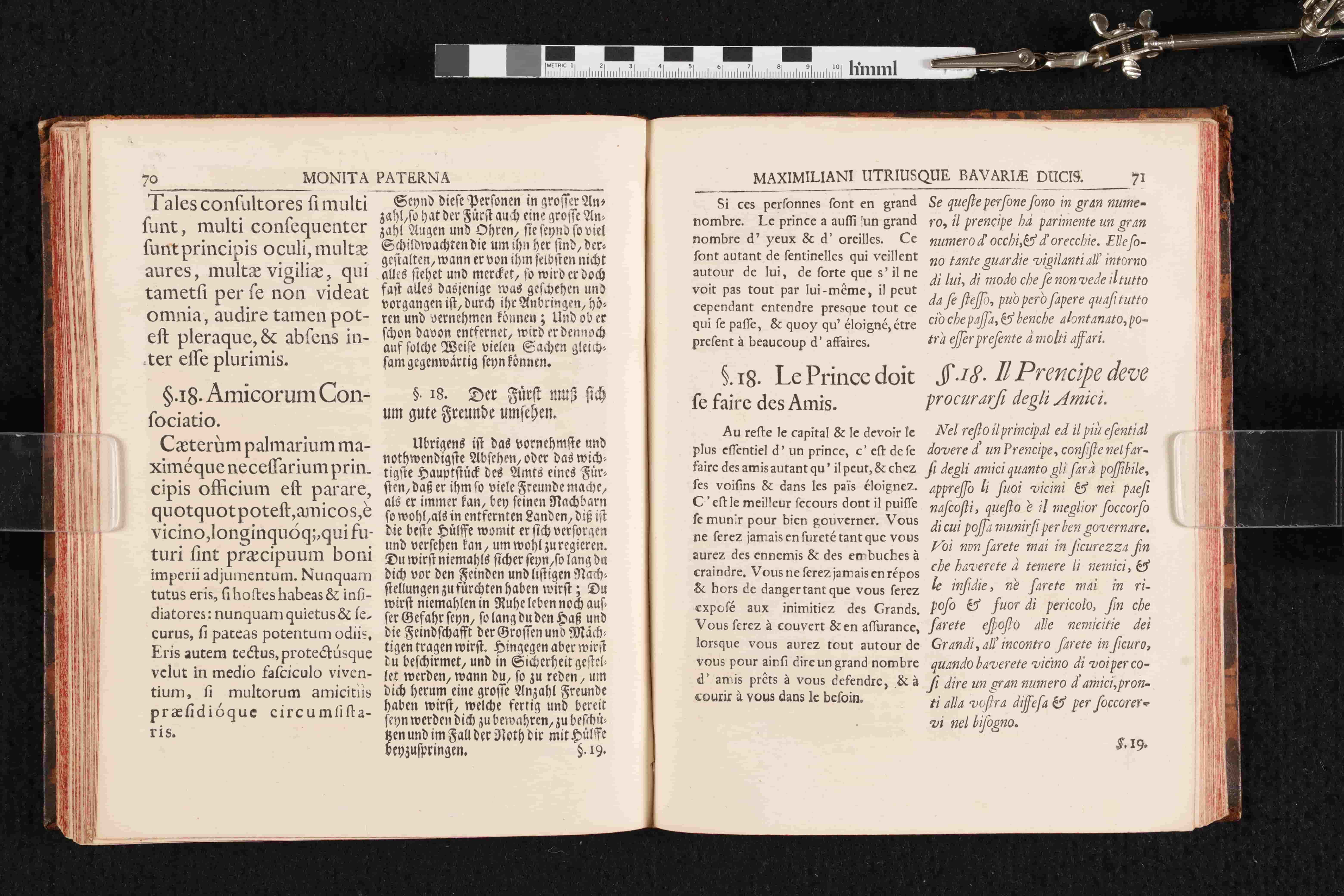
Monita paterna Maximiliani utriusque Bavariae Ducis.
Ratisbonae : Apud Joh. Henr. Böhm, 1730.
Maximilian I (1573-1651, Duke of Bavaria), composed a set of guidelines to live by for his son and future descendants. This Monita paterna was modeled after the Monita et exempla politica by Justus Lipsius (1547-1606), a guide to moral conduct for rulers.
This edition includes parallel translations into four languages.
Worth a Thousand Words
The English word “to translate” comes from Latin, meaning literally “to carry from one thing to another.” Often illustrations accompanying text can help carry the text’s meaning across; this is especially helpful for anyone unable to read the words. However, sometimes the words themselves can form a picture.
The creative display of words on the page can provide helpful diagrams, add beautiful decoration, or create playful visuals. In this way, the words’ shapes may add further meaning beyond the text.
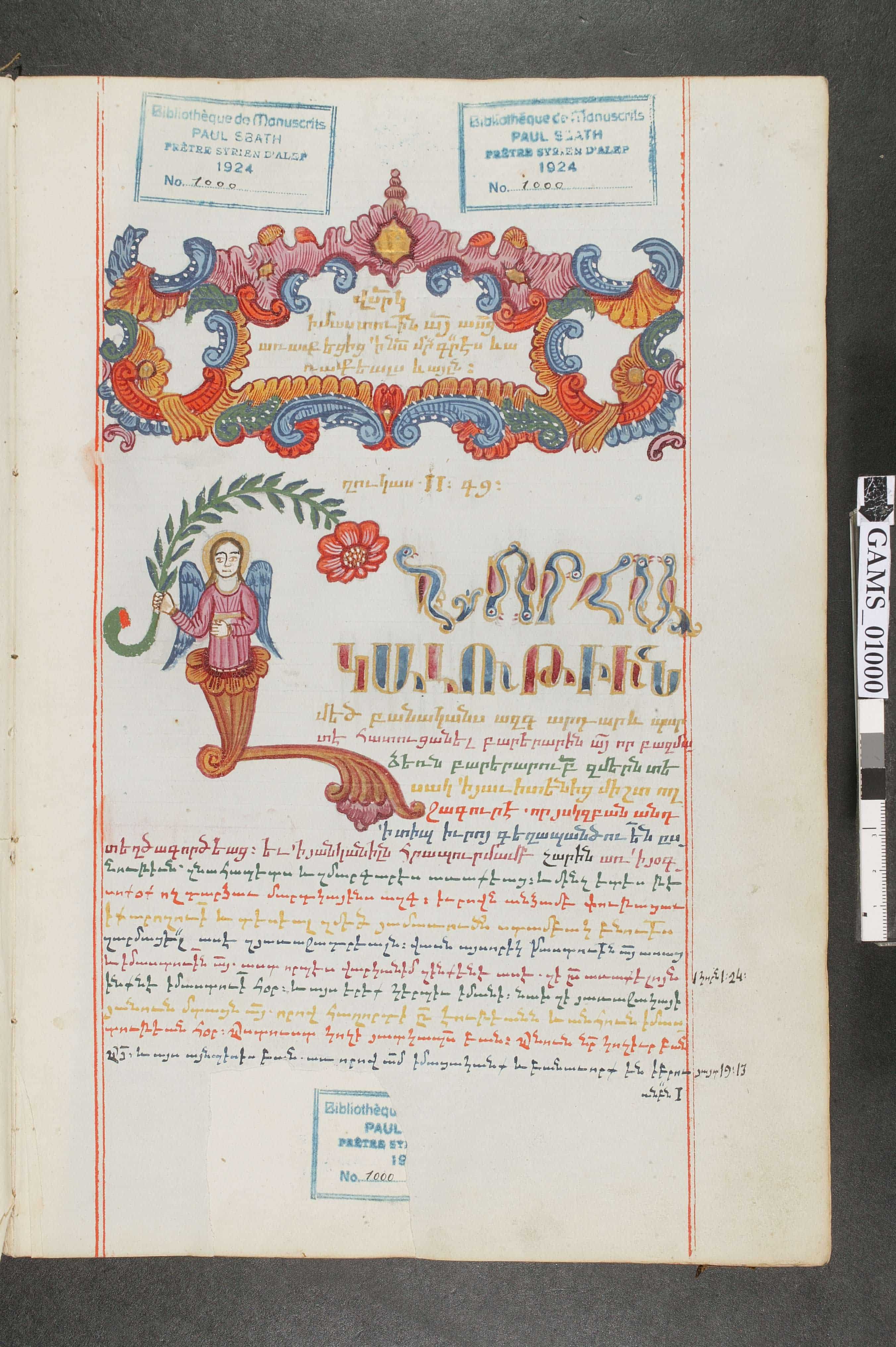
Petros Aghamalean. Kʻarozgirkʻ (Book of 37 Sermons).
1820.
This book of sermons was written by Petros Aghamalean, a Vardapet of the Armenian Apostolic Church. This page offers a sermon on Luke 11:49. Above the sermon are zoomorphic letters, formed from birdlike creatures reading “With gratitude.”
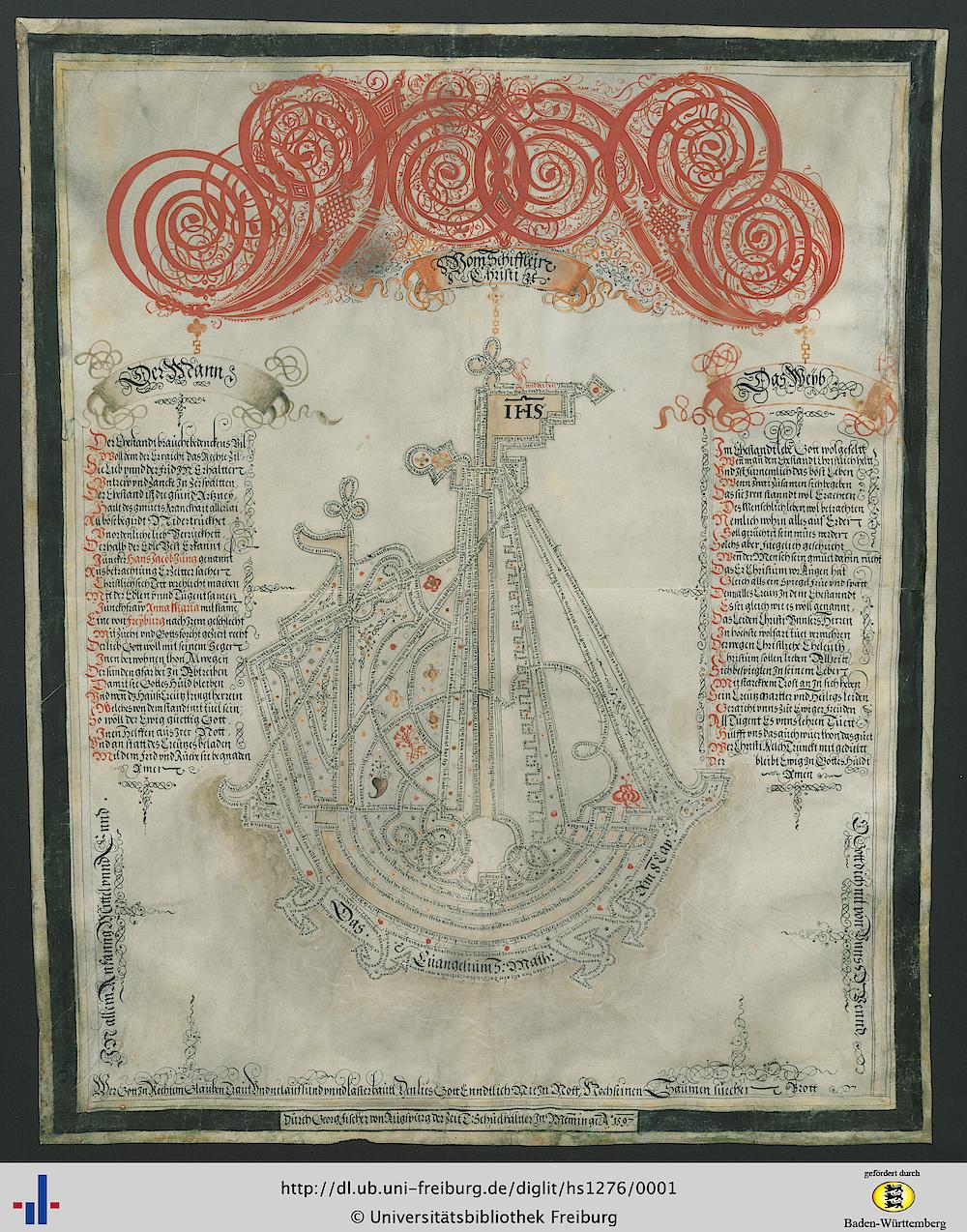
Georg Fischer. Vom Schifflein Christi.
Memmingen, Germany, 1597.
This manuscript contains two celebratory poems, addressing a bride and groom, and excerpts from Chapters 8 and 9 of the Gospel of Matthew regarding Christ’s calming of the storm. The passages from Matthew are written in a way that forms a two-masted sailing ship.
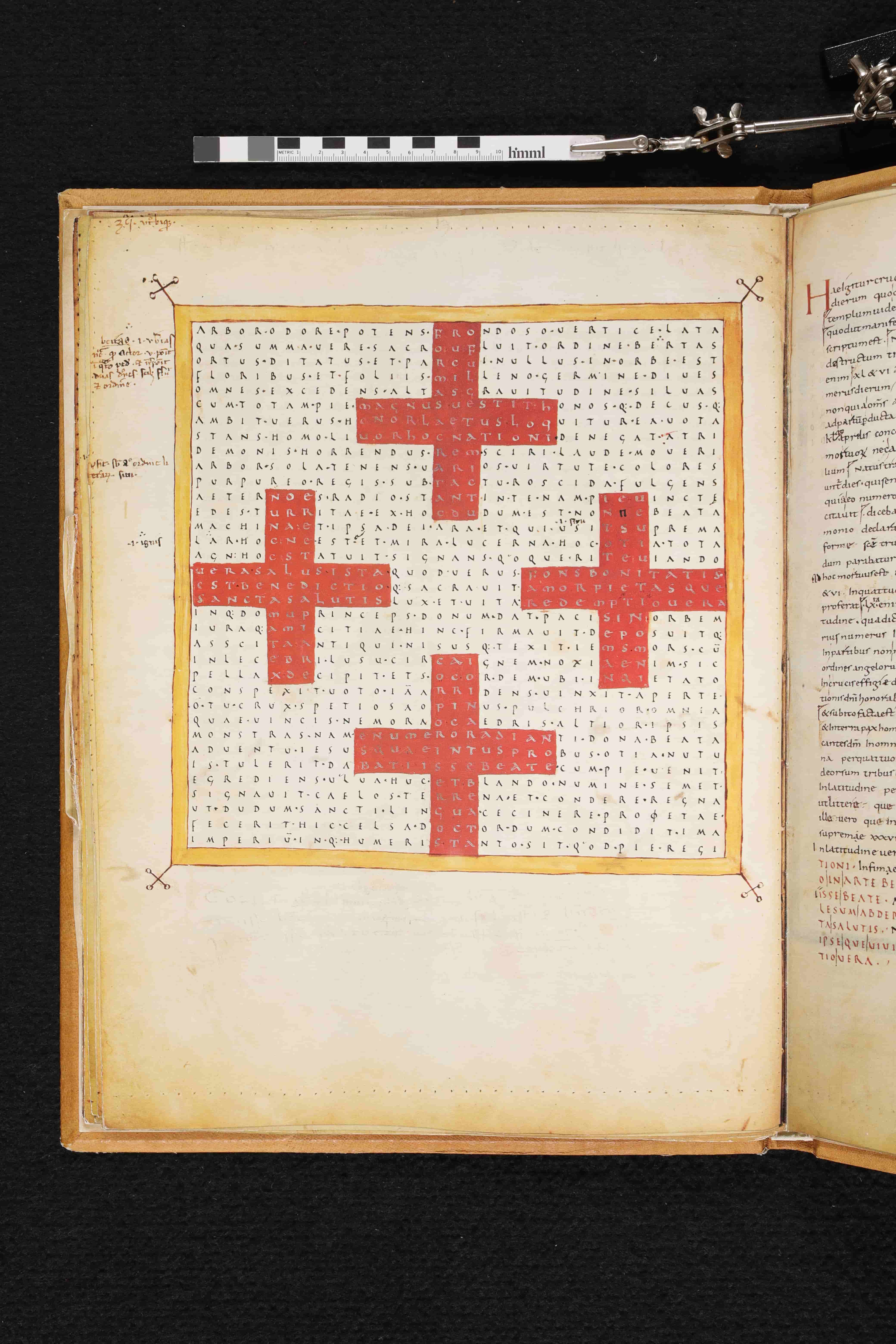
Facsimile of Liber de Laudibus Sanctae Crucis.
Memmingen, Germany, 1597.
Liber de Laudibus Sanctae Crucis is a book of pattern poetry by Rabanus Maurus, a 9th century Benedictine monk. Combining text and visuals, Maurus’ poems strongly resemble modern word searches, with the poems (often illuminated in colored boxes) surrounded by unrelated letters.
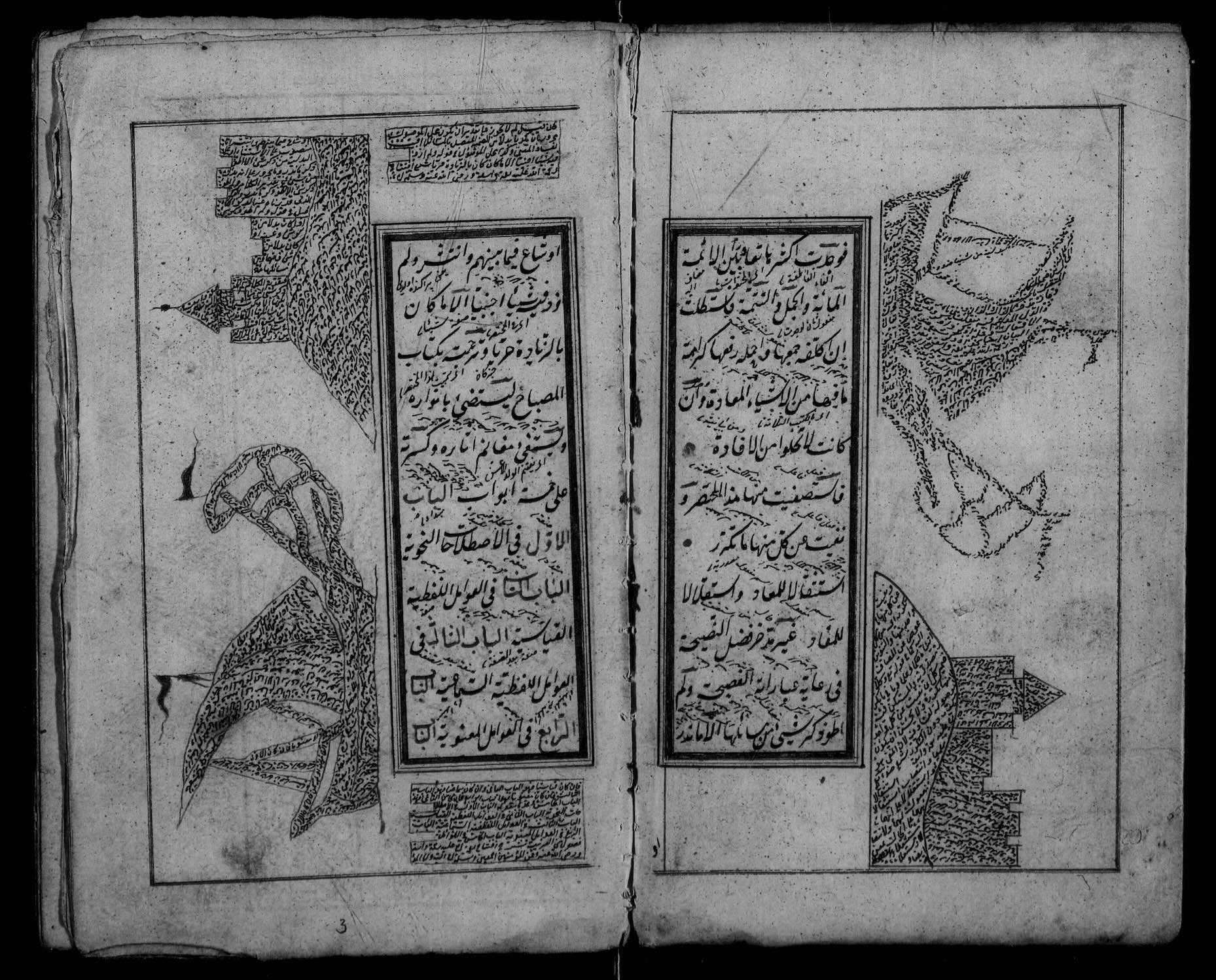
Nāṣir ibn ʻAbd al-Sayyid Muṭarrizī. Arabic grammar.
Turkey, 1568.
Some sects of Islam forbid the depiction of living beings, even in non-religious art. So, many Muslim scholars and scribes turned towards word art, calligraphy, and elaborate patterns to decorate their works. This is seen in this piece, where two opposing scenes are sketched out in Arabic, showing boats approaching a castle. While the text concerns Arabic grammar, it includes interlinear commentary in Turkish.
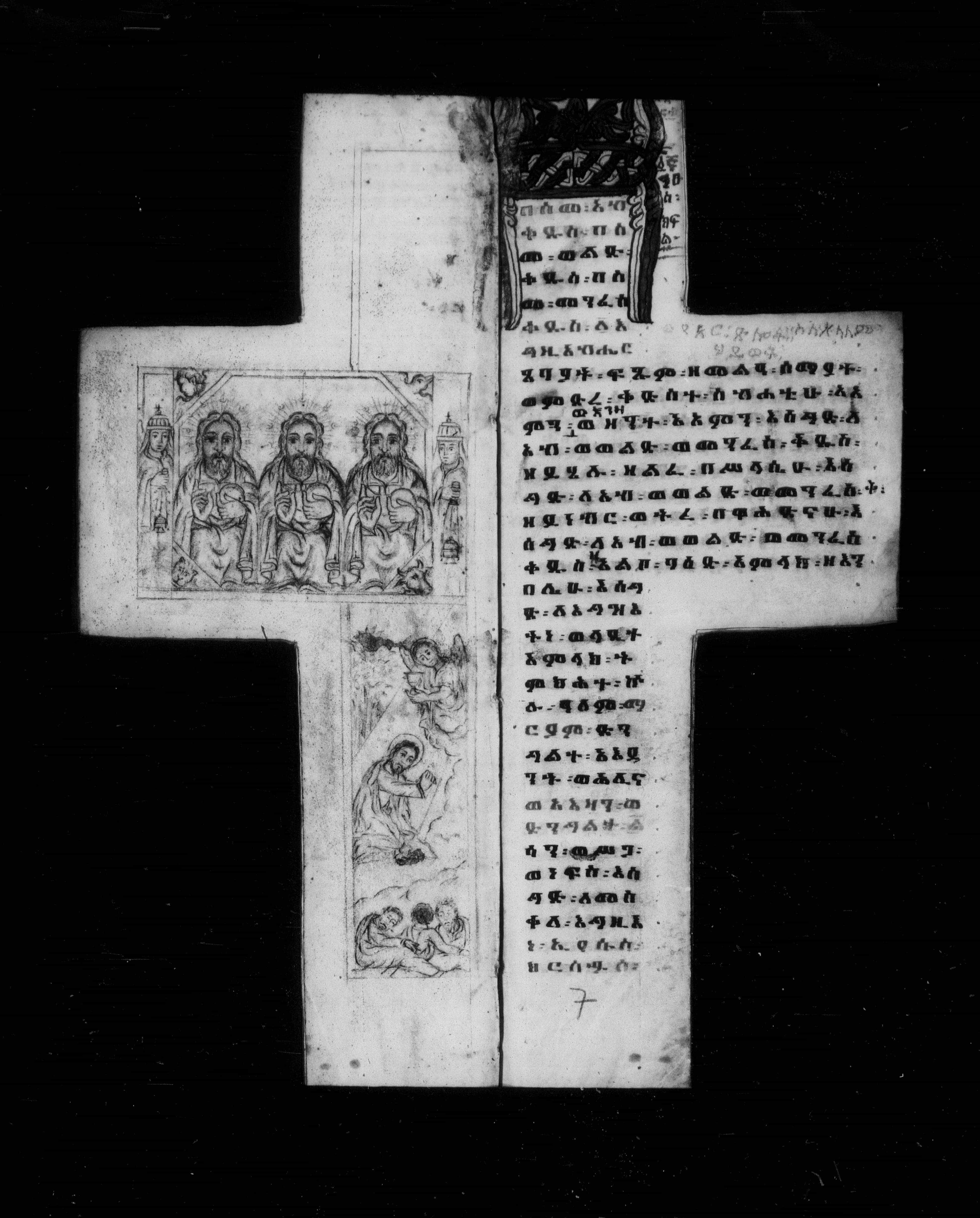
Dersāna māḥyawi.
Ethiopia, 20th century.
The Dersāna māḥyawi (Homiliary of the Savior) is a collection of stories. The unique thing about this manuscript, however, is its shape. Cut to form a cross when opened, the unusual shape was likely a marker of the wealth of the owner. Losing the corner spaces on each leaf of parchment meant more pieces had to be used, increasing the expense.
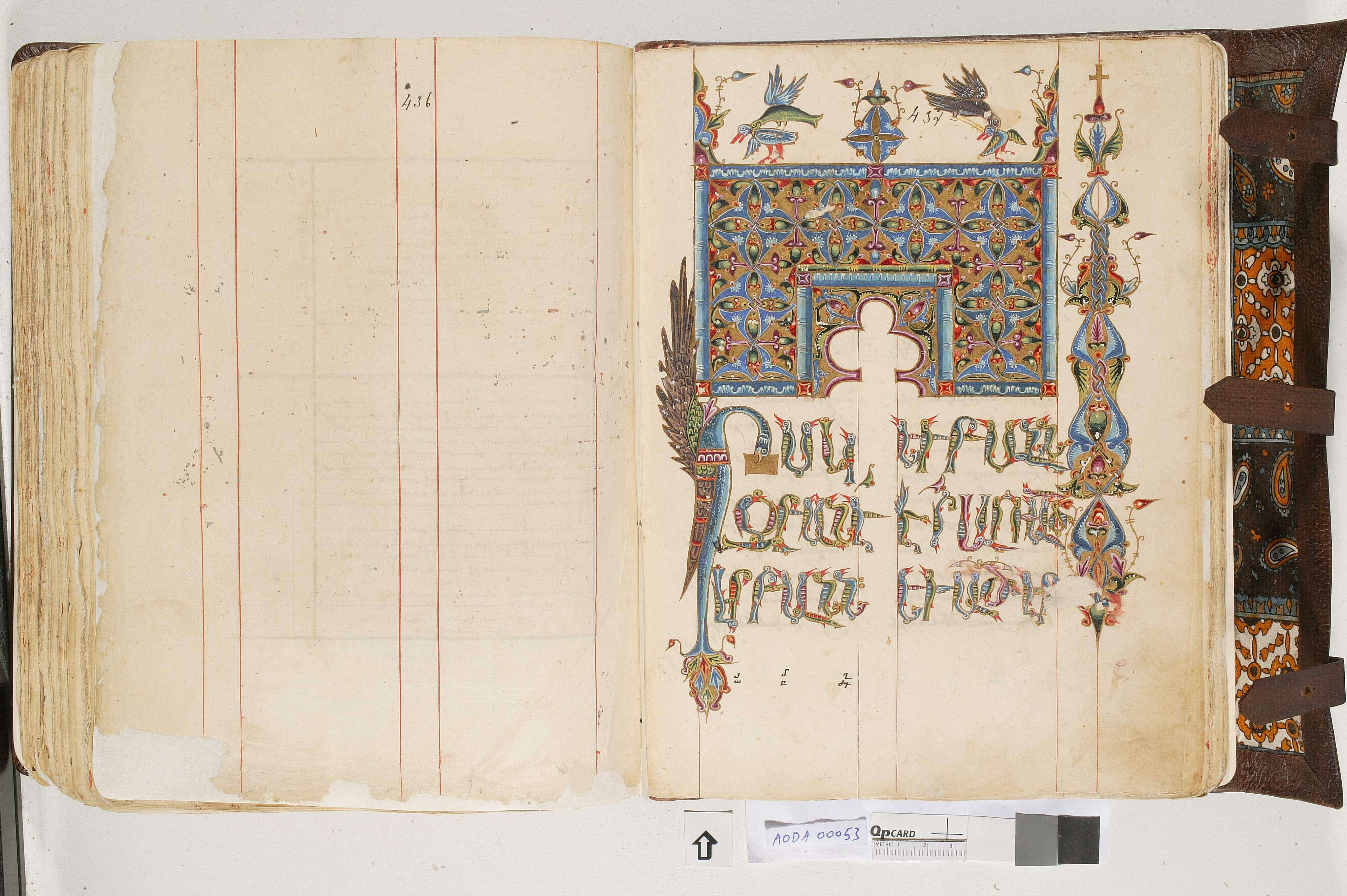
Gospels.
Aleppo, Syria, 1629.
This copy of the gospels, written in Armenian, is open to the beginning of the Gospel of John. Beneath the ornate headpiece, the letters of the gospel are formed by detailed birdlike creatures.
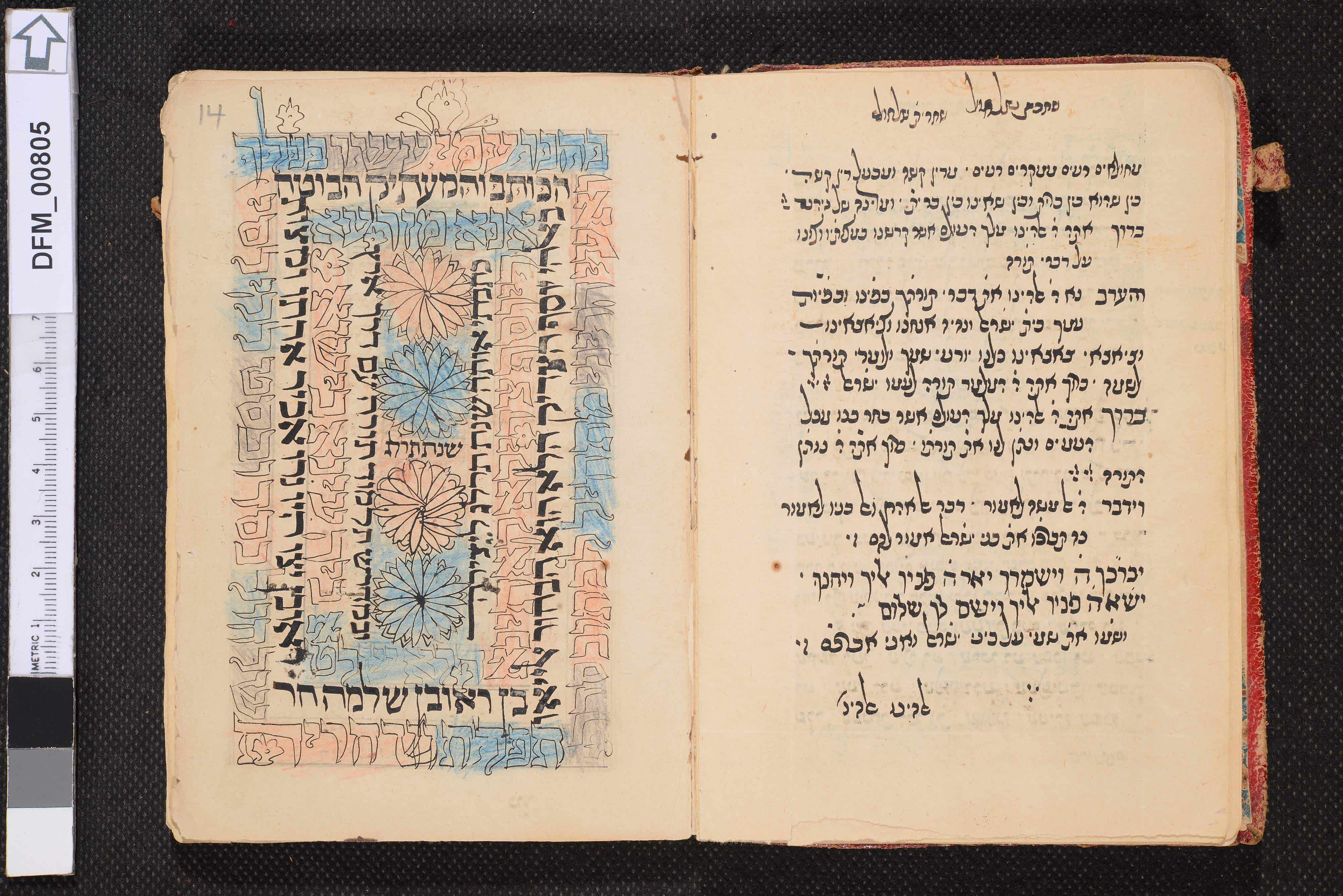
Eliya’v ben Re’uven Shelomoh. Prayers and liturgical texts.
Aleppo, Syria, 1629.
This elaborate colophon contains information on the manuscript’s scribe, Eliya’v ben Re’uven Shelomoh (אלייאו בן ראובן שלמה), and the manuscript’s publication. Eliya’v’s name appears wrapping around the lower right corner. The date of publication (1872) is given in the center, between the two sets of flowers.
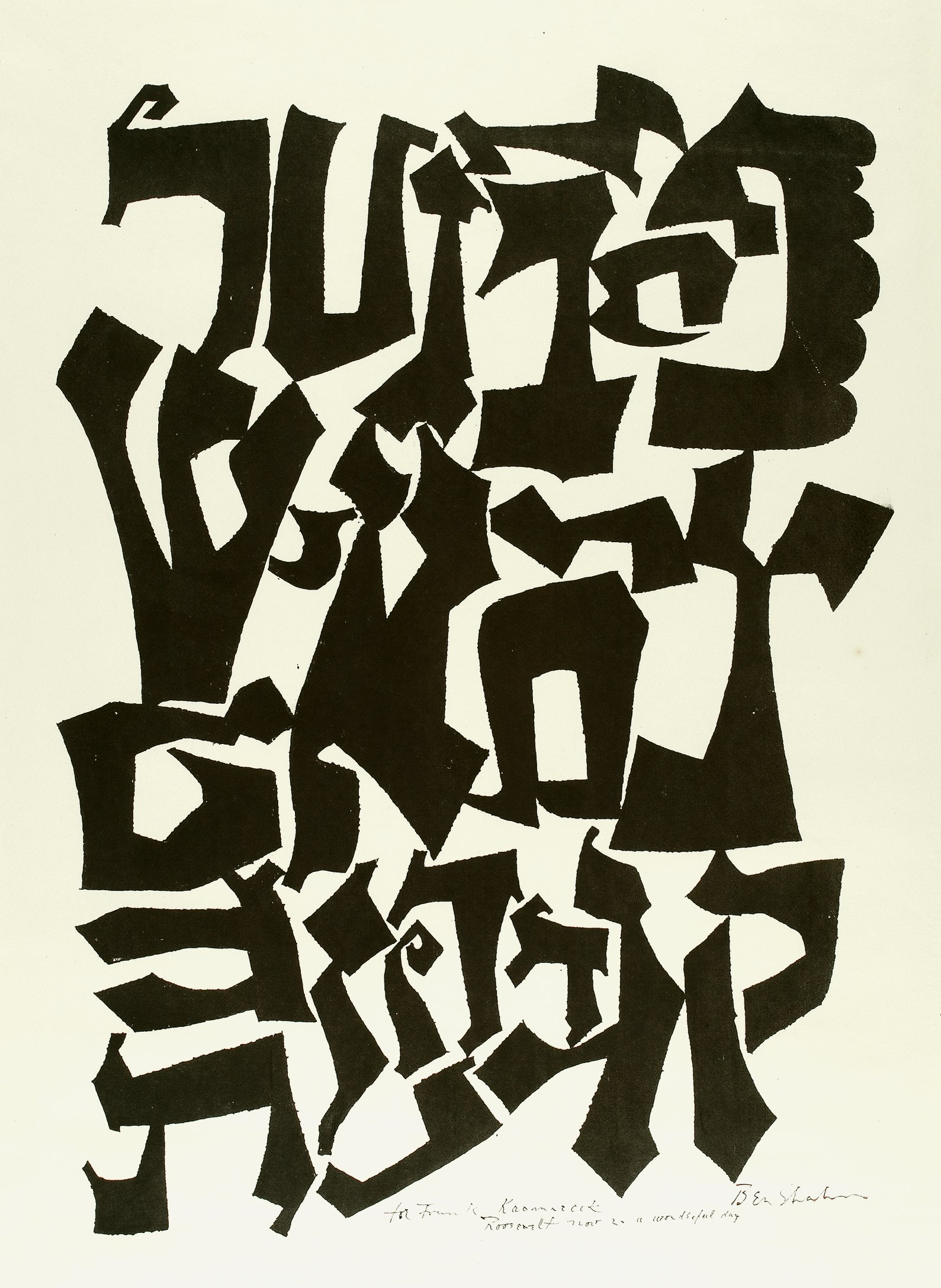
Ben Shahn. The Alphabet of Creation.
United States, 1957.
Ben Shahn (1898-1969) was born to a Jewish family in Russian-occupied Lithuania. His family emigrated to the U.S. in 1906. Shahn was an artist and photographer. This print, Alphabet of Creation, shows a stylized Hebrew alphabet curling around the page in a compact design.
Frank Kacmarcik received this print from Shahn after they spent the day together in Shahn’s home in Roosevelt, New Jersey. Shahn’s signature can be seen in the lower right corner.
Curator(s)
Dr. Jenn Carnell, Cataloger of Western Manuscripts; Rylie Owen (CSB+SJU Class of 2026)
Credits
Catalogers, curators, associates, staff, and interns graciously supplied recommendations and information for many of the objects displayed in this exhibition: Jeremy Brown, Constanta Burlacu, Ali Diakite, Katherine Goertz, Matt Heintzelman, Josh Mugler, Paul Naylor, Taylor Samuelson, Ani Shahinian, Columba Stewart, Catherine Walsh.
We are grateful for their assistance!
Jenn Carnell and Rylie Owen, curators