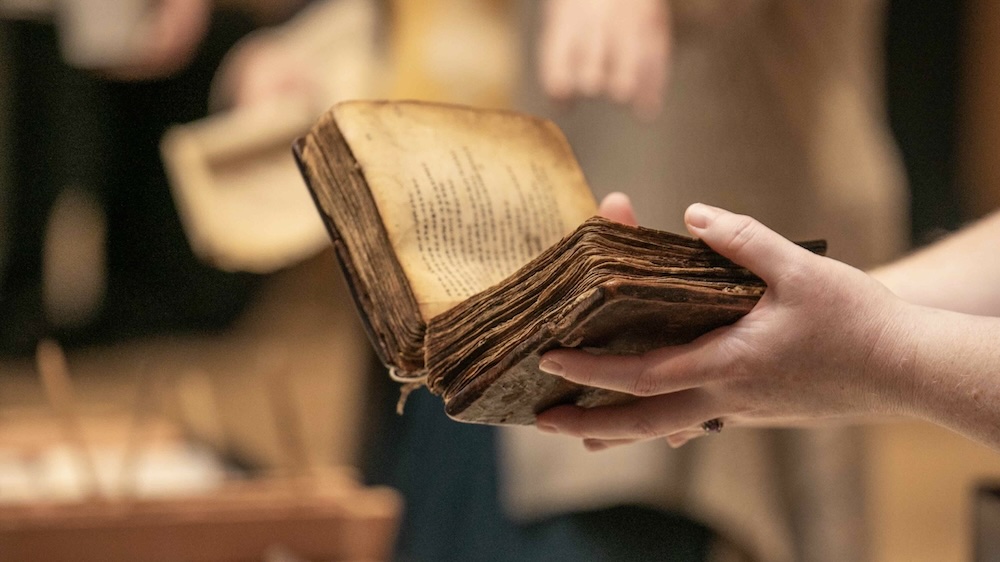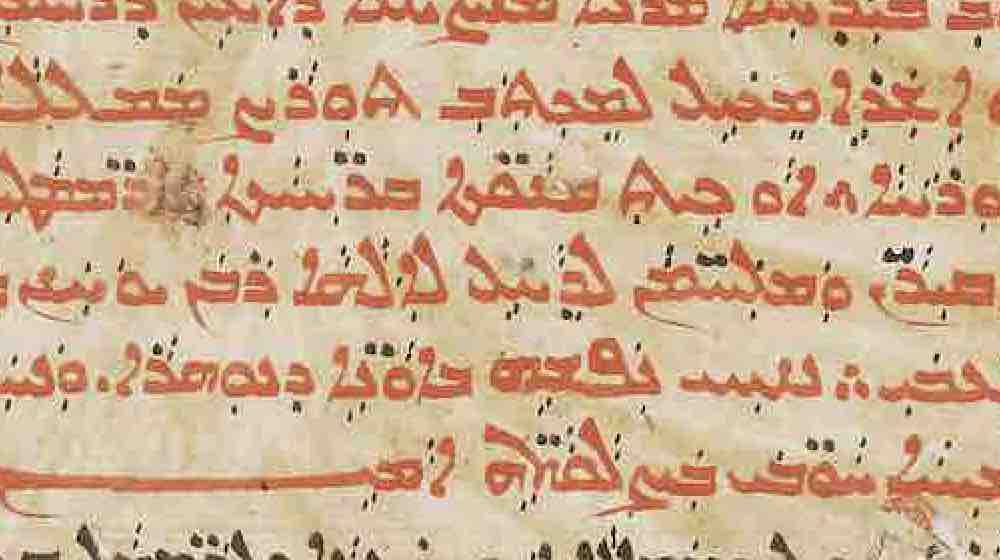
Arabian Nights In Timbuktu: The Story Of The Judge And The Thief
Arabian Nights in Timbuktu: The Story of the Judge and the Thief
This story is part of an ongoing series of editorials in which HMML curators and catalogers examine how specific themes appear across HMML’s digital collections. From the Islamic collection, Dr. Ali Diakite and Dr. Paul Naylor have this story about Tricksters.
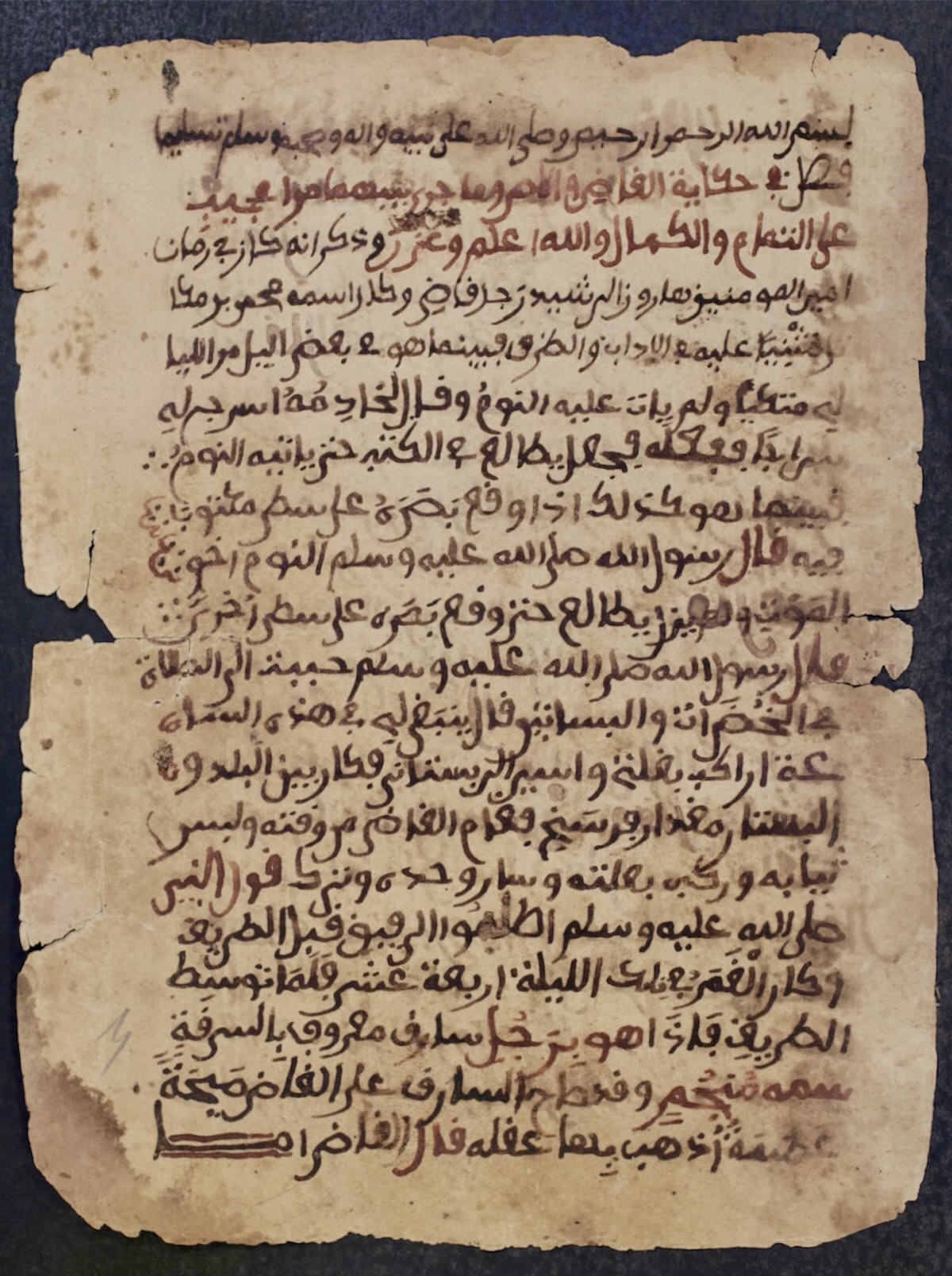
The Story of the Judge and the Thief, a story about a trickster, was evidently very popular in West Africa: HMML preserves digital copies of more than 40 manuscripts containing this story, located across 11 libraries in Mali.
The story is mentioned in ʻUmar al-Tūrūdī’s list of “unreliable” books, meaning that it was in circulation at least as early as the 18th century. Although, like the Arabian Nights, it is set in the time of Caliph Hārūn al-Rashīd (who lived approximately from approximately 763 to 809 CE), the story seems to have been written locally in West Africa. As such, it fits within a tradition of West African Arabian Night style spin-offs, such as The Story of Tawaddud the Servant and others preserved in HMML’s Mali collections.
Unlike the original Arabian Nights, whose primary purpose was to entertain, these tales educate through entertainment. Knowledge about the Islamic faith and religious practices, as well as general notes on moral conduct, are skillfully woven into the narrative, so that even those who may not have paid attention in a traditional school setting would in this way learn some fundamentals of their faith.
Within The Story of the Judge and the Thief, there are accurate citations from the Qur’an but, interestingly, other quoted passages—such as “sleep is the brother of death” and “I prefer prayer in the forest and the orchards”—are presented in the story as hadiths but are not actually authentic sayings of the Prophet Muḥammad. It is likely for this reason that the book appears on al-Tūrūdī’s list.
Here is our translation of the story, from several different manuscripts in the Mali collections:
In the time of Hārūn al-Rashīd there was a judge named Muḥammad ibn Muqātil. The man was educated, eloquent, and good-humored, but on some nights sleep did not come to him easily. One evening he told his servant to light the lamp so that he could read until he fell asleep. As he was drifting off his eye landed upon the line: “sleep is the brother of death”, and he did not read again until another passage, “I prefer prayer in the forest and the orchards.”
“If this is the case,” thought the judge, “instead of sleeping I would rather get on my mule and head out to my farm.” Now, between the town and the judge’s farm was a distance of around three miles. The judge got up, put on his robe, and set off alone on his mule, neglecting the words of the Prophet, “Before finding the route, find a companion.” The moon was full, and when the judge was halfway there, a man suddenly appeared before him, a known thief by the name of Munajjim. “Have you no shame?” said the judge, “I am a judge of the believers.” The thief replied, “You are a judge of the believers, and I am a thief of the believers.”
“I am astounded at you!” replied the judge. “And I am even more astounded at you,” said the thief, “going out at this time of night alone, travelling the road with no companion. This situation is a result of your own stupidity.”
“I had thought that the morning was approaching,” replied the judge. “Now I am all the more astounded at you,” said the thief, “for how can you be a judge of the believers if you don’t know the time nor the hour?”
The thief then explains to the judge exactly what time of the night it is by means of the visible stars and their positions in the night sky.
“Aha! Woe betide you!” said the judge in riposte, “Do you not know the saying of the Prophet, ‘He who places their trust in the stars has committed apostasy before God’?”
“I know it,” replied the thief, “but you took the words of the Prophet and neglected the words of Almighty God.” “How so?” said the judge.
“Indeed, ‘We have placed constellations in the sky, and adorned it for all to see’” [Qurʼan 15:16] recited the thief, “And, in another verse, ‘And He is the One Who has made the stars as your guide through the darkness of land and sea,’ [Qur’an 6:97] and He also said, ‘Also by landmarks and stars do people find their way.’” [Qur’an 16:16]
“You’re of course right,” the judge conceded. The thief continued, “So you claim to be a judge of the believers but you don’t even know the times for prayer, so be quiet in your ignorance and say no more and don’t give me any more sermons. Take off your robe, get off your mount and hand them both over to me. I am rather pressed for time.”
The judge and the thief continue in this manner, with both giving their side of the argument and the thief getting the upper hand. This is because the thief is able to turn the judge’s arguments against him using the Qur’an, as in this example:
The judge said, “For God’s sake, do not incite me further for it is Satan who incites Muslims.” The thief replied, “If I am Satan, that makes you a disbeliever.” “How can that be?!” asked the judge. “As God said, ‘Do you, O Prophet, not see that We have sent devils against the disbelievers, constantly inciting them?” [Qurʼan 19:83]
Finally, the judge has no choice but to give the thief his robe and his mule, as well as his ring. Dejected, he returns to his house on foot, naked, and remains there until morning prayers. The judge then sits in his chambers and relates to his companions what happened between him and the thief the previous evening. But his story is interrupted by a knock at the door:
The servant girl went to see who it was and there before her was a man dressed in the judge’s robe and riding his mule.
The thief has inexplicably turned up again! And, despite the judge’s protestations, he is admitted and comes to sit next to the judge. After more prevarications, the judge asks the thief to tell him plainly what he wants:
“After I had finished with you yesterday,” said the thief, “I went to buy a house for 45 mithqāls of gold [a mithqāl is a unit of mass equivalent to 4.25 grams or 0.137 oz]. Your ring was worth only five. If you pay me 40 mithqāls now there will be no more business between you and I.” The judge immediately went over to his treasury, weighed out the 40 mithqāls and handed them over, after which the thief left.
“Was what he did to you yesterday not enough?” exclaimed the judge’s wife, “And now you pay him exactly the amount that he asked?!” “Not another word!” the judge replied, “I don’t want him coming back and claiming that you are his wife and that through flattery and clever arguments which I am unable to answer you will go off with him!”
This humorous story nevertheless has several lessons to teach about the basic knowledge of Islam. For example, over the course of their argument the thief mentions the seven reading styles of the Qur’an, and the judge mentions the founders of the four Islamic legal schools. The story also demonstrates how to calculate the hours of the night and locate the cardinal direction using the stars, both vital pieces of knowledge for the Muslim prayer ritual, of which the judge was clearly ignorant. More broadly, The Story of the Judge and the Thief also reminds us that there are two sides to every argument, however absurd, and it is important to know all the complexities of the Qur’an and hadith before jumping to any definite conclusion.